Sunday, August 25, 2013

Publications: Water and Food Security – Experiences in India and China by The Global Water Partnership (2013)


Water and Food Security – Experiences in India and China


Source: The Global Water Partnership, 2013

Executive summary

The twin challenges of accessing water and energy for food and agriculture are central to reducing poverty and hunger in Asia. Despite the green revolution's success, the continent is home to two thirds of the world's poor and hungry. Investments in the 1970s and 1980s in irrigation and energy have fuelled agricultural revolutions throughout much of Asia and increased employment and incomes. But with the near double digit economic growth, Asia has also experienced increasing inequality, the world's highest population densities, and growing competition for limited land and water resources. The 2030 Water Resources Group, an alliance of private sector organisations, concluded that historic rates of supply expansion and efficiency improvement will only close 20 percent of the supply–demand gap. The Group argues that the future 'water gap' can be closed if water scarce countries boost efficiency, augment supply, or reduce the water-intensity of their economies by ranking alternative investments in terms of their benefits and costs.

But water and food security pose a 'wicked challenge'. A complex mix of hydrology, engineering, constitutional, legal, political, social, inter-sector, institutional, and agronomic issues – with a mix of vested interests – drive policy and determine outcomes in each country. As yet there are few examples of well-documented sustainably managed land and water systems even after nearly 20 years of global acceptance of the Dublin principles (ICWE, 1992).

Water and land related conflicts are increasing within and across national borders. Economicm growth will likely exacerbate these conflicts. Defence and security experts warn that such conflicts pose the biggest threat to regional peace and security in Asia in the twenty-first century.

There is a renewed urgency to understand the determinants and dynamics of water demand, given climate change and demographic pressures, and the challenges that governance poses for harnessing water resources for their effective, equitable, and sustainable use. To further the debate and analysis, this paper identifies important strategic issues confronting the governance of agricultural water management in Asia and its integral relationship with energy management in irrigated and rainfed agriculture. This paper focuses on India and China as dominant and influential countries in the region. Comparisons between these two mega-countries have fascinated analysts for decades as they have each attempted to address similar issues under very different political systems. This interest has increased even more. Their populations now exceed 1 billion each, and together constitute nearly a third of the global population. And until the advent of the global recession they were experiencing near double digit growth. This paper compares and contrasts the ways in which these countries are tackling the same challenge of harnessing water resources to increase effectiveness, equity, and sustainability under conditions of growing water scarcity and competing demands.

Effective water management is a more complex challenge in democratic and decentralised countries, such as India. Here there are competing interests at the political, administrative, and basin levels and less central control than in unitary centrist states, such as China. The differences range from their constitutions to local management. According to the Chinese constitution, ownership of land, water, and other natural resources is vested in the nation state. In a federated India, ownership and user rights, as well as responsibility for the management of water, agriculture, and forests, is largely vested in the hands of the governments of the 28 states and seven union territories. The role of the central government is limited to transboundary issues between states or across national boundaries.

Each country offers useful insights into developing agriculture and water policies and raises issues about the appropriate balance between the exercise of central authority and decentralised management. Yet solutions are not easily transferable across countries and continents, e.g. between China and India, or between Asia and sub-Saharan Africa, which also faces severe water and food security challenges. In the words of Douglas North, the Nobel Prize
winning economist, "the political choices and institutions are path dependent". Experience in China and India suggests that where governance and community capacity is weak, it is risky to undertake technologically demanding hardware projects. In situations of weak governance and institutional capacity, effective small-scale water management solutions are necessary, but are unlikely to be sufficient in the face of growing intra-country and inter-country transboundary
competition, impending threats of climate change, and differential state capacities for collective action. Three areas are in need of urgent attention:


  • Better, more reliable and transparent information on the rapidly changing nature of hydrological, demographic, and socioeconomic pressures at all levels, and an understanding of their complex and changing interactions;
  • Empirically based, methodologically sound analyses of the realities on the ground as an  essential input into developing normative policy prescriptions, including integrated water  resources management (IWRM) approaches; and
  • Awareness raising, information, and advocacy campaigns among people and decision makers at all levels to develop consensus on the magnitude of the water challenge and the urgency to act on it. This is an essential ingredient for developing solutions that are  effectively implemented and independently assessed on a routine basis to determine their impacts and refine solutions.
Link to download the full document:

Wednesday, August 21, 2013

Publications: WWF releases Hong Kong Ecological Footprint Report 2013: If everyone in the world lived a Hong Kong lifestyle, 2.6 Earths is needed to fulfil our needs (20 Aug 2013)

WWF releases Hong Kong Ecological Footprint Report 2013: If everyone in the world lived a Hong Kong lifestyle, 2.6 Earths is needed to fulfil our needs

Posted 20 August 2013  |  en  |  zh

There is no denying that Hong Kong is a materialistic society. For this reason, Hong Kong’s Ecological Footprint is considerably larger than the global average. Today, on Earth Overshoot Day, WWF-Hong Kong is releasing the “Hong Kong Ecological Footprint Report 2013”. This report explains and explores the reasons why Hong Kong people are living beyond the Earth’s limits. In a comparison of about 150 countries, Hong Kong was found to have the 26th largest per capita Ecological Footprint. If everyone in the world lived a Hong Kong lifestyle, we would need 2.6 Earths.

According to the report, Hong Kong has an average per person Ecological Footprint of 4.7 global hectares (gha), which is a staggering 150 times more than the 0.03 gha of Hong Kong’s available per capita biocapacity. The difference between the two figures means we are in “ecological deficit”. This deficit is the ninth largest in the world and the second-largest in Asia. The report predicts that if the situation remains unchanged in the future, by the middle of this century, we will need the equivalent resources of 3 Earths to satisfy our daily needs.

Mr CW Cheung, Head of the Footprint Programme of WWF-Hong Kong explained, “Hong Kong has always been reliant on the natural resources of other countries. Since ecological deficit is a growing problem around the world, there is increasing competition for global resources. Hong Kong has to make changes and adapt to the rules of this “new game”, to make us less vulnerable to fluctuations in global market prices and supply disruption. We hope that the Government, corporations and individuals can begin to take responsibility and adopt a “consume less, consume wisely” approach. This will reduce Hong Kong’s Ecological Footprint and also strengthen Hong Kong's competitive advantage.”

“Running significant biocapacity deficits is becoming more and more of a risk to economies in a world in overshoot,” said Global Footprint Network President Mathis Wackernagel. “With its innovation power and many efficiency advantages, Hong Kong has the potential to take the lead in sustainable development. This is not only good for the world, but it gives Hong Kong a distinct advantage and ensures economic stability.”

The report also shows that the consumption of goods is responsible for one-fourth of Hong Kong’s total Ecological Footprint, and is by far the largest single contributing sector to the Footprint. To learn 

more about the consumption habits of Hong Kong people, WWF-Hong Kong recently conducted an online “Hong Kong Clothing Consumption Survey” in August, 2013. The results of the survey show that almost 80 percent of respondents do not believe that they buy more clothes than they need; while over 80 percent knew that the manufacturing of clothes is associated with negative environmental impacts, and agree that they would buy fewer clothes if they knew that the manufacture of clothes negatively affected the environment. The survey findings show that Hong Kong people’s perception of the relationship between shopping and the environment is enormously different from what they actually do in their real lives.

Ms Leila Chan, an independent journalist and author of a series of green living publications said that it is difficult for Hong Kong people to live sustainably, but some simple practices can help people to practice the “consume less, consume wisely” philosophy. She explained, “Living sustainably does not have to involve personal hardship, simple practices like using recycled plastic bags instead of paper bags and conducting periodic “stocktaking” of our wardrobes from time to time will give us a better idea of what we have and what we do not need. These practices can definitely help us to live sustainably."

Mr Kwok, director of a Hong Kong indoor fish farm added, “All environmentally conscious businesses should consider sustainability in their decision-making. As an indoor fish farm, we include sustainability in every aspect of our daily operation, like using a water recirculation system to reduce the pollution impacts on the environment and partnering with other companies to reduce overall energy use.”

WWF-Hong Kong hopes that this new Hong Kong Ecological Footprint Report will allow Hong Kong people to start thinking about the imbalance between human needs and global resources. We believe now is the time for immediate action from the Hong Kong Government, the business community and individuals. It is time for all of us to “consume less, consume wisely”. We need to turn Hong Kong into a sustainable society, reduce Hong Kong’s Ecological Footprint and reduce our dependence on resources outside our borders.

For more information: 

HK's Updates: Task Force on External Lighting organises stakeholder and public engagement exercise (19 Aug 2013)

Press Releases

Task Force on External Lighting organises stakeholder and public engagement exercise
**********************************************************

     The Task Force on External Lighting today (August 19) published the Document for Engaging Stakeholders and the Public, which aims to invite comments on the Task Force's proposal for requiring lighting installations with decorative, promotional or advertising purposes that affect the outdoor environment to be switched off after a preset time in order to address the issues of light nuisance and energy wastage.

     The Chairman of the Task Force, Dr Albert Chau, said that the public engagement exercise would last for two months until October 18. "The Task Force is delighted to see the roll-out of the engagement exercise. We invite views from the public and stakeholders on the Task Force's findings and proposals. The Task Force would give careful consideration to the views collected before drawing up specific recommendations to the Government on the appropriate ways to regulate external lighting," he said.

     To encourage the public to participate in the deliberations on the issues involved, a public forum will be held on August 31 (Saturday). Participants will be invited to express their views on issues relating to the proposed switching-off requirement, including the appropriate preset time, the scope of the requirements and the exemptions to be granted as well as the implementation approach.

     "In addition to organising the public forum, the Task Force will hold two engagement meetings for stakeholders on August 28 and September 5. Over 60 stakeholder groups from different sectors including professional institutions, trade bodies and green groups will be invited to exchange views on the Task Force's findings and recommendations," Dr Chau added.

     "We hope the public and stakeholders would actively take part in the engagement activities and voice their views," Dr Chau said.

     The engagement document has been posted on the Environment Bureau's website (www.enb.gov.hk/external_lighting). Members of the public are invited to submit their views by email tohollyip@hkpc.org, by fax to 3187 4534 or by mail (Environmental Management Division, 3/F, Hong Kong Productivity Council Building, 78 Tat Chee Avenue, Kowloon) on or before October 18.

     The public forum will be held from 2pm to 4pm on August 31 (Saturday) at the Conference Hall, 4/F, Hong Kong Productivity Council Building, 78 Tat Chee Avenue, Kowloon. Members of the public may sign up for the forum by phone on 2788 5716, by email to amykwan@hkpc.org, on the website at u.hkpc.org/external-lighting or by fax to 3187 4534.

     The Government set up the Task Force in August 2011 to advise it on the appropriate strategy and measures for tackling nuisance and energy wastage problems caused by external lighting, having regard to international experience and practices. Members of the Task Force are drawn from a wide cross section of the community, including professional bodies, relevant trades, the academic community and green groups.
Ends/Monday, August 19, 2013
Issued at HKT 16:59

NNNN

Google: Google Earth presents fish-eye view of coral reefs (20 Aug 2013)

Google Earth presents fish-eye view of coral reefs
mongabay.com
August 20, 2013
You can now visit up-close and personal some of the world's most imperiled ecosystems on Google Earth: coral reefs. The Google team is working with scientists to provide 360 degree panoramas, similar to Google street-view, to give armchair ecologists a chance to experience the most biodiverse ecosystems under the waves.

"Only 1% of humanity has ever dived on a coral reef and by making the experience easily accessible the survey will help alert millions of people around the world to the plight of coral reefs," says Ove Hoegh-Guldberg with the University of Queensland. Hoegh-Guldberg heads the Catlin Seaview Survey which brings cameras mounted to a manned vehicle to photograph the reefs. Last year the team did around 30 surveys in the Great Barrier Reef region, while this year they have expanded to the Caribbean.

But the technology has other potential beyond education and appreciation. Researchers hope to employ citizen scientists to identify marine species via images, helping to catalogue biodiversity on embattled reefs.

Coral reefs are threatened by pollution, coastal development, on-land deforestation, and overfishing. However the largest threat to coral reefs is burning fossil fuels, which is pushing marine temperatures up and causing to ocean acidification.

"Our results show that even under the most moderate climate change projections from the Intergovernmental Panel on Climate Change, most corals will struggle to survive and reefs will rapidly decalcify," says Hoegh-Guldberg, who is running a longterm project in Australia that measures how corals respond to rising temperatures and acidification in controlled conditions.

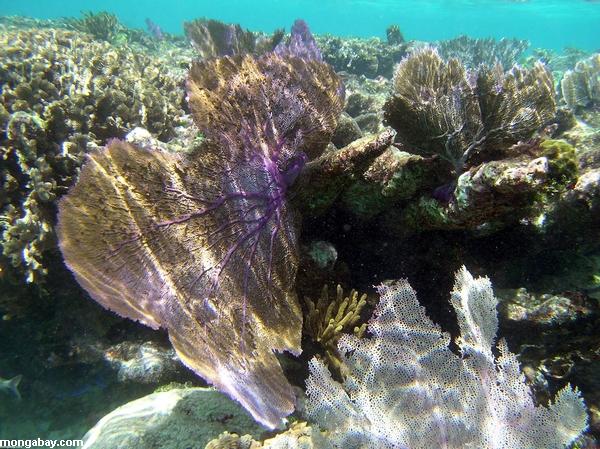
Sea fans on a coral reef off the coast of Mexico. Photo by: Rhett A. Butler.


Source: http://news.mongabay.com/2013/0820-hance-google-coral.html

New Books: Energy Balances of Non-OECD Countries -- 2013 Edition by IEA (Aug 2013)

Energy Balances of Non-OECD Countries -- 2013 Edition
554 pages, ISBN 978-92-64-17466-5, paper €120, PDF €96, CD-ROM €550 (2013)

More info about this titleType: Statistics Publication and CD-ROMs
Subject: Non-OECD Countries ; Statistics

Available now in PDF. The paper version and CD will be available end of August.

This volume contains data for 2010 and 2011 on the supply and consumption of coal, oil, natural gas, electricity, heat, renewables and waste presented as comprehensive energy balances. Data are expressed in thousand tonnes of oil equivalent, for over 100 non-OECD countries.

Historical tables summarise production, trade and final consumption data as well as key energy and economic indicators. These tables also include preliminary estimates of 2012 production (and trade when available) for natural gas, primary coal and oil. This book includes definitions of products and flows, explanatory notes on the individual country data and conversion factors from original units to energy units.

More detailed data in original units are published in the 2013 edition of Energy Statistics of Non-OECD Countries, the sister volume of this publication.


_____________________________________________________
In general the CD-ROM and on-line service contain detailed time-series back to 1971.
To order the on-line data service and find further information of coverage please consult http://data.iea.org

For more information: http://www.iea.org/W/bookshop/add.aspx?id=627

New Books: Energy Statistics of Non-OECD Countries -- 2013 Edition (Aug 2013)

Energy Statistics of Non-OECD Countries -- 2013 Edition
730 pages, ISBN 978-92-64-17459-7

Type: Statistics Publication and CD-ROMs
Subject: Non-OECD Countries ; Statistics
More info about this title
Available now in PDF. The paper version and CD will be available end of August.

This volume contains data for 2010 and 2011 on energy supply and consumption in original units for coal, oil, natural gas, electricity, heat, renewables and waste for over 100 non-OECD countries. Historical tables summarise data on production, trade, final consumption and oil demand by product. These tables also include preliminary estimates of 2012 production (and trade when available) for natural gas, primary coal and oil. The book also includes definitions of products and flows and explanatory notes on the individual country data and sources.

In the 2013 edition of Energy Balances of Non-OECD Countries, the sister volume of this publication, the data are presented as comprehensive energy balances expressed in tonnes of oil equivalent.

_____________________________________________________
In general the CD-ROM and on-line service contain detailed time-series back to 1971.
To order the on-line data service and find further information of coverage please consult http://data.iea.org

For more information: http://www.iea.org/W/bookshop/add.aspx?id=626