From Rio+20 to a New Development Agenda
Building a Bridge to a Sustainable Future
Routledge – 2014 – 264 pages
Description:
Twenty years after the United Nations Conference on Environment and Development, "The Earth Summit", the Rio+20 conference in 2012 brought life back to sustainable development by putting it at the centre of a new global development partnership, one in which sustainable development is the basis for eradicating poverty, upholding human development and transforming economies.
Written by practitioners and participants involved in the multilateral process of negotiations, this book presents a unique insider analysis of not only what happened and why, but also where the outcomes might impact in the future, particularly in the UN development agenda beyond 2015.
The book throws light on the changing nature of multilateralism and questions frequent assumptions on how policy is defined within the UN. It shows that Rio+20 was more than an international meeting; it represented a culminating point of decades of successes and failures and a watershed moment for seminal concepts, ideas and partnerships including the Green Economy, zero tolerance on land degradation, the introduction of Sustainable Development Goals, the creation of national measurements of consumption, production and well-being that are intended to go beyond GDP, the introduction of national green accounting and the commitment of billions of dollars for sustainable development partnerships, including Sustainable Energy for All.
The authors conclude by mapping out a new agenda for development in 2015, when the current Millennium Development Goals framework is due to expire. An agenda that will restore faith in the UN and inspire a global response to the demographic, economic and environmental challenges that will define our future in the decades to come.
Content:
Introduction
1. The Re-birth of Sustainable Development
President Lula da Silva’s & Brazil’s case for a Rio+20
The 2008 crisis as a catalyst for breaking the silos between development and sustainable development
The old order changes and the emergence of new players in the developing world
The science underpinning an integrated approach towards development
2. Chronicling the Key shapers of Rio+20
How was Rio+20 constructed
The formal preparations process and the lessons to be drawn
The political role of the UN Secretary-General
Innovative partnerships supporting Rio+20
The informal process in New York and its importance for consensus building
International meetings that gave Rio+20 a global impact
Stakeholders preparations and their growing influence in the policy definition process
The transition from the informal and the global to the textual of The Future We Want
Enabling UN leaders behind Rio+20
The Rio+20 Secretariat
3. How did it All Come to Happen?
The decisions that were required to start building a new development framework
Key divergences as the meeting started
The Group of developing countries too diverse to negotiate as a single block?
The European Union and Rio+20
The United States of America and Rio+20
A final push to conclude the process
No perfect outcome: the gaps in The Future We Want
4. Multiplying Commitments
Introduction
The stakeholder dialogue days
Voluntary commitments
National sustainable development councils and economic and social committees
Subnational and local government
Future Earth
Education and training
World Congress on Justice, Governance and Law for Environmental Sustainability
Initiatives on transparency and access to information
Sustainable Energy 4 All (SE4All) and commitments and achievements at Rio+20
Financial commitments
5. From Rio+20 to 2015 and the New Development Agenda
Was Rio+20 a failure or a success?
A new inspiring narrative: development for all within the limits of our planet
Institutions for a new development agenda
How can universal sustainable development goals build a single yet differentiated development agenda?
Resource mobilization and financing for sustainable development
A reformed Economic and Social Council and the High Level Political Forum
The UN Environment Assembly and a new governance model for environmental sustainability
The role of stakeholders in global policy making
Ahead of January 2016
Appendix I: Stakeholder Forum
Appendix II: Earth Negotiations Bulletin


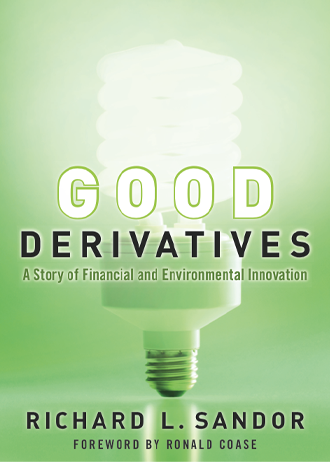 Through the eyes of an inventor of new markets, Good Derivatives: A Story of Financial and Environmental Innovation tells the story of how financial innovation – a concept that is misunderstood and under attack – has been a positive force in the last four decades. If properly designed and regulated, these “good derivatives” can open vast possibilities to address a variety of global problems. Filled with provocative ideas, fascinating stories, and valuable lessons, it will provide both an insightful interpretation of the last forty years in capital and environmental markets and a vision of world finance for the next forty years. Richard Sandor, widely regarded as the “father of financial futures” and named by TIME magazine as the “father of carbon trading”, will share his insights about market-based trading systems being a far more effective means of reducing pollutants than “command-and-control”.

 Posts
Posts


