Showing posts with label ecology. Show all posts

Friday, April 18, 2014

Book: Ecology and the Architectural Imagination (11 April 2014)

Ecology and the Architectural Imagination

By Brook Muller

Routledge – 2014 – 178 pages
Description:
By including ecological concerns in the design process from the outset, architecture can enhance life. Author Brook Muller understands how a designer’s predispositions and poetic judgement in dealing with complex and dynamic ecological systems impact the "greenness" of built outcomes. Ecology and the Architectural Imagination offers a series of speculations on architectural possibility when ecology is embedded from conceptual phases onward, how notions of function and structure of ecosystems can inspire ideas of architectural space making and order, and how the architect’s role and contribution can shift through this engagement. As an ecological architect working in increasingly dense urban environments, you can create diverse spaces of inhabitation and connect project scale living systems with those at the neighborhood and region scales. Equipped with ecological literacy, critical thinking and collaboration skills, you are empowered to play important roles in the remaking of our cities.
Content:
Preface Introduction Part 1: Ecological Architectures Within a Broader Context 1. Intensification 2. Commons 3. Ecosystem Models Part 2: Conceptual (Eco)Architectural Constructs 4. Metaphor and Respatialization 5. Bodies 6. Furnishings 7. Landscapes and Machines Part 3: EcoArchitectural Strategies and Orders 8. Networks 9. Assembling Context 10. Continuity of Singularities 11. Watermark Epilogue: Narrating Architectural Futures Bibliography Index
see more: http://www.routledge.com/books/details/9780415622752/

Tuesday, October 29, 2013

Vietnam Update: ASEAN urges more eco-system protection (8 Oct 2013)


ASEAN urges more eco-system protection Thứ ba, ngày 08 tháng 10 năm 2013 cập nhật lúc 15:49
ASEAN has called for more protection to be offered to critical ecosystems in the region in the face of increasing environmental fears.
The appeal was made at the fourth ASEAN Heritage Parks (AHP) Conference in Tagaytay city, the Philippines, which ran from October 1-4.

Over 300 delegates from all ten ASEAN member countries joined representatives of regional and international ASEAN has called for more protection to be offered to critical ecosystems in the region in the face of increasing environmental fears.
The appeal was made at the fourth ASEAN Heritage Parks (AHP) Conference in Tagaytay city, the Philippines, which ran from October 1-4.
Over 300 delegates from all ten ASEAN member countries joined representatives of regional and international organisations to discuss strategies improving the management of the AHP network and other protected reserves.
The fourth conference was part of ASEAN efforts to prevent environmental degradation while implementing protective measures in areas of high conservation.

ASEAN countries, which together house more than 1,300 protected reserves, have joined international efforts to improve the management of the reserves, especially the ASEAN Heritage Parks.

source from :

Wednesday, June 26, 2013

Study: Climate Change Threatens Many 'Safe Species' by International Union for the Conservation of Nature (IUCN) (26 Jun 2013)


Climate Change Threatens Many 'Safe Species'
2013-06-26

Most species of birds, amphibians and corals at greatest risk from climate change are not currently considered threatened with extinction and may be left out of conservation actions, according to a study released Monday.
Researchers from the International Union for the Conservation of Nature (IUCN) reported in the U.S. journal Plos One that they examined the findings of more than 100 scientists over the last five years and looked for the biological and ecological characteristics that make species more or less sensitive or adaptable to climate change.

Up to 83 percent of birds, 66 percent of amphibians and 70 percent of corals that were identified as "highly vulnerable to the impacts of climate change are not currently considered threatened with extinction" on the IUCN Red List of Threatened Species. They are therefore unlikely to be receiving focused conservation attention, according to the study.

"The findings revealed some alarming surprises," lead author Wendy Foden said in a statement.
"We hadn't expected that so many species and areas that were not previously considered to be of concern would emerge as highly vulnerable to climate change. Clearly, if we simply carry on with conservation as usual, without taking climate change into account, we'll fail to help many of the species and areas that need it most, " Foden said.
Up to 9 percent of all birds, 15 percent of all amphibians and 9 percent of all corals that were found to be highly vulnerable to climate change are already threatened with extinction. These species, which are threatened by unsustainable logging and agricultural expansion, need urgent conservation action in the face of climate change, according to the researchers.

The study also presented the first global-scale maps of vulnerability to climate change for the assessed species groups.

It showed that the Amazon hosts the highest concentrations of the birds and amphibians that are most vulnerable to climate change, and the Coral Triangle of the central Indo-West Pacific contains the majority of climate change vulnerable corals.
"This is a leap forward for conservation," said Jean-Christophe Vie, deputy director of the IUCN Global Species Program and a co- author of the study. "As well as having a far clearer picture of which birds, amphibians and corals are most at risk from climate change, we now also know the biological characteristics that create their climate change 'weak points.' This gives us an enormous advantage in meeting their conservation needs."

Source: http://english.mep.gov.cn/News_service/media_news/201306/t20130626_254363.htm

Sunday, May 19, 2013

Events: Who Will Feed Us in a Planet in Crisis? The Agro-ecological Answer organized by UNU-IAS on 27 May 2013


Monday, 27 May 2013, 14:30 - 16:30

Who Will Feed Us in a Planet in Crisis? The Agro-ecological Answer
Miguel A. Altieri
Professor of Agroecology, University of California, Berkeley

Venue: Meeting Room 1, UNU-IAS
Pacifico-Yokohama, 1-1-1 Minato Mirai
Nishi-ku, Yokohama


Event Description
"Greening" the green revolution will not be sufficient to reduce hunger and poverty and conserve biodiversity. The increasing cost of oil and fertilizers, and the deterioration of the climate and global ecology are key factors that undermine the capacity of humankind to feed itself. This phenomenon became evident when the "perfect storm" occurred in 2008 with the alarming rise in the cost of food that sent an additional 75 million people to the world’s line of hungry people.

Disregarding the above issues the ruling international agricultural elite continues asserting that food production will have to be increased by 70% by the year 2050. The threat to global food security is the direct result of the industrial model of agriculture characterized by large-scale monocultures tailored for the export markets. We need an alternative agricultural development paradigm that encourages more ecologically biodiverse, sustainable and socially just forms of agriculture.

There is a need for strategies that lead to the revitalization of small and medium sized farms, and point the way towards the reshaping of the entire agricultural policy and food system in ways that are economically viable to farmers and consumers. Currently proposed "sustainable intensification" in agriculture is ideologically buttressed by intellectual projects to reframe and redefine agroecology by stripping it of its political and social content and promoting the wrong notion that agro-ecological methods can co-exist alongside the aggressive expansion of transgenic crops and agrofuels. Many environmental and advocacy groups privilege those with access to capital and perpetuate an "agriculture of the poor for the rich". The technological determinism that the organic agriculture movement emphasizes, through development and dissemination of low-input or appropriate technologies, is not only naïve but also dangerous, as it assumes these technologies in themselves have the capability of initiating beneficial social changes.


Programme
14:30IntroductionRaquel Moreno-Peñaranda (Research Fellow, UNU-IAS/OUIK)
14:40 - 15:20
Who Will Feed Us in a Planet in Crisis?
Miguel A. Altieri (Professor of Agroecology, University of California, Berkeley)
15:20 - 15:30Comments from DiscussantClara I. Nicholls (Professor of Agroecology, Universidad de Antioquia (Colombia) and Lecturer, University of California, Berkeley)
15:30 - 16:15Q&A
16:15 - 16:25Closing Comments from DiscussantClara I. Nicholls (Professor of Agroecology, Universidad de Antioquia (Colombia) and Lecturer, University of California, Berkeley)
16:25 - 16:30Closing RemarksRaquel Moreno-Peñaranda (Research Fellow, UNU-IAS/OUIK)


Speaker's Biography

Miguel A. Altieri 
holds a BS in Agronomy from the University of Chile and a PhD in Entomology from the University of Florida. He has been a Professor of Agroecology at the University of California, Berkeley since 1981. Prof. Altieri has served as a Scientific Advisor to the Latin American Consortium on Agroecology and Development (CLADES) (Chile) – an NGO network promoting agroecology as a strategy for small farm sustainable development in the region. He also served for 4 years as the General Coordinator for the United Nations Development Programme's Sustainable Agriculture Networking and Extension Programme, which aimed at capacity building on agroecology among NGOs and the scaling-up of successful local sustainable agricultural initiatives in Africa, Latin America and Asia. In addition he was the chairman of the NGO committee of the Consultative Group on International Agriculture Research (CGIAR) whose mission was to make sure that the research agenda of the 15 International Agricultural Research Centers benefited poor farmers. Currently he is advisor to the FAO-GIAHS programme (Globally Important Agricultural Heritage Systems), a programme devoted at identifying and dynamically conserving traditional farming systems. He is also Director of the US-Brazil Consortium on Agroecology and Sustainable Rural Development (CASRD), an academic-research exchange programme involving students and faculty of UC Berkeley, University of Nebraska, UNICAMP and Universidad Federal de Santa Catarina (Brazil). He is also President of the Latin American Scientific Society of Agroecology. Prof. Altieri has authored over 250 publications, including widely used books: Agroecology: The Science of Sustainable Agriculture andPest Management in Agroecosystems and Agroecology and the Search for a Truly Sustainable Agriculture. Most of Prof. Altieri’s publications are available here.

Registration is free and open to the public. For further information, please contact UNU-IAS at unuias[at]ias.unu.eduor 045-221-2300.
For registration and more information: http://www.ias.unu.edu/sub_page.aspx?catID=8&ddlID=2610

Thursday, February 21, 2013

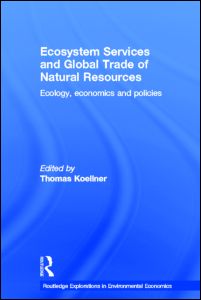
New Books:Ecosystem Services and Global Trade of Natural Resources Ecology, Economics and Policies Edited by Thomas Koellner (15 Feb 2013)


Ecosystem Services and Global Trade of Natural Resources

Ecology, Economics and Policies

Edited by Thomas Koellner

Published 15th February 2013 by Routledge – 292 pages
Description:
The utilization of natural resources to satisfy worldwide growing consumption of goods and services has severe ecological consequences. Aside from the projected doubling of food consumption in the next fifty years, the growing trade of biofuels and other commodities is a global challenge as the economic activities in the primary sector (i.e. mining, fisheries, aquaculture, forestry and agriculture) can damage biodiversity and ecosystem services. This should be taken into account in the decision-making affecting the global value chains linking consumer, retailer, processor, and producer in the North and the South.
To cover the topic of ecosystem services and global trade this book is organized into four major parts. Part 1 gives the theoretical framework from an ecological, economic and political perspectives. Part 2 explores how internationally traded biophysical commodities from agriculture, forestry and fisheries translates into a virtual flow of land, freshwater, and marine ecosystems. Part 3 describes how two widely used accounting tools (i.e., Life Cycle Assessment and Green National Accounts) deal with international aspects of ecosystem services, and Part 4 shows how instruments like labelling, bans, or payments for ecosystem services in the private and public sector can influence trade patterns and the management of ecosystem services.
This collection is a valuable contribution to the global change science dealing with ecosystem services. It illustrates the consequences of international trade on global ecosystem services and provides an overview of accounting tools and of market-based policy instruments to address negative and positive externalities. The book is certainly innovative, because it brings together research findings from distinct disciplines especially Industrial Ecology and Ecosystem Sciences, as well as Environmental Economics and Political Science.

Contents:
1. Ecosystem Services and Global Trade of Natural Resources: An Introduction Thomas Koellner

Part 1: Foundations for Understanding the Trade of Natural Resources and its Implication for Ecosystem Services

2. Global Human Dependence on Ecosystem ServicesJordan Levine and Kai M.A. Chan
3. Economics of Global Trade and Ecosystem ServicesDavid Zilberman
4. International Trade Policies and Ecosystem Services David Blandford
5. The Need for Global Governance of Ecosystem Services: a Human-Environment Systems Perspective on Biofuel Production Roland W. Scholz 
Part 2: Ecosystem impacts of global flows of virtual land, water and sea in the physical economy 6. Ecosystem Impacts of Virtual Land Use Embodied in Traded Goods and Services Thomas Koellner and Manel van der Sleen
7. Ecosystem Impacts of Virtual Water Embodied in Global Trade of Agricultural ProductsHong Yang, Jungo Liu, Alexander J.B. Zehnder, and Johan Rockström
8. Global Trade of Fisheries Products-implications for marine ecosystems and their services Lisa Deutsch, Max Troell, Karin Limburg and Miriam Huitric

Part 3: Accounting Tools for Global Ecosystem Services 
9. Life Cycle Assessment and Ecosystem Services Thomas Koellner, Stephan Pfister and Annette Koehler 10. Ecosystem Services in Green National Accounting Jean-Louis Weber 
Part 4: Instruments for Global Governance of Ecosystem Services
11. Fair Trade, Environmental Labels, Bans and Ecosystem Services Ulrike Grote and Pradyot R Jena
12. International Payments for Ecosystem Services: Principles and Practices Graciela Chichilnisky13. International Biodiversity Offsets Annah L. Peterson, Chloe Hill, Louise A. Gallagher
14. Landscape Labeling: Combining Certification with Ecosystem Service Conservation at Landscape Scales Jaboury Ghazoul 
Conclusion 15. Governance of Ecosystem Services in a World of Global Trade Thomas Koellner et al.


Sunday, December 2, 2012

BEC Workshop: "Ecology and Economy – Prosperity without Growth"


"Ecology and Economy – Prosperity without Growth" Workshop


Event Date:4 December, 2012 (Tuesday)
Event Time:9am to 5pm
Venue:Kadoorie Centre (Shek Kong), Seminar Room
Contact:Ms Anne Lam
Email:holisticedu@kfbg.org

Thursday, November 15, 2012

Chinese Updates: China Surveys Endangered Porpoises

China Surveys Endangered Porpoises
2012-11-13


Chinese scientists on Sunday launched a survey of endangered finless porpoises in the country's largest river Yangtze, amid worries that the freshwater mammal might be on the verge of extinction.

Consisting of researchers from the Ministry of Agriculture, the Chinese Academy of Sciences (CAS) and the World Wide Fund for Nature (WWF), the survey team set off in Wuhan, a central Chinese city along the Yangtze River.

The 40-day survey is the most comprehensive since 2006, when a survey found the population of finless porpoises down to 1,800 and pronounced the white-flag dolphin, a larger mammal native to the river, close to extinction.

There are probably only 1,000 finless porpoises in the Yangtze and two lakes linked to the waterway after continuous drops in the number, said Wang Ding, researcher from the Institute of Hydrobiology under the CAS.

"Finless porpoises may die out within 10 to 15 years, if strong measures are not taken," Wang warned.

The survey team will trace the porpoises using sonar system along the middle and lower reaches of the river, collecting data on the species' population, which will assist in the making of future protection policies.

The initial results of the survey will be published in December.

"As the flagship species in the Yangtze, finless porpoises are the barometer of the river's ecological conditions," said Wang Kexiong, deputy commander of the survey team.

"NOT OPTIMISTIC"

Scientists said the survey may not produce optimistic results, as human activities including illegal fishing, sand dredging and pollution have pushed the species to the brink of extinction.

In 2006, a similar survey found no white-flag dolphins along the Yangtze River, suggesting them as being "functionally extinct," which means the population is too small for the species' reproduction.

Both mammals were regarded as the symbol of the river, with groups of them seen swimming around ships, a demonstration of better river ecology back then.

Chinese scientists on Sunday launched a survey of endangered finless porpoises in the country's largest river Yangtze, amid worries that the freshwater mammal might be on the verge of extinction.

Consisting of researchers from the Ministry of Agriculture, the Chinese Academy of Sciences (CAS) and the World Wide Fund for Nature (WWF), the survey team set off in Wuhan, a central Chinese city along the Yangtze River.

The 40-day survey is the most comprehensive since 2006, when a survey found the population of finless porpoises down to 1,800 and pronounced the white-flag dolphin, a larger mammal native to the river, close to extinction.

There are probably only 1,000 finless porpoises in the Yangtze and two lakes linked to the waterway after continuous drops in the number, said Wang Ding, researcher from the Institute of Hydrobiology under the CAS.

"Finless porpoises may die out within 10 to 15 years, if strong measures are not taken," Wang warned.

The survey team will trace the porpoises using sonar system along the middle and lower reaches of the river, collecting data on the species' population, which will assist in the making of future protection policies.

The initial results of the survey will be published in December.

"As the flagship species in the Yangtze, finless porpoises are the barometer of the river's ecological conditions," said Wang Kexiong, deputy commander of the survey team.

"NOT OPTIMISTIC"

Scientists said the survey may not produce optimistic results, as human activities including illegal fishing, sand dredging and pollution have pushed the species to the brink of extinction.

In 2006, a similar survey found no white-flag dolphins along the Yangtze River, suggesting them as being "functionally extinct," which means the population is too small for the species' reproduction.

Both mammals were regarded as the symbol of the river, with groups of them seen swimming around ships, a demonstration of better river ecology back then.

Source:Xinhua
 
More information from:

Tuesday, June 26, 2012

The 4th Biennial Conference of the International Association for Ecology and Health: Sustaining Ecosystems, Supporting Health, 15 - 18 October 2012, China


The 4th Biennial Conference of the International Association for Ecology and Health: Sustaining Ecosystems, Supporting Health 


15th   to  18th October 2012
Kunming City, Yunnan, China

EcoHealth 2012 is for experts, practitioners, health leaders, policy makers, stakeholders & students globally who are interested in transdisciplinary approaches to health research conducted at the human-animal-ecosystem interface.

Organized by: International Association for Ecology and Health


Website: http://www.ecohealth2012.org/Default.aspx 

Tuesday, January 31, 2012

Second IPSI Global Conference in Nairobi, 13-14 March 2012

Date: 13-14 March 2012
Venue: Japan


The Second IPSI Global Conference will be organised in Nairobi, 13-14 March 2012. As described in the Operational Framework of the IPSI, the functions of the IPSI Global Conference are two-fold:

The IPSI Assembly – attended by the heads of member organisations or their nominated representative to review overall activities and take decisions on institutional matters.

The Public Forum – attended by all interested stakeholders (1) to strengthen collaboration and synergies among members as well as between the Satoyama Initiative and other relevant initiatives and programmes, and (2) to enhance understanding and raise awareness of the importance of socio-ecological production landscapes.

Tentative agenda, and details of this conference will be announced shortly.

For more informatio: http://satoyama-initiative.org/en/top-2/second-ipsi-global-conference-in-nairobi-march-2012-2/

Friday, December 2, 2011

Call for paper: International Seminar On GLOBAL ENVIRONMENTAL ISSUES: CHALLENGES TO INDUSTRY, ECOLOGY AND SOCIETY

Date: December 24-25, 2011

Venue

Snehangshu Kanta Acharya Institute of Law (SKAIL),
University of Kalyani Campus, Kalyani,
Nadia, W.B, India


The key note address will be delivered by
Prof. George James, University of North Texas

Sub-Themes

  • Global Environmental Problem: Issues and Challenges
  • Environmental challenges and society’s response.
  • Environmental challenges and ecological imbalance.
  • Corporate Policy and accounting measures to the environmental issues.
  • Climate change: Inter-play of natural and social scientific knowledge.
  • Contemporary Eco-critical Discourses.
  • Socio-legal Environmental Discourse.

Important Dates:

The last date for submission of full paper with the abstract 17-12-2011
Registration Deadline21-12-2011


For more information: http://www.irdf.in/seminar-and-conference

Thursday, November 24, 2011

Call for Paper: International Seminar on GLOBAL ENVIRONMENTAL ISSUES: CHALLENGES TO INDUSTRY, ECOLOGY AND SOCIETY

Date: December 24 -25, 2011
Venue: Snehangshu kanta Acharya Institute of Law (SKAIL)
             University of Kalyani Campus
             Kalyani, Nadia
             West Bengal, India

Organized by Integrated Research and Development Foundation (IRDF)


Call for Papers
'Conceptual and empirical papers are invited for presentation from academicians, research scholars, students, practitioners and industry representatives from various disciplines on any of the sub-themes mentioned above. The abstract (Maximum 300 words) and full papers (Maximum 3000 words) on the above mentioned topics should be submitted as e-mail attachment in MS WORD file (Font: Times New Roman, Size: 12pt., Spacing: 1.5, Margin: 1-inch on all side, Reference: in alphabetical order). In addition a hard copy of the above is to be sent by post. Both the abstract and the full paper should contain the title of the paper along with the name of the author(s), the address of the institution(s), and the e-mail ID(s). Accepted full papers will be published in the conference volume with ISBN number. In each technical session one paper will be selected for the “BEST PAPER AWARD”.'

The last date for submission (along with registration fee) of full paper with the abstract is 17 December, 2011.
Information about the acceptance or otherwise will be sent by E-mail only.
E-mail ID for sending Abstract and Paper:
irdf.mail@rediffmail.com
sudiptasarkar235@rediffmail.com

For more details: http://irdfblog.blogspot.com/

International Conference on Advances in Ecological Research


Date: 19-21 December, 2011
Venue: Maharaja Ganga Singh University


"The biological diversity, land cover, atmospheric composition, climate system etc., are altering at an unprecedented rate. It is critical to understand these interactions so that science can provide a foundation for environmental policy at local, national, and international levels. Losses of biodiversity and changes in ecosystem are some of the most vulnerable issues which need immediate attention. The organization of this Conference is a small step to show our concern towards the losses we are facing and the consequences we are experiencing every day. The gamut of subjects covered by the Conference is comprehensive and wide-scoped.

The Conference will have Plenary Sessions with Distinguished Speakers, Concurrent Technical Sessions on various Thematic areas with Keynote addresses, Selected Oral and Poster presentations."

Organized by Maharaja Ganga Singh University, Bikaner & Nature Conservators.

Official website of ICAER:http://icaer.ac.in/index.php