Sunday, August 25, 2013

Indian Updates: Exotic shark fins soup industry comes under environment ministry's radar (23 Aug 2013)

Exotic shark fins soup industry comes under environment ministry's radar


NEW DELHI: Exotic shark fins soup industry will have to observe certain dos and don'ts in India under a new government policy. Union environment ministry has prohibited "the removal of shark fins on board a vessel in the sea" so that the law enforcers can monitor illegal hunting of banned species of sharks.

The policy prescribes that any possession of shark fins that are not naturally attached to the body of the shark would amount to "hunting" of a Schedule-I (protected category) species which attracts punishment under the Wild Life(Protection) Act.

"The policy calls for concerted action and implementation by the concerned state governments through appropriate legislative, enforcement and other measures", said the ministry in a statement issued on Friday.

It said, "With a view to stop the inhuman hunting of sharks and to enable the enforcement agencies to monitor the illegal hunting/poaching of the species listed in Schedule-I, the environment and forest minister Jayanthi Natarajan has approved a policy for prohibiting the removal of shark fins on board a vessel in the sea".

Sharks, Rays and Skates play an important the role in maintenance of the marine ecosystem like tigers and leopards in the forests. India is known to be home to about 40-60 species of sharks.

However, the population of some of these has declined over the years due to several reasons including over exploitation and unsustainable fishing practices. Therefore, 10 species of sharks have been listed in the Schedule- I of the Wild Life (Protection) Act, 1972, in order to provide them the highest degree of protection.

"Due to high demand of shark fines in the shark fin-soup industry, it has been reported that the fins of the sharks captured in the mid sea are removed on the vessel and the de-finned sharks are thrown back in the sea to die a painful death.

"This has not only resulted in in-human killing of large number of sharks and in this process, but also has further decimated the population of listed species. This practice prevailing on board the shipping vessels has led to difficulties in enforcement of provisions of the law as it becomes difficult to identify the species of sharks from the fins alone, without the corresponding carcass, from which the fins have been detached", said the ministry.

Vietnamese updates: Vietnam initially succeeded in protecting the ozone layer (22 Aug 2013)


Vietnam initially succeeded in protecting the ozone layer 
Thứ năm, ngày 22 tháng 08 năm 2013 cập nhật lúc 00:07


September 16th every year is International Day for the Preservation of the Ozone Layer. In this day, the world reiterated the importance of ozone layer, the influence of people on the degradation of the ozone layer due to the emission of hazardous substances that cause ‘damage’ to fragile ozone layer in the upper atmosphere. Looking back the past, Vietnam has achieved remarkable success in the gradual restriction of the use of ozone depleting substances.
Protecting the ozone layer is the responsibility of mankind. Therefore, the leaders of the countries all over the world had a meeting in Montreal (Canada), 195/196 countries have agreed to participate in the Montreal Protocol 1997 to eliminate the use of chemicals to deplete the ozone layer. The current goal of Vietnam and countries participating in the Montreal Protocol on substances that deplete the Ozone Layer is to gradually eliminate the entire of ozone depleting substances such as CFC, HCFC, HFC (chemicals used in Cooling mechanism of conditioning equipment, air conditioning, etc.). These substances have the potential to cause global warming thousand times higher than CO2.
Although in January 1994, Vietnam participated in Montreal Protocol, until January 2010, there is no longer any business in Vietnam using CFC (the catalyst has high affection in breaking ozone molecules) in cosmetics production. Cooling and air conditioning industry also achieve positive results with an average reduction of 3.6 tons of CFC 11 per year in the textile industry, 5.8 tons of CFC-12 in air conditioning used in cars and 40 tons of CFCs in commercial refrigeration equipment and appliances, etc. Vietnam has completely eliminated the annual consumption of ozone depleting substances, with about 500 tons of CFCs and 3.8 tons of halons. With these achievements, Vietnam’s efforts and contribution in the implementation of Montreal Protocol have been recognized by ‘Environment Program’ of United Nations.
According to the Montreal Protocol, in 2013, Vietnam has only consumed HCFC HCFC at the basic line level (221.2 tons). From October 2015 to the end of 2019, it has to decrease by 10% compared to the basic line level , 35% from 2020 and completely eliminate in 2030. The industry of equipment repair and maintenance is allowed to use HCFC until 2040. To ensure the compliance with the limits to eliminate HCFCs according to the Montreal Protocol, with the support of the World Bank, Department of Meteorology, Hydrology and Climate Change (Ministry of Natural Resources and Environment) has completed the construction of the project ‘National Management Plan for eliminating HCFC substances of Vietnam’. The project’s phase 1 was approved by the Executive Committee of Multilateral Fund with the grant of $ 10 million USD, being implemented since 2012-2016. Phase 2 of the project will be constructed and called for financing by the Department of Hydrometeorology and Climate Change in collaboration with the World Bank and in 2015. It is estimated that Vietnam needs 20-25 million more to completely eliminate HCFC.
The responsibility of Vietnam in the next years is t9bcompletely eliminate HCFC consumption. This process can be extended to 2030. To achieve this objective, from now on, Vietnamese Government is calling for people to join hands to protect the ozone layer by changing consuming behavior. Do not use conditioners containing HCFC-22 coolant with low price. Instead, use HCFC-410a. When purchasing household products, especially the kind using in a spray bottle, consumers should find the kinds with the label of "no CFC ". When painting house, paint by brush or roller, do not use a spray. Reduce the use of plastic foam packaging. If available, take advantage of it for many times. Businesses should not install new equipment using HCFC, they should use advanced technology from the beginning to avoid technology transfer, which requires international roadmap that has been approved.
However, according to Mr. Nguyen Khac Hieu, Deputy Director of Department of Meteorology, Hydrology and Climate Change: If receiving the full support of finance and technology from international organizations, Vietnam will have completed eliminating HCFC in 2025.

Mai Chi
Source: 

Event: 2014 International Conference and Utility Exhibition on “Green Energy for Sustainable Development” organized by Asian Institute of Technology, Thailand from 19-21 Mar 2014

Clean Air Initiative

2014 International Conference and Utility Exhibition on “Green Energy for Sustainable Development”

2014 International Conference and Utility Exhibition on“Green Energy for Sustainable Development” is organized by the Asian Institute of Technology, Thailand will be held on 19-21 March 2014 at Jomtien Palm Beach Hotel and Resort, Jomtien, Pattaya City, Thailand.
In discussions of economic development, industrialization, modernization and urbanization are often in the equation. But as this generation being a product of past environmental transgressions, we are now all inclined to include environmental sustainability in the picture. We now not only refer economic development to quantitative and qualitative progress in the economy, community and society, but we now also consider the kind of natural environment we would be leaving for future generations. Industrialization, modernization and urbanization translate to an insatiable thirst for energy. But as demand for energy grows, so do the greenhouse gas emissions. If the aspiration of development is to raise living standards, provide proper access to modern energy services, more efficient use of energy to protect the global environment and ensure reliable energy supplies, then green growth must play a key role. Incorporating elements of low-carbon green growth in economic strategies that would cover technological, financial and investment aspects, as well as national and regional energy development policies geared towards achieving a sustainable green future has now become more important. A low-carbon based type of economy will help mitigate environmental pollution and CO2 emissions caused by fossil fuel use, help reduce reliance to dwindling fossil reserves, and encourage technological innovations.
This ICUE 2014 conference will be a venue to exchange research ideas, experiences, technical, social, financial, economic and policy issues covering greening energy utilization. Here, energy professionals, policy makers, researchers, members of the academe, engineers, members of the energy supply sector, etc., will have a platform to showcase research findings, technological innovations, transformative emerging technologies, and even to discuss burning global, regional and national issues in energy utilization for development and environment policies and programmes. In particular, the following topics will be featured:
ü Greening the Fossil Fuels
ü Renewable Energy
ü Electric Power Generation, Transmission and Distribution
ü Smart Grid and Renewable Energy Integration
ü Greening the Industrial Sector
ü Green Energy in Transport
ü Green Buildings and Infrastructures
ü Energy and Water Nexus
ü Energy and Health
ü Greening Urbanization and Urban Settlements
ü Green Policies and Programmes
ü MDGs and Green Energy Rural Development through Green Energy
ü Green Energy Education and Training
Important dates to remember are:
15 September 2013 : Due date of Abstract Submission
15 October 2013: Notification of Abstract Acceptance
20 December 2013: Due date of Full Paper Submission
15 January 2014: Due date of Early Registration
For further information, please contact:
ICUE 2014
Dr. Shobhakar Dhakal
Conference Director
School of Environment Resources and Development
Asian Institute of Technology
P.O. Box 4, Klong Luang, Pathumthani 12120
Thailand
Tel: (+662) 524-6216 and 524-5413
Fax: (+662) 524-5439
e-mail: icue@ait.ac.th
URL: www.icue2014.ait.asia or www.icue2014.ait.ac.th
Ms. Maria Kathrina B. Gratuito, Conference Secretariat, Email: icue@ait.ac.th
Persons Presenting and the files used for this event

New Books: Climate Change and Cultural Heritage A Race against Time By Peter F. Smith (22 Aug 2013)

Climate Change and Cultural Heritage

A Race against Time

By Peter F. Smith

Routledge – 2014 – 216 pages
Descriptions:
History reveals how civilisations can be decimated by changes in climate. More recently modern methods of warfare have exposed the vulnerability of the artefacts of civilisation. Bringing together a range of subjects - from science, energy and sustainability to aesthetics theory and civilization theory - this book uniquely deals with climate change and the ensuing catastrophes in relation to cultural factors, urbanism and architecture. It links the evolution of civilisation, with special emphasis on the dynamics of beauty as displayed in architecture and urbanism, to climate change. It then considers both the historic and predicted impacts of climate change and the threat it poses to the continued viability of human civilisation when survival is the top priority.
This book gives students, researchers and professionals in architecture and sustainable design as well as anyone interested in the threat of global warming to civilisation, new insights as to what could be lost if action is not taken at a global level.
Contents:
  1. Introduction: Bridging the Cultural Divide
  2. Goldilocks 
  3. The Evolution of Civilisation 
  4. The Dynamics of Climate Change 
  5. Climate and the Price of Progress 
  6. Predictions for the UK 
  7. The Race Against Time
  8. From Climate to Civilisation and the Principle of Harmony 
  9. Beyond the Maths 
  10. The energy Dilemma 
  11. Green Technologies - a sample 
  12. Access to Clean Energy 
  13. Carbon Dioxide Uncertainties 
  14. Nuclear Developments and Complementary Technologies 
  15. Essential Services Provided by Nature 
  16. China, on the Ascent 
  17. The Four Degrees Scenario

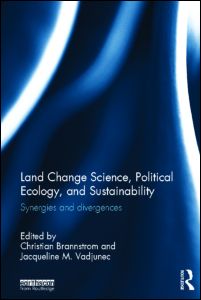
New Books: Land Change Science, Political Ecology, and Sustainability Synergies and divergences Edited by Christian Brannstrom, Jacqueline M. Vadjunec (22 Aug 2013)

Land Change Science, Political Ecology, and Sustainability

Synergies and divergences

Edited by Christian Brannstrom, Jacqueline M. Vadjunec

Routledge – 2013 – 266 pages
Descriptions:
Recent claims regarding conver
gence and divergence between land change science and political ecology as approaches to the study of human-environment relationships and sustainability science are examined and analyzed in this innovative volume. Comprised of 11 commissioned chapters as well as introductory and concluding/synthesis chapters, it advances the two fields by proposing new conceptual and methodological approaches toward integrating land change science and political ecology.
The book also identifies areas of fundamental difference and disagreement between fields. These theoretical contributions will help a generation of young researchers refine their research approaches and will advance a debate among established scholars in geography, land-use studies, and sustainability science that has been developing since the early 2000s. At an empirical level, case studies focusing on sustainable development are included from Africa, Central and South America, and Southeast Asia. The specific topics addressed include tropical deforestation, swidden agriculture, mangrove forests, gender, and household issues.

Contents:
Foreword
Andrew Millington
1. Notes for Avoiding a Missed Opportunity in Sustainability Science: Integrating Land Change Science and Political Ecology
Christian Brannstrom and Jacqueline M. Vadjunec
2. The Ghost of von Thünen Lives: A Political Ecology of the Disappearance of the Amazonian Forest
Robert Walker and Peter Richards
3. Forest Transitions in Southeast Asia: Synergies and Shortcomings in Land Change Science and Political Ecology
Guillaume Lestrelin, Jean-Christophe Castella and Jefferson Fox
4. Politicizing Land Use Change in Highland Madagascar: Struggles with Air Photo Analyses and Conservation Agendas
Christian A. Kull
5. Producing Biodiversity in Tanzania’s Mangrove Forests? A Combined Political Ecology and Ecological Resilience Approach to "Sustainably Utilized Landscapes"
Betsy A. Beymer-Farris
6. Gender, the Household, and Land Change in Southeastern Mexico
Claudia Radel, Birgit Schmook, and Crisol Méndez
7. Border Integrations: The Fusion of Political Ecology and Land Change Science to Inform and Contest Transboundary Integration in Amazonia
David S. Salisbury, Mariano Castro Sánchez Moreno, Luís Dávalos Torres, Robert Guimaraes Vásquez, José Saito Diaz, Pedro Tipula Tipula, Andrés Treneman Young, Carlos Arana Courrejolles, Martin Arana Cardó and the Grupo de Monitoreo de Megaproyectos Región Ucayali
8. Political Ecology and Land Change Science in the Study of Infrastructure Impacts: The Case of the Southwestern Amazon
Stephen G. Perz, Jane Southworth, Grenville Barnes, Youliang Qiu, Yibin Xia, Jing Sun, Karla Rocha
9. Deforestation and the World-as-Representation: The Maya Forest of Southern Belize
Joel Wainwright, Shiguo Jiang, and Desheng Liu
10. Shifting Spaces and Hidden Landscapes in Rural South Africa
Brian King
11. Political Ecology, Land Change Science and the Political Economy of Nature
Brent McCusker
12. The Intersection of Independent Lies: Land Change Science and Political Ecology
Rinku Roy Chowdhury
13. Two-Way Traffic across a Porous Border
Paul Robbins and B. L. Turner II

New Books: Environmental Economics An Integrated Approach By Philip E. Graves (21 Aug 2013)

Environmental Economics

An Integrated Approach

By Philip E. Graves

CRC Press – 2013 – 264 pages
Descriptions:
Rigorous, yet written in a way that facilitates 
understanding of sometimes difficult material, this book provides practical and working knowledge of how environmental policy analysis is conducted in the United States and, to a lesser extent, elsewhere. It details the tools required to conduct that analysis and also discusses weaknesses in the existing methods, underlining areas for future improvement. This approach allows readers to get a sense of what is known and what is not known about environmental economics.

Contents:
Basic Theory: Introduction. The Economy and the Environment: Uncontrolled Case. The Economy and the Environment: The Case of Optimal Controls. Alternative Regulatory Approaches. 
Physical Effects: Optimal Controls in Real-World Settings: General Considerations. The Physical Effects of the Various Residuals: Air. The Physical Effects of the Various Residuals: Water. The Physical Effects of the Various Residuals: Solid Waste and Hazardous Materials. 
Valuation of the Physical Effects: Overview of Valuation Methods. Environmental Valuation: Voting and Referenda. Environmental Valuation: Constructed Markets. Environmental Valuation: The Sum of Specific Damages Approach. Environmental Valuation: The Hedonic Method. Environmental Valuation: The Travel Cost Method. Do Decision-Makers "Care" about Efficiency and Equity? 
The Role of Time and Benefit-Cost Analysis: The Role of Time in Economics: Interest Rates, Compounding, and Discounting. Benefit-Cost Analysis.
Appendices.