Sunday, July 22, 2012

S. Korean Updates: APEC environment ministers to show expectation on GGGI’s role


APEC environment ministers to show expectation on GGGI’s role
Date2012.07.18


MINISTRY OF ENVIRONMENT REPUBLIC OF KOREA

2012 APEC, the three-day meeting of ministers responsible for the environment, ended on the 18th with a statement. The meeting was held on 16-18 July, in Khabarovsk, the Russian Federation. It was held in 15 years since the last meeting in 1997, in Toronto, Canada.

At the meeting, the attendees discussed about conservation of biological diversity, sustainable use of natural resources, water management, trans-boundary air pollution and climate change and green growth, emphasizing the necessity of joint cooperation among APEC region.

In the statement, chief delegate of Korea, Song Jae-yong, the head of the Environmental Policy Department of the Ministry of Environment, and the Korean delegation reflected the anticipation of Global Green Growth Institute (GGGI)’s role in assisting green growth of APEC economies. In the speech as the chief delegate, Song introduced Korea’s measures against climate change and green growth policies. He also stressed that GGGI will contribute in expansion of global green growth.

Refer to the attached for the ‘Statement of the 2012 APEC Meeting of Ministers Responsible for the Environment’.
2012 APEC Statement. pdf

Source: http://eng.me.go.kr/board.do?method=view&docSeq=10625&bbsCode=new_infocus&currentPage=1&searchType=&searchText=

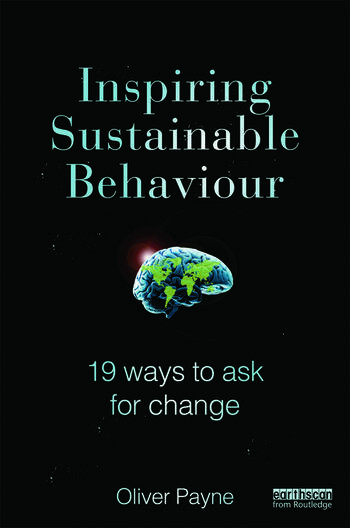
New Book: Inspiring Sustainable Behaviour - 19 Ways to Ask for Change by Oliver Payne


Inspiring Sustainable Behaviour - 19 Ways to Ask for Change
By Oliver Payne

Published 5th April 2012 by Routledge – 180 pages

Description

Large ImageWhat is the answer to inspiring sustainable behaviour? It starts with a question – or nineteen. With this simple and inspiring guide you'll learn how to ask for persistent, pervasive, and near-costless change by uncovering our hidden quirks, judgmental biases, and apparent irrationalities. The only change you'll need to make is how you ask.

Businesses, larger or small, will soon have to cut costs and cut carbon, irrespective of the products they sell, or the services they perform. National government has structural policy and legislative needs, and local government has implementation and documentation needs. Indeed, the new UK government coalition’s approach to transport is simply ‘cut costs and cut carbon’. Set against this there is an increasing sense that popular culture and popular science are congregating around a desire to understand who we are and how we behave. The recent rise of behavioural economics is a testament to this as well as the relevance of environmental psychology. Allied to this is a sense that big business is forging ahead with plans to account for and mitigate carbon emissions without the marketing and communications departments being able to help or communicate this effectively either through their own efforts or those of their communication agencies.

The ‘19 Different Ways to Ask for Change’ offer a solution to all these needs by pulling them together and showing that changing how we ask is near-costless, but its effects could be near-priceless. This book shows that simplification isn’t always the solution, an action can be the most successful question, and a default answer can be the most important. It explores why short-term memory tasks change our behaviour, how singing roads regulate speed, and that commitment gaps change outcomes; how our worry-profile is the same as an Argentinean farmer's, why knowledge of what kills you is irrelevant but asking about behaviour that kills is deadly, and what a chimpanzee’s tea-party tells us about the effect of ownership on decision-making.

This timely book will be of great value to scholars and practitioners whose work relates to reducing carbon emissions with a particular emphasis on environmental psychology, behavioural economics, project design, and psychology. It offers practical solutions for policy makers and professionals in marketing and communications departments.

For more details: http://www.routledge.com/books/details/9781849714006/

New Book: Decision-Making for a Sustainable Environment: A Systemic Approach by Chris Maser


Decision-Making for a Sustainable Environment: A Systemic Approach

Series: Social Environmental Sustainability
Published: August 07, 2012 by CRC Press - 304 Pages
Author(s): Chris Maser, Consultant, Corvallis, Oregon, USA

Features
Suggests new ways of thinking and problem solving
Decision-Making for a Sustainable Environment: A Systemic ApproachExplains the inviolable biophysical principles of sustainability in simple, clear language
Addresses the rules of social-environmental decision making and their complexity
Examines why and how environmental agencies become dysfunctional and environmentally degrading instead of environmentally protective and sustaining
Includes an in-depth case study and examples of decisions at the local, regional, and global scale

Summary
Increasingly, environmental decision making is like playing a multidimensional game of chess. With interactions between the atmosphere, the litho-hydrosphere, and the biosphere, the game is at once a measure of complexity, uncertainty, interdisciplinary acuity, social-environmental sustainability, and social justice for all generations. As such, it demands a systemic point of view. Decision Making for a Sustainable Environment: A Systemic Approach gives readers the tools to replace the dysfunctional, symptomatic decision making that has plunged the world into environmental crises with a systemic approach that fosters social-environmental sustainability.

A New Paradigm for Environmental Decision Making
Based on the author’s more than 45 years of research and broad, international experience, this book guides policy makers and managers to work with—rather than within—theoretical and methodological frameworks to achieve multidimensional and multilayered policy decisions. It discusses systemic thinking as a rational, viable alternative to competitive, materialistic, and symptomatic decision making.

Insights, Approaches, and Examples for Leadership
Organized into three parts, the book begins by describing the inviolable biophysical principles that define the limitations of human choices. The second part examines in depth why the conventional command-and-control form of decision making tends to become dysfunctional and fails. It also explains how to break the cycle of such behavior. A case study by Jessica K. La Porte explores the challenges of creating a program of environmentally sustainable decision making. The third part of the book explores what it takes to be a psychologically mature decision maker.

A Peaceful Path toward Social-Environmental Sustainability for All Generations
Proposing new ways of thinking and problem solving, this book provides readers with the ideas, language, approaches, and examples to move toward genuine social-environmental sustainability. It offers counsel on how to be a psychologically mature trustee of planet Earth and leave a more viable legacy for future generations.

For more details: http://www.crcpress.com/product/isbn/9781466552166

New Book: Environmental Decision-Making in Context: A Toolbox by Chad J. McGuire


Environmental Decision-Making in Context: A Toolbox

Published: April 25, 2012 by CRC Press - 205 Pages
Author(s): Chad J. McGuire

Features
Environmental Decision-Making in Context: A Toolbox* Presents a tool-based and process-focused approach to environmental decision-making
* Provides a substantial, holistic, interdisciplinary framework to inform decision-makers from a variety of backgrounds
* Focuses on science, economics, and values
* Takes a nuts and bolts approach to environmental problem solving
* Includes case studies, online problem sets, and instructor materials

Summary
Because of the complexity involved in understanding the environment, the choices made about environmental issues are often incomplete. In a perfect world, those who make environmental decisions would be armed with a foundation about the broad range of issues at stake when making such decisions. Offering a simple but comprehensive understanding of the critical roles science, economics, and values play in making informed environmental decisions, Environmental Decision-Making in Context: A Toolbox provides that foundation.

The author highlights a primary set of intellectual tools from different disciplines and places them into an environmental context through the use of case study examples. The case studies are designed to stimulate the analytical reasoning required to employ environmental decision-making and ultimately, help in establishing a framework for pursuing and solving environmental questions, issues, and problems. They create a framework individuals from various backgrounds can use to both identify and analyze environmental issues in the context of everyday environmental problems.

The book strikes a balance between being a tightly bound academic text and a loosely defined set of principles. It takes you beyond the traditional pillars of academic discipline to supply an understanding of the fundamental aspects of what is actually involved in making environmental decisions and building a set of skills for making those decisions.

For more info: http://www.crcpress.com/product/isbn/9781439885758

Thursday, July 19, 2012

New Book: Sustainable Solid Waste Management by Syeda Azeem Unnisa and S. Bhupatthi Rav


Sustainable Solid Waste Management


Published:July 01, 2012 by Apple Academic Press - 180 Pages 
Editor(s):Syeda Azeem Unnisa; S. Bhupatthi Rav


Sustainable Solid Waste Management

This book compiles many different treatment options and best practices for the treatment and recycling of municipal solid waste from all over the globe, factoring in cost-effectiveness, sanitation, and environmental degradation. Important to professors, researchers, students, policymakers, and municipal offices, this informed book looks into innovative waste management systems from a number of developing countries, which may prove useful to developed countries of the world as well. This book is unique in that it focuses on state-of-the-art urban solid waste management and future trends. 

For more info: http://www.crcpress.com/product/isbn/9781926895246;jsessionid=6dT7GZwzWAjyoO92isY+rg__

Wednesday, July 18, 2012

New Book: The Polluters - The Making of Our Chemically Altered Environment by Benjamin Ross and Steven Amter


The Polluters
The Making of Our Chemically Altered Environment
by Benjamin Ross and Steven Amter


ISBN13: 9780199930968
ISBN10: 0199930961
Paperback, 240 pages


The Polluters: The Making of Our Chemically Altered Environment

Description

The chemical pollution that irrevocably damages today's environment is, although many would like us to believe otherwise, the legacy of conscious choices made long ago. During the years before and just after World War II, discoveries like leaded gasoline and DDT came to market, creating new hazards even as the expansion and mechanization of industry exacerbated old ones. Dangers still felt today--smog, pesticides, lead, chromium, chlorinated solvents, asbestos, even global warming--were already recognized by chemists, engineers, doctors, and business managers of that era. A few courageous individuals spoke out without compromise, but still more ignored scientific truth in pursuit of money and prestige.

The Polluters reveals at last the crucial decisions that allowed environmental issues to be trumped by political agendas. It spotlights the leaders of the chemical industry and describes how they applied their economic and political power to prevent the creation of an effective system of environmental regulation. Research was slanted, unwelcome discoveries were suppressed, and friendly experts were placed in positions of influence, as science was subverted to serve the interests of business. The story of The Polluters is one that needs to be told, an unflinching depiction of the onslaught of chemical pollution and the chemical industry's unwillingness to face up to its devastating effects.

Features

  • Traces back the roots of current environmental problems and shows they were understood far earlier than most people believe and industry will admit
  • Demonstrates that many crucial decisions that allowed pollution were not caused by lack of knowledge or mistakes, but were the outcome of political conflicts in which economic interests prevailed
  • Reveals new documents showing that industries knew of toxic hazards long before the public


For more info: http://www.oup.com/us/catalog/general/subject/Chemistry/EnvironmentalChemistry/?view=usa&ci=9780199930968