Showing posts with label E-waste. Show all posts

Wednesday, February 12, 2014

Hong Kong News: Electronics recycling drive a success (4 Feb 2014)

Electronics recycling drive a success

February 04, 2014
Waste not want not
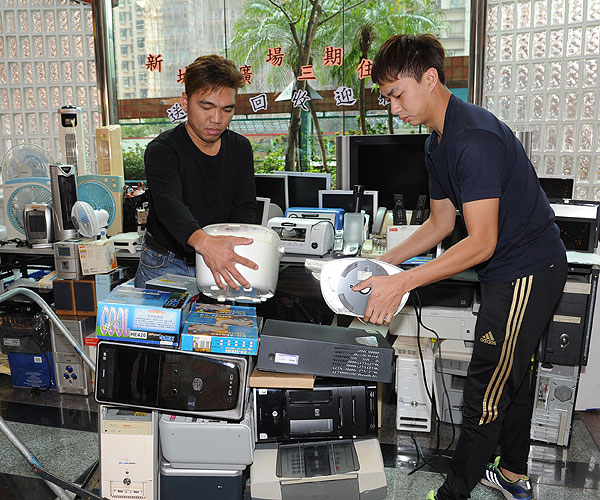
Waste not want not:  Used electrical and electronic equipment is collected for recycling in an Environmental Protection Department programme.

The Environmental Protection Department has collected more than 5,800 used computers and electrical appliances from 400 housing estates in a year-end recovery campaign.

Promoting the "Use Less, Waste Less” message, the items will be repaired and donated to those in need through the Caritas-HK Computer Workshop, St James' Settlement, and the WEEE Recycling Association.

A special Lunar New Year collection programme encouraged people to properly dispose of items like computers, rechargeable batteries, and fluorescent lamps and tubes.

Items that cannot be fully refurbished will be dismantled so their reusable components and materials can be recovered.

Click here for details. 

Wednesday, December 18, 2013

China News: Poor lead battery recycling raises fears (12 Dec 2013)

Poor lead battery recycling raises fears


The government should improve policies and formulate measures to better regulate the network for recycling lead-acid storage batteries, a major source of lead pollution, according to a policy research report released in Beijing on Wednesday.
"China is the biggest producer, consumer and exporter of lead-acid storage batteries in the world. More than 2.6 million metric tons of waste lead-acid storage batteries are generated in China every year, but less than 30 percent are reclaimed and processed under official standards," said Shen Xiaoyue, a senior engineer from the Policy Research Center for Environment and Economy, a think tank affiliated to the Environmental Protection Ministry and the main producer of the report.
The proportion of such batteries reclaimed in developed countries is usually more than 95 percent.
Lead that leaks into the environment without proper treatment poses significant health threats, especially to children, said Pan Xiaochuan, a professor at Peking University’s School of Public Health.
It can destroy children’s nervous systems, leading to cognitive problems, attention deficit disorder and anemia, said Pan.
At least 10 lead poisoning scandals took place across China from 2007 to 2009, with more than 6,000 children suffering excessive blood lead levels.
"A major source of lead pollution some 20 years ago in China was printing, but as the technology has upgraded, the contribution of waste lead-acid storage batteries has become increasingly prominent," Pan said.
Almost 900,000 tons of waste acid containing lead from lead-acid storage batteries entered the environment untreated from 2008 to 2012, polluting the air, water and soil, said Cao Guoqing, deputy secretary-general of the China Battery Industry Association.
There are already tight restrictions on the recycling, storage and disposal of lead-acid storage batteries, one of 49 types of hazardous waste under special regulation. However, poor management results in chaos in practice, the report said.
"Of the 40-some companies qualified to handle hazardous waste nationwide, only five are authorized to transport and dispose of waste lead-acid storage batteries," Cao said. "But more than half of the waste batteries go to illegal dealers, polluting the environment after they are dismantled haphazardly."
Yang Xiaoming, another senior engineer from the Policy Research Center for Environment and Economy, said the main problem is not the small number of legal recyclers, but the huge price difference between legal and illegal dealers, which prompts most waste batteries to be sold to the latter.
"The purchase price offered by illegal dealers can be as high as 7,000 yuan ($1,150) per metric ton, but if my price is higher than 4,000 yuan per ton, I’ll start losing money considering the 200-million-yuan investment I spent on equipment and running costs," said Wan Xuejie, deputy general manager of Shanxi Jitaly Science and Technology Co.
The company is one of the national pilot projects to promote standard recycling of waste lead-acid storage batteries.
The business of collecting waste batteries nationwide and recycling them remains unprofitable, said Wan.
Beijing Eco-island Science and Technology Co, the only qualified battery collector in Beijing, encounters similar problems.
Built to treat 20,000 tons of waste batteries a year, the company can only access 7,000 tons to recycle.
In March 2013, five ministries issued a document that said the rate of standardized recycling of waste lead-acid storage battery would reach 90 percent by 2015.
"With good policy guidance and a legal framework, achieving such a high rate is possible, when everybody in the system is better off. The system in China is not working for anyone right now except for those who operate illegally, so it’s time to act," said David Lennett, senior attorney of the Natural Resources Defense Council, an international environmental NGO headquartered in New York and the other producer of the report

Thursday, July 18, 2013

Call for paper: Apply by 31 July for December E-waste Academy in Switzerland


Apply by 31 July for December E-waste Academy in Switzerland

JULY 18, 2013     SWITZERLAND
The Sustainable Cycles (SCYCLE) operating unit of the United Nations University Institute for Sustainability and Peace will organize the fourth E-waste Academy – Scientists Edition (EWAS), under the aegis of the Solving the E-waste Problem (StEP) initiative. The 4th EWAS will be held in December in Switzerland,
The EWAS has, over its first three editions, brought together nearly 60 young researchers from around the world to look at solving the e-waste from different disciplinary perspectives. It has become the foremost forum available to young scientists to share their e-waste knowledge, interact with experts from academia, industry and the policy community, and develop collaborative partnerships.
The EWAS is open to PhD students, post-docs and early-career researchers from social and physical sciences who are investigating the political, social, economic, environmental, health or technological aspects of e-waste. The programme will include a mix of student presentations, expert lectures, workshops, group work and study tours.
Applications are now being accepted; the final deadline is 31 July 2013.
An application comprises a short (3- to 5-page) paper, a completed application form and a recent CV. To download the application form and paper template, please see http://www.step-initiative.org/index.php/ewas.html.
Topic areas will include (but are not limited to):
  • Transboundary e-waste flows, international e-waste governance
  • Legislation review, policy & regulatory approaches & tools; standards
  • Financing and business models; take back system design; reverse logistics
  • Design for Re-use and Recycling (DfR) / Eco-design; corporate social responsibility (CSR); extended producer responsibility (EPR)
  • Environmental & public health issues
  • Consumer recycling / reuse/ disposal behaviour; consumer awareness campaign design and communication; marketing
  • Technological developments in material recovery and disposal technologies; formal and informal recycling of e-waste;
  • Critical raw materials in e-waste
  • Modelling and forecasting methodologies
For more information, or to read about this and past years′ academies, please visit the EWAS website.

Tuesday, July 9, 2013

Chinese Updates: Plug the flow of e-waste (20 Jun 2013)

Plug the flow of e-waste

China Daily, June 20, 2013

That China has become the world's largest dump for electronic waste has underscored the urgent need to regulate its disorderly electronic waste processing and recycling market and plug the policy and legislation loopholes that have facilitated the inflows of e-waste.
According to a recent report co-drafted by the United Nations University and Tsinghua University, about 70 percent of the electronic waste generated worldwide, from scrapped televisions and refrigerators to computers and cell phones, ends up in China. A large portion of it is illegally transferred from the United States and elsewhere to China through ports or via Vietnam. Some e-waste also sneaks its way into the mainland through Hong Kong.
It is estimated that 3.62 million tons of e-waste were discarded in China in 2011. And considering the rapid increase in the consumption of electrical and electronic devices at home in recent years, as a result of improved living standards, the amount of e-waste that will need to be dealt with will further rise in the years to come.
A UN Environment Programme report in early 2010 warned that electronic waste comes with serious risks to the environment and human health unless proper disposal methods are employed.
However, due to a lack of suitable facilities, small and unlicensed workshops have so far played a major role in the processing and recycling of these huge amounts of e-trash. Without proper technologies, equipment and operating methods, disposal of electronic waste, which usually contains heavy metals such as lead and cadmium, is a health hazard to workers and a threat to the environment.
The recent exposure of rice with high cadmium content in Guangzhou, 400 kilometers away from Guiyu in Guangdong province, a town known as the e-waste capital, has raised concerns about e-waste's impact on food safety.
Facing the growing threat to the environment and public health from disorderly electronic waste disposal, the country should regulate e-waste processing and recycling, and increase funding and the technological input into the sector. The government should also work to raise public awareness of the risks involved in e-waste processing, and effective policy and legislation measures should be taken to halt the transfer of e-waste from other countries and regions.

Wednesday, May 29, 2013

Taiwan Updates: 環保署參與巴塞爾公約 展現廢電子電器回收成果 (28 May 2013)


環保署參與巴塞爾公約 展現廢電子電器回收成果
提供單位:行政院環境保護署廢管處
發布日期:2013.05.28

新聞圖片環保署派員參加5月3日至6日在瑞士日內瓦召開之巴塞爾公約第11次締約國大會(BC COP11),大會期間並積極參與友邦國布吉納法索及瓜地馬拉等2國舉辦之周邊會議,並於會中報告我國電子廢棄物管理成果(E-WASTE),獲得現場熱烈討論與一致好評。 

環保署說明,本次大會達成多項重要決議:一、通過有害及其他廢棄物之環境友善化管理架構。二、持續研擬電子廢棄物越境轉移技術指引。三、針對特定名詞如再使用、二手物品以及使用過物品等明確定義,以降低各國間的管理歧異。另因近年電子產品使用普及,汰換速度迅速,以致產生大量電子類廢棄物,為了解各國對該類廢棄物管理情形及公約未來發展趨勢,該署在2009年即加入巴塞爾公約「電腦設備夥伴計畫(PACE)」,並透過實際會議的參與及通訊會議的討論,使國內管理政策與國際接軌。 

環保署執行電子廢棄物回收,成效卓著。2011年電腦、電視機、電冰箱、洗衣機、冷(暖)氣機等13項廢棄物,約計回收580萬台,換算重量有11萬4,657公噸。統計每人每年回收量為4.94公斤,已超越歐盟2012年每人每年回收量4公斤的目標值。另2012年該署新增家電販賣業者須無償回收民眾汰換的電視機、電冰箱等家電,以提升民眾回收的便利性與習慣。透過資源回收系統的運作,國內產出的電子廢棄物大多已進入回收體系。

本次環保署除參與友邦國周邊會議外,並與日本、美國、及布吉納法索等國家代表,針對永續物料管理趨勢對於電子廢棄物輸出入政策影響、環保與海關部門間合作機制、特定有害廢棄物輸出入現況問題及其他環境議題進行會談,雙方在環保專業領域上進行實質交流,建立未來合作契機。 

環保署為妥善管理廢棄物及落實巴塞爾公約精神,已全盤檢討「廢棄物輸入輸出過境轉口管理辦法」、「有害事業廢棄物認定標準」、「禁止輸入之廢棄物種類」等相關規定,且為促進廢棄物源頭減量及循環利用,已草擬「資源循環利用法(草案)」,該署以務實的作為,堅守維護國民健康及環境保護的責任。 

For more information: http://ivy5.epa.gov.tw/enews/fact_Newsdetail.asp?InputTime=1020528150025

Monday, February 25, 2013

Pakistani Updates: Report Exposes Pakistani E-Waste Recycling Workers' Plight (21 Feb 2013)


Report Exposes Pakistani E-Waste Recycling Workers' Plight


Feb. 21, 2013 — A 6-year-old girl in a remote Pakistani village sits quietly in the family's kitchen, breathing toxic fumes that drift from across the table where her father is burning a computer circuit board. The scene is one of scores documented by researcher Shakila Umair, whose has compiled the first known evidence of horrifying conditions in the country's secretive e-waste recycling cottage industry.


After months in Pakistan gaining locals' confidence -- and even risking a confrontation with a local mob boss -- Umair is just beginning to get the ICT industry to pay attention to the problem. The PhD student from KTH Royal Institute of Technology in Stockholm presented her findings last week at the ICT for Sustainability conference in Zurich, which was attended by representatives from the public and private sector, as well as academia.
"This is the unfortunate reality for many people in Pakistan," says Umair, a native of Pakistan. "I have seen barrels of acid filled with disintegrating wires set just a few feet from where an entire family sleeps, and children playing in the soot left from people burning wires in the open air.
"The ICT industry could work with the Pakistani government to make the work safer, but the biggest problem has been the lack of documentation about the problem and its extent. So I hope this is an eye-opener for them."
Umair's social life cycle assessment documented hundreds of individuals, including adults and children, working without any protection from the dioxin, furans and other dangerous substances released as a result of the crude methods of manually dismantling discarded electronic devices and extracting precious materials. They work 12 hours shifts and are paid the equivalent of USD 2.70 per day, she says.
"Relatively small protective measures such as gloves and masks would easily make a big difference on the workers' health. But they cannot afford it themselves," she says. She also recommends making safety information available workers.
"The only time I saw someone using a mask was while dismantling printers," she says. "It was because of the toner. Unlike dioxin, it's visible. But it was a basic surgical mask that stops nothing.
"They are not aware of the toxins they are inhaling, and some of them are illiterate. They're unable to relate their illnesses to the work they do. I talked to people who said they felt uncomfortable physically, that they had trouble breathing. But they said they have no choice."
Stopping the flow of e-waste to Pakistan is not Umair's goal. "If it stops, their livelihood vanishes. I am from Pakistan and I would never want to see that happen," she says. Furthermore, she says some of the e-waste comes in the form of donations, which make it possible for many in Pakistan to get access to ICT tools that they otherwise couldn't afford.
Nokia's Sustainability Manager for Africa and the Middle East, Ulrike Vött, was one of those listening to Umair's presentation in Zurich. "With our Take back and awareness campaign involving media across Pakistan during 2011, we have started to try and find first ways of engagement -- with the aim of putting the topic onto the agenda," Vött says. "It is a long way to solving the e-waste problem. There are many other, governmental and non-governmental and industry groups working on this issue, and the picture is very complex indeed."
Photo: Shakila Umair presents her investigation of horrifying conditions in Pakistan's secretive e-waste recycling cottage industry. (Credit: Image courtesy of KTH The Royal Institute of Technology)
Source: 

Saturday, February 2, 2013

Taiwanese Updates: 環保署與業者攜手合作推動廢手機回收 (31 Jan 2013)

環保署與業者攜手合作推動廢手機回收
提供單位:行政院環境保護署廢管處
發布日期:2013.01.31

新聞圖片農曆春節將近,大掃除時發現的廢手機不知道該怎麼辦嗎?環保署持續與業者合作,提供免費回收手機服務。民眾除了可將廢手機、配件交給清潔隊資源回收車回收之外,也可交給大眾電信、中華電信、台灣三星(Samsung)、台灣大哥大、台灣樂金(LG)、台灣諾基亞(Nokia)、全虹、全家便利商店、宏碁(acer)、宏達電(HTC)、亞太電信、拓勤(G-Plus)、威寶電信、統一超商、愛買、索尼(Sony)、遠傳電信、震旦電信、燦坤、聯強等20家業者共1萬1千個以上門市回收。 

行動通訊產品更新速度快,廢棄量大且具回收再利用價值,環保署於95年公告廢手機為清潔隊資源回收項目、於97年增列手機充電器。該署並自98年起與手機製造業者、電信業者及行動通訊門市等業者簽署「廢行動通訊產品回收合作備忘錄」,擴大提供回收管道,免費回收民眾的廢手機及配件。廢手機及配件的回收量也逐漸提升,101年約共回436公噸,為95年回收量110公噸的3.9倍。

環保署呼籲民眾妥善回收廢手機,以促進資源循環再利用,同時也特別提醒民眾,交付回收前請先刪除個人資料,以降低個人資料外洩風險。回收點相關資訊,請上環保署廢行動通訊產品回收網(http://ivy2.epa.gov.tw/mobile/)查詢。

Saturday, January 26, 2013

Chinese Updates: Residents Near Chinese E-Waste Site Face Greater Cancer Risk (22 Jan 2013)


Residents Near Chinese E-Waste Site Face Greater Cancer Risk

Jan. 22, 2013 — Residents living near an e-waste recycling site in China face elevated risks of lung cancer, according to a recent study co-authored by Oregon State University researchers.

Electronic trash, such as cell phones, computers and TVs, is often collected in dumps in developing countries and crudely incinerated to recover precious metals, including silver, gold, palladium and copper. The process is often primitive, releasing fumes with a range of toxic substances, including polycyclic aromatic hydrocarbons, or PAHs, a group of more than 100 chemicals.
PAHs, many of which are recognized as carcinogenic and linked to lung cancer when inhaled, were the focus of the study. Over the course of a year, researchers collected air samples from two rooftops in two areas in China.
One was in a rural village in the southern province of Guangdong less than a mile from an active e-waste burning site and not surrounded by any industry. The other was Guangzhou, a city heavily polluted by industry, vehicles and power plants but not e-waste.
The scientists concluded that those living in the e-waste village are 1.6 times more likely to develop cancer from inhalation than their urban-dwelling peers.
"In the village, people were recycling waste in their yards and homes, using utensils and pots to melt down circuit boards and reclaim metals," said Staci Simonich, a co-author of the study and a professor of environmental and molecular toxicology at OSU. "There was likely exposure through breathing, skin and food -- including an intimate connection between e-waste and the growing of vegetables, raising of chickens and catching of fish."
The researchers estimated that of each million people in the e-waste area, 15 to 1,200 would develop lung cancer on account of PAHs over their lifetimes, while the likelihood in the city is slightly lower at 9 to 737 per million. These approximations do not include lung cancer caused by smoking.
The study also found that the level of airborne carcinogenic PAHs exceeded China's air quality standards 98 percent of the time in the e-waste area and 93 percent of the time in the city.
The study was published in the journal Environmental Science and Technology. The OSU Superfund Research Program provided assistance for the study. The National Institute of Environmental Health Sciences (NIEHS) and the National Institutes of Health (NIH) provided funding for the study. Eight researchers collaborated on the project, including OSU graduate student Leah Gonzales and scientists from China.


Photo:
Chemist Staci Simonich examines a vial containing air pollutants at her lab at Oregon State University. She co-authored a study that found that residents in an rural Chinese village near an electronic waste dump are 1.6 times more likely to develop lung cancer than their peers in the heavily polluted Chinese city of Guangzhou. (Credit: Photo by Tiffany Woods)

Source:
http://www.sciencedaily.com/releases/2013/01/130123101615.htm?utm_source=feedburner&utm_medium=feed&utm_campaign=Feed%3A+sciencedaily%2Fearth_climate%2Fair_quality+%28ScienceDaily%3A+Earth+%26+Climate+News+--+Air+Quality%29