Showing posts with label food. Show all posts

Saturday, September 28, 2013

Lecture by HKU: SERVICE 100 Lecture Series - Food (25 Sep, 29 Oct, 6 Nov and 20 Nov, 2013)

The University of Hong Kong
Sustainability@HKU

SERVICE 100 Lecture Series - Food

SERVICE 100 Lecture Series - Food

Introduction

Poverty and Food Budget, GROW a Fairer Global Food System, Feeding Hong Kong to Fight Hunger and Food Waste, Eating Green can Solve World Hunger?
Date:
25 Sep 2013 ,29 Oct 2013 ,06 Nov 2013 ,20 Nov 2013
Lecture 1: Poverty and Food Budget
Date: 25 September, 2013 (Wed)
Time: 6:30 p.m. to 7:30 p.m.
Venue: T5, Meng Wah Complex, HKU
Speaker: Dr. Stephen Frederick Fisher, Director General of Oxfam Hong Kong
Language: English
Lecture 2:  GROW a Fairer Global Food System
Date: 29 October, 2013 (Tue)
Time: 6:30 p.m. - 7:30 p.m.
Venue: LE3, Library Extension, HKU
Speaker: Ms Kalina Tsang, Senior Manager, Hong Kong Programme Unit, Oxfam Hong Kong
Language: English
Lecture 3: Feeding Hong Kong to Fight Hunger and Food Waste
Date: 6 November, 2013 (Wed)
Time: 6:30 p.m. - 7:30 p.m.
Venue: LE3, Library Extension, HKU
Speaker: Ms. Gabrielle Kirstein, Executive Director, Feeding Hong Kong
Language: English
Lecture 4: Eating Green can Solve World Hunger?
Date: 20 November, 2013 (Wed)
Time: 6:30 p.m. - 7:30 p.m.
Venue: T6, Meng Wah Complex, HKU
Speaker: Mr. David Yeung, Co-Founder, Green Monday
Language: English
For details of SERVICE 100 Lecture Series, please visit: http://cedars.hku.hk/SERVICE100Lectures.
For details of SERVICE 100 Workshop Series, please visit: http://cedars.hku.hk/SERVICE100Workshops.
Enquiries:cedars-programmes@hku.hk/ 2857 8387
For more information: http://www.sustainability.hku.hk/news-event/detail/service-100-lecture-series-food

Wednesday, September 25, 2013

Publications: Thinking about Water Differently: Managing the Water–Food–Energy Nexus by ADB (Sep 2013)

Thinking about Water Differently: Managing the Water–Food–Energy Nexus

Date:September 2013
Type:Guides
Subject:
ISBN:978-92-9254-252-8 (print), 978-92-9254-253-5 (web)
Price:US$18.00 (hard copy)


PURCHASE PUBLICATION

DOWNLOAD FOR FREE

Description

The water-food-energy nexus is emerging as a critical issue in Asia and the Pacific. It is clear that solutions must be found to assure water security, thereby eliminating the immediate--and increasing--risk to food security, energy security, and economic growth and stability: water must be recognized as an economic as well as a social good. Governments need to be encouraged to think differently about water, take the longer-term view, and be mindful of the strategic and economic value of this limited resource.
This publication is the result of a scoping study initiated by the Asian Development Bank to better understand the issues associated with the water-food-energy nexus in Asia and the Pacific. It provides high-level guidance on the choices available to address the region's water security issues.

ADB and water

Some strategic thrusts likely to be promoted by ADB in the water sector include the following:

Asian Water Development Outlook 2013: Measuring Water Security in Asia and the Pacific
  1. Reforming water governance. Through advocacy at global, regional, and national levels, demonstrate convincingly to developing members the critical need to manage water differently, assigning its strategic and vital value in allocation and trade-offs, and to amend governance structures and procedures accordingly;
  2. Data and information. Support developing members in generating reliable data on the availability and behavior of water resources, in particular, groundwater. Make information on all aspects of water security accessible and place them into the public domain, including possible measures to deal with water scarcity;
  3. Resource protection. Support developing members in more effective reduction of wastewater and other waste discharging into freshwater supplies through regulation, investment, and innovation;
  4. Water for food. Stimulate research into improving the use of water in agriculture, increasing food production on the same area of land, and using less water; and
  5. Increasing storage. Promote increases in strategic storage, including aquifer recharge, in response to uncertainties in supply, aggravated by climate change.

Contents

  • Executive Summary
  • Background
  • Water Security in the Face of Water Scarcity
  • The Water–Food–Energy Nexus
  • New Water Accounting
  • Emerging Opportunities
  • The Potential Response
  • References
For more information: 

Tuesday, September 24, 2013

Events: First International Conference on Global Food Security 29 Sep - 2 Oct 2013


Event


First International Conference on Global Food Security


The First International Conference on Global Food Security aims to explore the economic, social, biophysical, technological and institutional drivers of current and future global food security. The topics list includes, inter alia: enabling trade and market policies for local and global food security; sustainable intensification of food production systems; novel ways of feeding 9 billion; land sparing, land sharing and trade-offs; agricultural production as feedstock for renewables; lost harvest and wasted food; nutritional security; and labelling, certifying and striving for quality and sustainability of food production. 


dates: 29 September - 2 October 2013   
location: Noordwijk, Netherlands   

Sunday, September 15, 2013

Study: FAO Assesses Food Waste Impacts on Land, Climate, Water and Biodiversity by FAO (11 Sep 2013)

FAO Assesses Food Waste Impacts on Land, Climate, Water and Biodiversity

FAO11 September 2013: The Food and Agriculture of the UN (FAO) has released a study documenting the environmental impacts of global food wastage as well as its direct economic impacts, which it reports add up to $750 billion annually.

The study provides a global account of the environmental footprint of food wastage (both food loss and food waste) along the food supply chain, focusing on impacts on climate, water, land and biodiversity. It includes a tool-kit that documents how food loss and waste can be reduced. FAO stresses the moral issue of 870 million people going hungry while 1/3 of all food produced goes to waste.

The study indicates that food waste is responsible for 3.3 billion tons of greenhouse gas (GHG) emissions, making food wastage rank as the third top emitter, after the US and China. It notes that 54% of wastage occurs during production, post-harvest handling and storage, and 46% of wastage occurs during processing, distribution and consumption, with production losses occurring most in developing countries, and consumption losses highest in high and middle income countries.

Hotspots of food wastage identified in the report are: wastage of cereals in Asia, with impacts on carbon, blue water and arable land; wastage of meat in high income regions and Latin America; fruit wastage with blue water impacts in Asia, Latin America, and Europe; and vegetables wastage in industrialized Asia, Europe, and South and South East Asia, with a high carbon footprint.

The study calls for reducing food wastage through better planning and addressing post-harvest loss, as well as by finding secondary markets and diverting excess food to livestock feed. The UN Environment Programme (UNEP) is a partner of the FAO in the Think Eat Save-Reduce Your Foodprint campaign. 


For more information: 
http://climate-l.iisd.org/news/fao-assesses-food-waste-impacts-on-land-climate-water-and-biodiversity/214724/

Wednesday, September 11, 2013

UN food agency: 'One third of food wasted, costs world economy $750 bn' (11 Sep 2013)

'One third of food wasted, costs world economy $750 bn'
Last Updated: Wednesday, September 11, 2013, 19:56


Rome: One third of the food produced worldwide is wasted, costing the global economy around USD 750 billion a year, a new report by the UN food agency said on Wednesday.

The Rome-based Food and Agriculture Organisation (FAO) said some 1.3 billion tonnes of food are wasted every year, with the Asia region including China seen as the worst culprit.

The food agency's director general, Jose Graziano da Silva, told a press conference that in total, "one third of the food produced today is lost or wasted... Equivalent to the Gross Domestic Production (GDP) of Switzerland."

Achim Steiner, head of the United Nations Environment Programme (UNEP), described it as "a staggering phenomenon."

"This is a big wake up call. We may not even have captured many of the more indirect impacts of food waste... and the costs which will be borne by our children and grandchildren," he told the joint press-conference.

"It will take less than 37 years to add another two billion people to the global population. How on earth will we feed ourselves in the future?" he asked.

Steiner said that eliminating food wastage had "enormous potential" to reduce hunger and called on citizens to take individual action to tackle the issue.

"Each one of us has a role to play. Starting with the ridiculous phenomenon in wealthy countries of not buying crooked vegetables anymore," he said, adding that over-zealous observation of sell-by dates was also leading to huge quantities of food being thrown away.

High-income countries waste during the food consumption phase, while developing countries are losing food during production, the FAO said.

The report fingered Asia in particular, saying that over 100 kilos (221 pounds) in vegetables per capita are wasted every year on average in "Industrialised Asia", a region including China, Japan and South Korea.

It estimated that the region also wastes 80 kilos of cereals, mainly rice per person, warning that rice cultivation was also high-intensity in carbon and had emerged as "a significant environmental hotspot".

Wastage of vegetables in Asia occurred "during agricultural production, post-harvest handling and storage, and consumption phases," the FAO said.

Other key areas identified in the report in terms of waste and environmental impact were the meat industry in North America and Latin America, as well as fruit wastage in Asia, Europe and Latin America.

Produced but uneaten food occupies 30 percent of the world's farmland, the report said.

"Food wastage reduction would not only avoid pressure on scarce natural resources but also decrease the need to raise food production" to meet the demands of a fast-growing world population, it said. 

AFP

Source: 
http://zeenews.india.com/business/news/companies/one-third-of-food-wasted-costs-world-economy-750-bn_83766.html

Sunday, August 18, 2013

Singaporean Updates: New ‘Singapore Standard’ Provides Guidelines To Help Caterers Prevent And Reduce Food-Borne Hazards (16 Aug 2013)


News Releases

New ‘Singapore Standard’ Provides Guidelines To Help Caterers Prevent And Reduce Food-Borne Hazards

Singapore Standard to provide comprehensive guidance to caterers on how to implement a Food Safety Management System in a cost-effective manner
JOINT NEWS RELEASE BETWEEN NEA, SINGAPORE STANDARDS COUNCIL  AND SINGAPORE MANUFACTURING FEDERATION
Singapore, 16 August 2013 – The National Environment Agency (NEA) today announced a new Singapore Standard on food safety management for food service establishments. This follows NEA’s earlier announcement at the 2013 Committee of Supply (COS) debates of new measures to ensure the hygienic preparation of food by caterers[1].
2          Developed by NEA and the Food Standards Committee[2], the Singapore Standard will provide comprehensive guidance to caterers on how to put in place a Food Safety Management System (FSMS) in a cost-effective manner. A properly implemented FSMS can help caterers to systematically identify, prevent and reduce food-borne hazards at every stage of the food storage, preparation, cooking, and delivery process. Hygiene lapses and non-compliance with proper food safety practices can be easily identified and corrected as the system requires documentation of processes during operations and regular auditing by supervisory staff.
3          NEA has also worked with the Singapore Workforce Development Agency (WDA) to provide caterers with training to design and implement an FSMS plan suitable for their operations. Caterers will be required to have at least one staff, preferably in-charge of day-to-day operations, undergo training in FSMS planning and execution. The two-day training programme which consists of theory and on-site assessment at the caterer’s premises will help each caterer develop an FSMS plan tailored to its operations. Course fees are subsidised up to 90% for SMEs. WDA-accredited training companies will run the course starting from January 2014.
4          NEA’s hygiene officers will check on the proper practice of the FSMS regime during our inspections of caterers. Officers will focus on the pre-requisite programmes, for example, a daily regime to monitor food handlers’ practices during food preparation, screening of staff to ensure those who are unwell are not handling food and cross-contamination prevention procedures and critical food hazard control points identified in the FSMS such as proper temperature of stored and cooked food.
5          NEA will continue to work with the Association of Catering Professionals to support the catering industry’s efforts to improve their food safety management procedures and practices to meet the new requirements. The industry has been consulted on the new FSMS requirement and will be updated on the training component including course fees and course dates by October 2013.
 6          Mr Derek Ho, Director-General of Public Health at NEA said, “The FSMS will help caterers to prevent and reduce common critical hazards likely to occur in the preparation and service of food and beverages.  However, proper implementation of FSMS can be challenging and this is where the Singapore Standard is designed to help. With these guidelines, caterers can easily identify all the critical food hazard risks in their day to day operations and put in place the necessary control measures.”
7          Mr Ho added, “Importantly, the FSMS allows caterers to have closer supervision of daily food safety practices and to correct deviations promptly, addressing weak links in their system which will help to prevent incidents of food poisoning.” 
8         “Increasing public expectation and awareness of the issue of food safety has heightened the need for companies to adopt food safety management systems to ensure that food prepared and served is safe for consumption. The interaction among food practitioners, industry experts at SMF-SDO and regulatory authorities has helped to shape the Singapore Standard and ensure its relevance to the F&B industry,” added Mr Tan Khieng Sin, Chairman of Food Standards Committee.
9          “The launch of Singapore Standard 583: 2013 Guidelines on Food Safety Management for Food Service Establishments is a significant development on food safety management. We must always remain vigilant to ensure that food safety standards are met. The Food Standards Committee has put in much effort to develop the guidelines. The new requirements by NEA will lead to the widespread practice of food safety standards at every step of the catering process, benefiting many consumers”, said Mr Tay Jih-Hsin, Chairman of the Singapore Manufacturing Federation Standards Development Organisation (SMF-SDO).

[1] NEA announced at the 2013 COS debates that from 1 June 2014, new caterers will need to have in place a Food Safety Management System (FSMS) within three months of getting an NEA licence to operate a catering business. Existing catering licensees are required to submit an FSMS plan three months before their next licence renewal date, starting with licences expiring from 1 September 2014.
[2] Managed by the Singapore Manufacturing Federation Standards Development Organisation (SMF-SDO), the Food Standards Committee comes under the purview of the Singapore Standards Council.
~~ End ~~
For more information, please contact

Call Centre: 1800-CALL NEA (1800-2255 632)
Email: Contact_NEA@nea.gov.sg
For more information: 
http://app2.nea.gov.sg/corporate-functions/newsroom/news-releases/new-singapore-standard-provides-guidelines-to-help-caterers-prevent-and-reduce-food-borne-hazards

Thursday, August 1, 2013

Events: IN BEIJING: Global Choke Point: Water-Energy-Food Confrontations in the World’s Two Largest Economies organized by the Wilson Center on 7 Aug 2013

Events

IN BEIJING: Global Choke Point: Water-Energy-Food Confrontations in the World’s Two Largest Economies

August 07, 2013 // 2:00pm — 4:30pm


NOTE: This meeting will be held in Beijing
LOCATION: Room 127, Leo KoGuan Building, Peking University School of Government - Beijing, China
Three colliding trends — declining freshwater reserves, uncertain grain supplies, and booming energy demand — are disrupting economies, governments, and environments around the world. Unlike food or energy, we cannot grow or easily produce more water. That is especially true in the era of climate change, when deeper droughts and terrible floods tighten the food and energy choke points are already caused by waste, pollution, and mismanagement of water.
These complex challenges demand integrated analyses and innovative solutions. For three years research teams from the Woodrow Wilson Center and Circle of Blue have been reporting from the United States, China, Australia, India, and the other frontlines of the world’s water-food-energy crisis. In our Choke Point: China reports we were the first to find that China's northern desert provinces, which supply 70 percent of the nation's coal and 20 percent of its grain, would run out of water by the end of this decade if conventional farm and energy production practices did not change. Our Choke Point: U.S. work is examining some of the risks of energy development in the United States, like shale gas boom, which uses significant amounts of water and are developing in both important grain-growing states and some of the nation's driest regions.
Building on our Choke Point research in the United States and China, the Wilson Center’s China Environment Forum partnered with the Beijing-based Greenovation Hub to organize a diverse group of U.S. and Chinese experts into a China Water-Energy Team (China WET). The team is holding roundtable discussions in Beijing the week of August 5, 2013 with the goal of gathering information and data to identify research, legal, policy, and NGO priorities for China to begin dealing with water-energy confrontations and to explore opportunities for further U.S.-China cooperation on these issues.
At this workshop at Beijing University our Chinese and U.S. China WET members will be joined by Dr. Paolo Farah to delve into the water-energy challenges facing China and the United States, looking at risks and opportunities to build resilience to deal with these growing natural resource confrontations.
 
Event Documents: 
BACK TO TOP
 
Event Sessions: 
  • Short keynote: Global Choke Point
  • Keith Schneider, Circle of Blue

Panel 1: Water-Energy Confrontations in the United States
  • Vince Tidwell, Sandia National Laboratory
  • Pam Bush, Delaware River Basin Commission 
  • Q&A

Panel 2: Solving China’s Water-Energy Nexus Challenges
  • Jia Shaofeng, Institute for Geographic Sciences and Natural Resources Research—
  • Sun Qingwei, Greenpeace China
  • Yang Fuqiang, Natural Resources Defense Council
  • Q &A

Panel 3: Climate Change, Energy Security and Water Wrap Up Panel

Sunday, June 30, 2013

Publications: FAO Statistical Yearbook Highlights Food Production’s GHG Emissions (19 Jun 2013)


News


FAO Statistical Yearbook Highlights Food Production’s GHG Emissions


FAO19 June 2013: The Food and Agriculture Organization of the UN (FAO) has released its Statistical Yearbook for 2013, which provides a lens into agriculture's contribution to climate change, natural resource management, and food security.

The Yearbook covers the following topics: capital and investment; climate change; food availability; food production and trade; food prices; hunger and malnutrition; the consequences of political instability and natural- and human-induced disasters on food security; the state of the agricultural resource base and sustainability; and environmental impacts.

It notes that greenhouse gas (GHG) emissions from the agriculture sector have grown 1.6% per year since 2000, equivalent to 10% of anthropogenic emissions. It indicates that livestock and fertilizer are the two greatest contributors to emissions in the sector.

The Yearbook also highlights that 12% of the global population was undernourished in 2010-2012, and that global crop production has tripled over the past 50 years. It further underscores the increase in agricultural research and development investments. [Publication: FAO Statistical Yearbook 2013] [FAO Press Release]


For more information: 

Research: Growth in crop yields inadequate to feed the world by 2050 (20 Jun 2013)

Growth in crop yields inadequate to feed the world by 2050 – research

Agriculture productivity not rising fast enough to meet the needs of a rapidly growing population
Thursday 20 June 2013 17.21 BST guardian.co.uk,
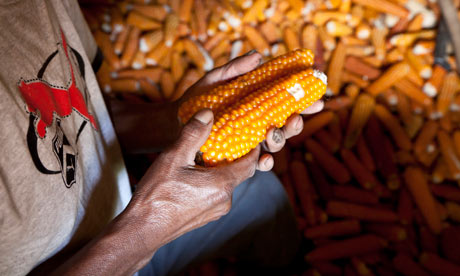
Maize : Close up of the hands of a male Mayan, Guatemalan farmer holding corn or maizeIf the world is to grow enough food for the projected global population in 2050, agricultural productivity will have to rise by at least 60%, and may need to more than double, according to researchers who have studied global crop yields.
They say that productivity is not rising fast enough at present to meet the likely demands on agriculture.
The researchers studied yields of four key staple crops – maize, rice, wheat and soybeans – and found they were increasing by only about 0.9% to 1.6% a year. That would lead to an overall increase of about 38% to 67% by 2050, which would only be enough to feed the population if the lower end of the estimate of yields needed and the maximum yield increase turns out to be the case.
It also does not take into account other factors, such as climate change, which the World Bank said this week could lead to massive food shortages in many areas as soon as the 2030s.
The study's findings are also likely to fuel debate over the efficacy of genetically modified crops, which some scientists have argued may be needed in future to feed the rapidly growing global population, which is expected to reach at least 9 billion by 2050.
Deepak Ray, who led the new research, said that some countries were faring far worse than others. For instance, in Guatemala, the productivity of the maize agriculture is declining, while the population is growing.
The slow increase in agricultural productivity around the world stands in marked contrast to the "green revolution" that led to a huge increase in crop yields in Asia in the 1960s to 1970s, with the widespread use of new artificial fertilisers, pesticides and growing techniques. The green revolution enabled high population growth and sparked unprecedented economic growth in many Asian countries. Signs that its effects have petered out could be a warning that future population growth may be harder to accommodate.
There is also a danger that large swathes of pristine land — including forests — could be cleared for agriculture to compensate for the slow growth in yields, with potentially damaging effects on the climate and on ecosystems. Fertile agricultural land is at a premium in most countries, and overuse, water scarcity and soil degradation are taking further tolls.
However, the authors of the study only examined crop yields — they emphasised that there should be other ways to improve the world's food supply, including increasing efficiency and cutting the massive waste of food that takes place in both developed and developing countries.
Jon Foley, co-author of the paper, said: "Clearly, the world faces a looming agricultural crisis, with yield increases insufficient to keep up with projected demands. The good news is, opportunities exist to increase production through more efficient use of current arable lands and increased yield growth rates by spreading best management practices. If we are to boost production in these key crops to meet projected needs, we have no time to waste."

Saturday, June 29, 2013

Publications: Creating a Sustainable Food Future, Installment Two: Reducing Food Loss and Waste by Brian Lipinski, Craig Hanson, Richard Waite, Tim Searchinger, James Lomax, Lisa Kitinoja (Jun 2013)

Creating a Sustainable Food Future, Installment Two: Reducing Food Loss and Waste


Brian LipinskiCraig HansonRichard WaiteTim Searchinger, James Lomax, Lisa Kitinoja
Working Paper: June, 2013

About 24 percent of all calories currently produced for human consumption are lost or wasted. This paper examines the implications of this amount of loss and waste, profiles a number of approaches for reducing it, and puts forth five recommendations for how to move forward on this issue. “Reducing Food Loss and Waste” is the second installment in the series that forms the foundation of the “World Resources Report 2013-14: Creating a Sustainable Food Future.”
WRI working papers contain preliminary research, analysis, findings, and recommendations. They are circulated to stimulate timely discussion and critical feedback and to influence ongoing debate on emerging issues. Most working papers are eventually published in another form and their content may be revised.

Inquiries


Downloads

Full Text (PDF, 1.1 Mb)
Licensed under Creative Commons (more info).

Summary 
The Food and Agriculture Organization of the United Nations (FAO) estimates that 32 percent of all food produced in the world was lost or wasted in 2009. This estimate is based on weight. When converted into calories, global food loss and waste amounts to approximately 24 percent of all food produced. Essentially, one out of every four food calories intended for people is not ultimately consumed by them.
Food loss and waste have many negative economic and environmental impacts. Economically, they represent a wasted investment that can reduce farmers’ incomes and increase consumers’ expenses. Environmentally, food loss and waste inflict a host of impacts, including unnecessary greenhouse gas emissions and inefficiently used water and land, which in turn can lead to diminished natural ecosystems and the services they provide.
Big inefficiencies suggest big savings opportunities. We estimate that if the current rate of food loss and waste were cut in half―from 24 percent to 12 percent―by the year 2050, the world would need about 1,314 trillion kilocalories (kcal) less food per year than it would in the business-as-usual global food requirements scenario described in The Great Balancing Act, the first installment of this World Resources Report working paper series. That savings–1,314 trillion kcal–is roughly 22 percent of the 6,000 trillion kcal per year gap between food available today and that needed in 2050. Thus, reducing food loss and waste could be one of the leading global strategies for achieving a sustainable food future.
In this paper, we profile a subset of approaches to reducing food loss and waste that experts suggest are particularly practical and cost-effective, that could be implemented relatively quickly, and that could achieve quick gains. We also recommend a number of cross-cutting strategies to further galvanize commitment to reducing food loss and waste.
Reducing Food Loss and Waste is the second in a series of working papers that we’ll roll out over the course of a year. Each subsequent paper will take a detailed look at a potential solution that could help achieve a sustainable food future. These installments will set the foundation for and culminate in the World Resources Report 2013-2014: Creating a Sustainable Food Future. To learn more about the series and sign up to receive updates, visit the World Resources Report website.