Showing posts with label government policy. Show all posts

Tuesday, April 15, 2014

Hong Kong News: Fund mooted to boost recycling (11 April 2014)

Fund mooted to boost recycling

April 11, 2014
The Government proposes launching a fund to support Hong Kong's recycling industry, Secretary for the Environment KS Wong says.

Speaking to the media today, Mr Wong said the Government is formulating details on the plan, which aims to bolster recycling output to reduce the city’s waste and relieve pressure on landfills.

The fund is initially proposed to run on a two-year-project basis. Individual companies can apply up to $5 million in funding, while project applications from industry associations can receive up to $10 million.

The Government will consult industry practitioners on the proposal, he added.

source from: http://www.news.gov.hk/en/categories/environment/html/2014/04/20140411_163318.shtml

Monday, April 14, 2014

China News: China to regulate sea use in 2014 (1 April 2014)

China to regulate sea use in 2014

China will issue a policy on regulating the country's maritime area commercial use via tender, auction or listing in 2014, said the State Oceanic Administration (SOA) on Monday.
According to a SOA guideline on sea area management in 2014, the SOA will improve the system of maritime property deals and jointly release a mortgage policy on the right of maritime use with the central bank.
The administration will make the utmost efforts to complete the establishment of county-level oceanic functional zones and improve a three-tier oceanic zone system including national, provincial and city and county levels, said the guideline.
The SOA will also tighten implementation of the country's sea reclamation plan, establish a multi-level coastal protection mechanism, and promote the protection and use of provincial-level coastlines.
In order to reinforce safe seabed use, the SOA plans to improve the administration of seabed cable tunnels this year.
The SOA will also set up pilot zones with dense maritime projects where surveys of current sea area use will be carried out, and accelerate the upgrade of dynamic monitoring.
source from: http://www.china.org.cn/environment/2014-04/01/content_31960798.htm

Monday, March 24, 2014

China News: China's 1st pollution insurance plan launched (18 Macrh 2014)

China's 1st pollution insurance plan launched
CRI, March 18, 2014

The Peoples Insurance Company of China (PICC) started offering the first insurance plans for severe air pollution (Fangxin Bao) in the country on March 17, 2014.
The insurance company will pay the insured a maximum of 1800 yuan in pollution subsidies when the air pollution index hit more than 300 for five consecutive days.
The PICC is offering plans to cover those between the ages of 10 and 50 years old at premiums ranging from 78 yuan to 138 yuan. Not exceeding 1800 yuan in total, the smog insurance plan provides policy holders with a 300-yuan payment if the air pollution index reaches more than 300 for five straight days and a 1500-yuan payment if the insured is hospitalized due to air pollution.

Wednesday, March 12, 2014

World News: China to tighten rules against pollution (08 March 2014)

China to tighten rules against pollution

China to tighten rules against pollution
Chinese women wear masks as Beijing is shrouded by a haze of pollution. (AP Photo)

BEIJING: China will tighten environmental legislation and force polluters to pay compensation following renewed blasts of toxic air, the country's top legislator said on Sunday.

Zhang Dejiang said in a report to the ceremonial legislature's annual session that businesses were responsible for the environmental damage they caused and must be held to account. He said legal revisions were being prepared, but offered no specifics.

Changes are also needed to strictly supervise emissions and control pollution at the source, Zhang said.
January saw air pollution density readings of 2.5 particles exceeding 500 micrograms per cubic metre, about 20 times as high as considered safe by the World Health Organization.

Heavy pollution has lingered over much of northern China through February and March, leading to increased hospitalizations for heart and breathing problems, and forcing schools to cancel outdoor events. Heavy smog has also been blamed for disrupting air transport and retarding the growth of crops by blocking out the sun.

China has repeatedly emphasized the need to control pollution, but has been reluctant to enforce even those paltry measures already announced, largely out of a fear of social disruption and increasing the burden on an already slowing economy.

Zhang's 90-minute speech to the National People's Congress is his only national address and is usually scrutinized for any sign of changes to China's one-party Marxist-Leninist political system - something past leaders have ruled out entirely.

This year's address offered routine support for the current system, under which the entire nearly 3,000 member parliament meets for only a few days per year, with virtually all legislative business handled by its roughly 175-member standing committee.

"Through practice, we have fully verified that the system of people's congresses is the fundamental political system that conforms to China's national conditions," Zhang said.

source from: http://timesofindia.indiatimes.com/home/environment/pollution/China-to-tighten-rules-against-pollution/articleshow/31723869.cms

Tuesday, March 11, 2014

China News: Drawing up a new blueprint (8 March 2014)

Drawing up a new blueprint

Traffic on Beijing's East Third Ring Road on a particularly hazy day on February 22 [Photo:Luo Xiaoguang]
Traffic on Beijing's East Third Ring Road on a particularly hazy day on February 22 [Photo:Luo Xiaoguang] 


Choking smog lingered, covering an area of 1.43 million square km in central and east China, an area more than twice the size of France, for a whole week starting from February 20.
Beijing and part of the neighboring Hebei Province suffered most. On February 25, readings of PM 2.5, fine particulate matter 2.5 microns or less in diameter, in different parts of Beijing exceeded 300 micrograms per cubic meter, 12 times the level deemed safe by the World Health Organization.
In the country's capital city, break time exercise for students was moved from playgrounds into classrooms, and hospitals battled a surge of patients experiencing respiratory problems, including some with emphysema and asthma.
In response, Beijing and several other severely affected cities activated their emergency anti-smog action plans, which led to the shutdown or suspension of operations by polluting enterprises, halt of construction work, and limits of the number of vehicles on the roads.
According to a study jointly conducted by the Chinese Academy of Social Sciences and the China Meteorological Administration, during the first 10 months of 2013, China as a whole experienced an average of 29.9 days of hazy weather, the longest since national meteorological records began. The report, which was issued in November 2013, also identified a considerable increase of smoggy days in eastern areas of the country, particularly the Yangtze River Delta and the Pearl River Delta.
Under these circumstances, it is no wonder that "fighting pollution" has topped the agenda in most provincial-level governments' work plans for 2014, which were adopted by local people's congresses at their annual sessions in January and early February.
Fighting the smog
Pressured by a torrent of public complaints about the health hazards brought by air pollution, many local governments have prioritized measures to reduce smog in their work reports to local people's congress sessions this year. Out of the 31 provinces, municipalities and autonomous regions on the Chinese mainland, a total of 29 mentioned curbing air population and 15 mentioned reducing hazy weather and monitoring PM2.5. In 2013, only eight provinces and municipalities mentioned hazy weather and PM2.5 in their government work reports.
Beijing has vowed to cut coal consumption by 2.6 million tons and close down 300 polluting companies throughout 2014. Shanghai proposed the setting up of a joint mechanism for fighting air pollution together with other provinces on the Yangtze River Delta. The approach of combined regional efforts against air pollution also appeared in the work reports of the provincial governments of Guangdong, Hebei, Shanxi and Sichuan.
In the monthly air-quality ranking of over 74 major cities in China compiled by the Ministry of Environmental Protection, cities from Hebei stubbornly occupied at least half of the top 10 positions for the worst air throughout 2013. Hebei produces more than a quarter of the steel made in China. In October 2013, the State Council announced that it would cut out 80 million tons of the national steel production capacity within five years so as to curb pollution, and 60 million tons are put out by Hebei.
In order to cope with air pollution, the Hebei Provincial Government has imposed a strict ban on the production of steel, concrete and glass. "An increase of even 1 ton of production capacity in these industries necessitates the immediate removal of local government and Party chiefs from their positions," reads one government work report.
Efforts by local governments to tackle smoggy weather are expected to have a positive economic effect. Sun Junwei, an HSBC macro-economic analyst based in Beijing, told Economic Information Daily that hazy weather is deeply rooted in the extensive growth mode, while cleaning up the environment equals more input in technological upgrading and new manufacturing equipment that boasts energy conservation and low emissions.
Zheng Xinli, Executive Vice Chairman of the China Center for International Economic Exchanges, believes the investment in the environmental protection industry could also create new job opportunities and become a new engine of economic growth.
Fine-tuning growth engines
As revealed by their annual development goals, of all the 31 provincial-level regions, Guangdong stands out as the only one to increase its projected GDP growth rate for 2014. The province, known as China's export-oriented manufacturing hub, bumped up its projected growth rate to 8.5 percent from its goal of 8 percent for 2013. However, the coastal province had lowered the growth forecast in its government work report for both 2012 and 2013.
Other provincial governments either favor maintaining their current rate of growth or have made projections for an economic slowdown. The most pessimistic is the province of Jilin in northeast China, whose provincial government is aiming for a GDP growth rate of 8 percent in 2014, a sharp drop compared to its12-percent goal for 2013.

Thursday, February 20, 2014

South Korean News: NORTH KOREA NEWSLETTER NO. 299 (6 Feb 2014)

NORTH KOREA NEWSLETTER NO. 299 (Feb. 6, 2014)
Uploaded-byadmin ()
Date2014-02-06
Acess40
North Korea-weekly review-5FOREIGN TIPS

N. Korean leader's aunt in Europe: report

TOKYO (Yonhap) -- North Korean leader Kim Jong-un's aunt is staying in Europe following the execution of her husband, Jang Song-thaek, a news report said on Jan. 30.

Kim Kyong-hui, a senior party secretary and sister of late North Korean leader Kim Jong-il, stayed in Switzerland after the North executed Jang in December on charges of treason, Japan's Yomiuri Shimbun reported, citing unidentified sources.

The newspaper also said it obtained information that she later moved to Poland where Kim Pyong-il, the half-brother of late leader Kim Jong-il, has been serving as the North's top envoy since 1998. Kim Jong-il was the father of current leader Kim.

In Seoul, the National Intelligence Service, South Korea's top spy agency, said Kim's reported stay in Europe has not been confirmed.

Kim Kyong-hui was last seen in public on Sept. 9 when she watched a military performance.

South Korean officials said earlier this month that Kim Kyong-hui appeared to be in gravely poor health.'

------------------------

NK leader focuses on military inspections following uncle's execution

SEOUL (Yonhap) -- North Korean leader Kim Jong-un's military inspections accounted for two-thirds of his public activities in January, an analysis by Yonhap News Agency showed on Feb. 1.

According to the analysis into Pyongyang's three media outlets -- the Korean Central News Agency, Korean Central Television and Rodong Sinmun -- Kim partook in nine publicized activities in January, with six of them related to the military.

Though military inspections by the North Korean ruler are not unusual, his recent trips have drawn particular attention after his powerful uncle Jang Song-thaek was ousted in a shocking execution in December.

It also comes while the communist state is offering a series of conciliatory gestures toward Seoul, calling on South Korea and the United States to cancel their upcoming joint military drills, set to run from late February through April. 
Early last month, Kim visited the command post and a freezing facility at the Ministry of the People's Armed Forces. He also attended a military band's performance.

Late January, he observed exercises by the North's air force unit and special forces as routine winter drills have been underway since early December. 
The other three events, which were not related to the military, were announcing the New Year's message, watching a friendly basketball game led by former NBA star Dennis Rodman to mark the leader's birthday on Jan. 8, and visiting a state-run science institute in the capital Pyongyang. 
Kim's latest moves are different from those observed during the same period of last year, when the young leader focused on economic inspections, which included visiting a construction site and convening a party meeting.

In response to the international move to impose additional sanctions on Pyongyang for its long-range rocket launch in December 2012, Kim convened a meeting of law enforcement and police officials to urge them to tighten security in January 2013.

Kim's recent military inspections sparked speculation that the communist state is seeking to forge internal unity following the highly publicized political upheaval involving Jang, once considered the nation's No. 2.

"Kim Jong-un's recent activities are seen as an effort to boost military morale and show his commitment to national security," said Yang Moo-jin of the University of North Korean Studies in Seoul. "It also seems to show the regime's stability following Jang Song-thaek's execution."

------------------------

Pyongyang scales back anti-Seoul radio broadcast, leaflets near border

SEOUL (Yonhap) -- North Korea has recently toned down anti-South Korea rhetoric via propaganda radio broadcasts and leaflets after it suggested halting cross-border slander to improve bilateral ties, Seoul's defense ministry said on Feb. 3.

Pyongyang has recently reduced the number of its radio programs broadcast via loudspeakers along the inter-Korean border and temporarily stopped flying propaganda leaflets near its western border since the communist state offered a series of peace gestures toward Seoul last month.

"North Korea's threats and propaganda radio broadcasts against South Korea have continually decreased of late," ministry spokesman Kim Min-seok said in a briefing. "However, other activities including military drills have not stopped." 
Since Pyongyang called on Seoul to halt all acts provoking and slandering the other side in mid-January, no propaganda balloon has been detected near the western front, according to military officials.

While the North's latest moves are seen as part of its peace gesture, North Korea has continually been carrying out its winter drills since December, though some were reduced during the Lunar New Year holiday last week, they said.'

------------------------

Trade between N. Korea, China hits record $6.45 bln in 2013

SEOUL (Yonhap) -- Trade volume between North Korea and its major trading partner China reached a record US$6.45 billion last year, up 10.4 percent from a year earlier, data showed on Feb. 1.

North Korean exports to China jumped 17.2 percent on-year, while imports from China increased 5.4 percent, according to the data from the Korea International Trade Association.

Pyongyang's trade deficit recorded $721 million, a 25 percent decrease compared with the previous year, the data showed.

North Korea's major export items were minerals, with $1.37 billion worth of anthracite and $294.1 million of iron ore shipped to China last year.

North Korea's anthracite exports are a major source of income, and China is virtually the only destination for the shipments.

The isolated socialist state heavily relied on China for crude oil, buying $598.1 million from its sole financial and diplomatic backer.

Inbound shipments of China-made cell phones fell to $44 million last year, shrinking by 26.6 percent from a year ago.

The latest data showed the heavily sanctioned North Korea is increasingly reliant on China, even though the Asian giant has become frustrated with its wayward neighbor, particularly after Pyongyang's third nuclear test early last year.

Beijing voted in favor of tougher United Nations sanctions to punish Pyongyang for conducting the nuclear test.'

------------------------

N. Korea to be 340,000 tons of grain short in 2014: report

SEOUL (Yonhap) -- North Korea is likely to face a shortage of 340,000 tons of grain this year, a report showed on Feb. 2, which would mean another year to its chronic food scarcity.

The report contributed to the Korea Development Institute said Pyongyang is estimated to need some 5.37 million tons of grain this year.

The estimate was based on assumptions that the population of the communist country is 24.8 million and that each person consumed an annual average of 175 kilograms of grain in 2013.

The U.N. Food and Agriculture Organization (FAO) and the World Food Program, who had visited the North for about two weeks in late September to survey food production, forecast the communist country's grain production at 5.03 million tons this year.

"While North Korea can cover a shortage of 300,000 tons with imports, it will have to rely on international aid for the remaining 40,000 tons," the report written by the Korea Rural Economic Institute said.

The report noted that the country's grain production in the last few years falls far short of 6 million tons during the 1980s.

It said while North Korea is making efforts to cultivate food from all arable lands, the country is suffering losses in productivity due to soil erosion and floods.

North Korea suffers from chronic food shortages with the average amount of rice and corn consumed by the people said to be only half of the daily consumption recommended by the United Nations.'

------------------------

Fuel ration seems to have been dismantled in N. Korea: report 

SEOUL (Yonhap) -- A fuel ration system in North Korea seems to have been dismantled due to a chronic fuel shortage, a report said on Feb. 3.

The report by the state-run Korea Energy Economics Institute (KEEI) said a majority of households in North Korea secure their fuel for heating and cooking on the black market or by themselves, hinting that the country's fuel ration system might have been scrapped.

The report was made on the basis of data compiled from a poll of 350 North Korean defectors who fled the country after 2011.

According to the report, 51.1 percent of the North's households bought their heating and cooking fuel on the market, with 42 percent gathering their fuel, such as firewood, by themselves.

Only 6.8 percent of them were provided with fuel for heating and cooking through the country's fuel ration channel.

The energy consumption of a North Korean household was estimated at 0.291 tons of oil equivalent (TOE) as of 2011. The TOE is a unit of energy which is equivalent to the amount of energy released by burning one ton of crude oil.

The consumption of energy gaining from coal briquettes accounted for 36.8 percent of the total, reaching 0.107 TOE, followed by wood with 0.069 TOE, electricity with 0.038 TOE, oil products with 0.025 TOE and propane gas with 0.023 TOE.

The energy consumption for heating took up 50.9 percent of the total, amounting to 0.148 TOE.

The KEEI said a program for fuel aid to North Korea should be mapped out on the basis of exact data on the energy consumption in the North's private sector.'

------------------------

U.N. fund gives US$15.1 mln to N. Korea in 2013

SEOUL (Yonhap) -- The United Nations humanitarian fund created to speed up relief efforts around the world said on Feb. 3 that it allocated US$15.1 million for aid to North Korea in 2013.

The Central Emergency Response Fund (CERF) said on its website that it provided emergency food assistance, as well as vaccines and essential medicines, to people in the flood-affected regions especially children and women in the communist North through the World Food Program and other U.N. organizations.

In 2012, the U.N. humanitarian fund allocated $12.9 million to North Korea.

The CERF provided a total of $482 million to 45 countries across the globe last year, with North Korea being the 11th-largest recipient.

The North has relied on international handouts since the late 1990s when it suffered a widespread famine that was estimated to have killed 2 million people.'

------------------------

N. Korea to miss first Winter Games in 12 years: official

SOCHI (Yonhap) -- North Korea will miss the Winter Olympic Games for the first time in 12 years, an Olympics official here said on Feb. 4.

An official with the International Olympic Committee (IOC) said no North Korean has qualified for the Feb. 7-23 Sochi Winter Games in Russia. North Korean athletes also failed to earn special "wild cards" for the Olympics as granted by international sports federations, the official added.

The Sochi Winter Olympics' website lists North Korea as a participating country but doesn't display any athlete.

Last month, an informed source in Moscow told Yonhap News Agency that Pyongyang would send Kim Yong-nam, the country's ceremonial head of state, to Sochi's opening ceremony, even if the North wouldn't have athletes in competition.

North Korea last missed a Winter Olympics in 2002 in Salt Lake City. The reclusive state's first Winter Games was in Innsbruck in 1966, where speed skater Han Pil-hwa grabbed the silver medal in the women's 3,000 meters. It was the North's first ever Olympic medal, winter or summer.

The North also entered the Winters Games in 1972, 1984, 1988, 1992 and 1998. In Albertville in 1992, short tracker Hwang Ok-sil won the bronze in the women's 500m.

North Korea sent six athletes to the Turin Games in 2006 and two more to Vancouver in 2010 without winning any medal.


source from: http://www.keei.re.kr/main.nsf/index_en.html?open&p=%2Fweb_keei%2Fen_news.nsf%2Fxmlmain2%2F556A8988FF3144EE49257C7B00058425&s=%3FOpenDocument%26menucode%3DES91

Wednesday, February 19, 2014

Hong Kong News: $10m in transport subsidies approved (18 Feb 2014)

$10m in transport subsidies approved

February 18, 2014
The Environmental Protection Department today announced the approval of the ninth batch of applications under the Pilot Green Transport Fund.

The 15 newly approved applications include the trial of 10 electric taxis, three electric vans, 13 hybrid goods vehicles, and retrofitting the engines of four buses, involving a total subsidy of $10.7 million.

This brings the total number of trials under the fund to 73, with a total subsidy value of $93 million.

The Government set up the $300 million fund in March 2011. Transport operators can apply to the fund to test green transport technologies, subject to a maximum subsidy of $9 million per application and $12 million in total.

Click here for details.

Publication: Recent Developments in Sudan’s Fuel Subsidy Reform Process (24 Feb 2014)

IISD Publications Centre

Recent Developments in Sudan’s Fuel Subsidy Reform Process

» Laura James, IISD, 2014.Paper, 19 pages, copyright: IISD
In September 2013 Sudan introduced the third and most dramatic in a series of fuel subsidy cuts, raising prices of petrol, diesel and liquefied petroleum gas (LPG) by 65 to 75 per cent each. This came in a context of high economic pressure, following the loss of oil revenue from South Sudan after July 2011. That resulted in significant structural imbalances in the fiscal and current accounts, sending the black market exchange rate out of control and requiring the Central Bank to print money to finance excessive government spending.

The overall pricing system was not changed by the subsidy cuts, and no explicit linkage to the market was introduced, meaning that further reforms are likely to be required. However, that may be politically difficult, given the highly negative public reaction (with the worst riots seen in the capital city for at least two decades) and the lack of support for the reforms among the media and other political forces—including sections of the ruling party itself. Internal disunity appears to have been one of the main factors preventing the government from launching an effective communications strategy and broader consultations.

PDF
  • Hard copy not available.

Tuesday, January 21, 2014

Malaysia News: Budget 2014: Environment, wildlife, heritage conservation efforts need boost in funds (10 Jan 2014)

 Budget 2014: Environment, wildlife, heritage conservation efforts need boost in funds 

PETALING JAYA: When it comes to allocations in the national budget, everyone fights for a slice of the pie. Amidst the calls for accelerating economic growth and social welfare, conservation groups are hoping that a little is put aside to safeguard our environment, wildlife and heritage buildings.
“What we would like to see in the 2014 budget is the creation of an institutional framework to mainstream sustainable development in Malaysia, through committees such as a National Cabinet Committee for Sustainable Development” said Nithi Nesadurai, president of the Environmental Protection Society of Malaysia.
“Under this system, before any projects get approved, those seeking approval will have to consider if the projects are good for Malaysia’s environmental sustainability,” he explained.
Nesadurai also recommended the establishment of a National Council on Sustainable Development which allows for vertical integration.
“This will bring all players on the federal, state and local government sectors on one table to bring emphasis to environmental protection,” he said.
Malaysian Nature Society (MNS) president Professor Maketab Mohammad advocates substantial tax breaks for truly green industries and tax exemptions for corporate social responsibility (CSR) conservation programmes from major companies.
In addition to that, financial support for environmental non-governmental organisations (NGOs) and similar organisations should also be taken into account, he said.
Currently, he said MNS’ rent for its headquarters in Kuala Lumpur and Penang is subsidised but it does not receive any financial funding from government agencies.
What about wildlife?
Malaysia’s abundance of flora and fauna makes it an irresistible target for wildlife poachers and traffickers. Apart from the high demand for endangered animals in traditional medicine and in the exotic meat market, Malaysia also serves as a significant transit area for ivory smuggling.
As such, a large number of enforcement officers is required to be able to handle the stream of wildlife criminals who make base in our lands.
Dr Chris R. Shepherd, wildlife protection NGO Traffic deputy regional director, argued that although our nation has very good wildlife conservation laws, enforcement is still lacking.
“The number of staff patrolling Malaysia’s protected areas is very low, considering the size of the area, and the constant threat from local and foreign poachers,” said Shepherd and added that a bigger presence of authorities works as a deterrent to poachers.
“This is an area that the Malaysian government should look into when tabulating the budget.”
He said there was also the issue of specialised training required in species identification, wildlife trade policies and handling wildlife crime cases, all of which require further funding.
Preserving culture and history through heritage buildings
At present, conservation measures of heritage buildings are mainly reactive in nature. To encourage the preservation of our architectural history, perhaps it is time to go the extra mile and implement preventive conservation in addition to present reactive measures.
“The 2014 budget can look into allocating funds to establish a specialised team in every state which are trained to look for and restore heritage buildings. This will allow for better maintenance and progressive restoration,” said Khoo Salma Nasution, Penang Heritage Trust president.
Khoo also recommended the establishment of a task force within specific government bodies, which is trained to handle conservation.
“Some of these buildings require immediate attention. If we don’t take quick action, their condition will only worsen,” said Khoo, who added that good maintenance and preventive conservation would save costs on extensive restoration later on.
“This specialised body can help to oversee repairs and make sure they are done in a way which is compatible with conservation approaches,” said Khoo.
While it may be difficult to allocate resources to restore private sector buildings, Khoo believes that government assets deemed heritage, at the very least, should be taken care of.
“Now that the Government is asking the private sector to conserve its buildings, it must make sure none of its own heritage buildings are badly renovated or left in derelict conditions.”

Thursday, January 16, 2014

Hong Kong News: $1b to push recycling industry (12 Jan 2014)

$1b to push recycling industry

January 15, 2014

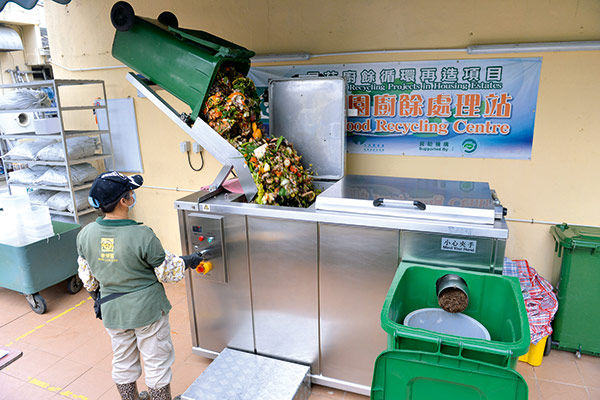
Food reusedFood reused:  The Government is planning to reuse organic waste.
The Government has reserved $1 billion to set up a recycling fund to support the industry, Chief Executive CY Leung announced in his second Policy Address today.

On waste management, Mr Leung said the Government’s policy is to introduce quantity-based charging for municipal solid waste.

The Council for Sustainable Development has conducted a public-engagement exercise on the issue, he said, and it will offer proposals for a waste-charging system in Hong Kong.

The Government will also develop plans to handle organic waste, including converting organic waste into energy and other useful resources, he added.

Mr Leung’s address also announces plans for community green stations in each of the 18 districts, aiming to enhance environmental education and help collect recyclables in the community. The first station will be set up by the middle of the year.

Singapore News: Smoking Ban Extension (14 Jan 2014)

Smoking Ban Extension

In line with the long term plan to prohibit smoking at all public places, NEA extended the smoking prohibition extension to more public places such as common areas of residential buildings, covered walkways and linkways, pedestrian overhead bridges, 5m radius from bus shelters and hospital outdoor compounds from 15 January 2013. To raise awareness of the new smoke-free areas, NEA launched an integrated campaign on TV, cinema, print, radio, outdoor, mobile and online platforms
- See more at: http://app2.nea.gov.sg/events-programmes/campaigns/smoking-ban-extension#sthash.WCDhFvsW.dpuf


Residential Estates:
All common areas including:
  • Linkways from bus stops to residential blocks
  • Void decks
  • Corridors
  • Staircases
  • Stairwells
  • Multi-purpose halls
- See more at: http://app2.nea.gov.sg/events-programmes/campaigns/smoking-ban-extension#sthash.WCDhFvsW.dpuf

Public Spaces
  • Covered walkways and linkways
  • All pedestrian bridges
  • 5 metres from the edge of bus stops
  • Hospital outdoor compounds
  • - See more at: http://app2.nea.gov.sg/events-programmes/campaigns/smoking-ban-extension#sthash.WCDhFvsW.dpuf

    source from: http://app2.nea.gov.sg/events-programmes/campaigns/smoking-ban-extension

    Wednesday, January 15, 2014

    Hong Kong: KS Wong rejects landfill claims (10 Jan 2014)

    KS Wong rejects landfill claims

    January 10, 2014
     
    Secretary for the Environment KS Wong has refuted claims the Government launched a “surprise attack” in seeking funds for preparation work for its landfill-extension plans.

    Speaking to reporters today, he said every major project requires preparation work. In seeking funds for it, the Government followed procedures that have been in place for many years.

    Explaining why the Government withdrew the fund application, he said: "We have our internal review, and also, as appreciated by many Legislative Councillors, they welcomed that there could be more dialogue so that any confusion could be minimised."

    He said the Government will resubmit the landfill proposal to the Legislative Council soon.

    source from: http://www.news.gov.hk/en/categories/environment/html/2014/01/20140110_162611.shtml