Showing posts with label politics. Show all posts

Monday, April 28, 2014

Book: The Politics of Knowledge and Global Biodiversity (24 April 2014)

The Politics of Knowledge and Global Biodiversity

By Alice B.M. Vadrot

Routledge – 2014 – 320 pages
Description:
The establishment of the Intergovernmental Platform on Biodiversity and Ecosystem Services (IPBES) points to the crucial role attributed to science and knowledge for the successful implementation of biodiversity politics by both scientists and policy-makers. With the increased importance of biodiversity in international politics, and in part inspired by the success the Intergovernmental Panel on Climate Change (IPCC) has had in raising awareness of global warming, the call for an ‘IPCC for Biodiversity’ was successful.
The Politics of Knowledge and Global Biodiversity gives a full overview of the process of its implementation as finalised in 2013 and proposes an innovative conceptual framework that puts this specific case into a more general perspective of international politics and relations. It provides a detailed empirical analysis of the knowledge politics associated with the establishment of IPBES and its conceptual framework and methodological approach is grounded in a theoretical perspective.
This pioneering work is the first to examine IPBES in this way and is essential reading for researchers and scholars of International Relations, Environmental and Biodiversity Politics, Science-Policy Interfaces and Global Environmental Governance. It will also be of interest to political scientists and social scientists.
Content:
Introduction 1. How we view Nature now: the emergence of 'biodiversity' 2. A Novel Approach: 'epistemic selectivities' 3. Who needs a 'Science-Policy Interface' for Biodiversity 4. Conception and Birth of New International Body: the IPBES 5. The Manifold Narratives of the IPBES negotiations 6. Epistemic Selectivies: Knowledge and Institutional Change
source: http://www.routledge.com/books/details/9780415729901/

Wednesday, February 12, 2014

World News: Nations will face big political question in Lima over climate change (8 Feb 2014)

Nations will face big political question in Lima over climate change


Nations will face big political question in Lima over climate change

NEW DELHI: President of the Warsaw climate conference (COP19) and Poland's secretary of state, Marcin Korolec, has said the "nature of contributions" from countries to deal with menace of global warming would be the "main political questions" in Peruvian capital Limawhere leaders/negotiators from across the globe assemble for the next marathon meeting in December.

In first and only interview to Indian media over outcome of the last climate conference (COP19),Korolec told the TOI that the road to Paris for universal climate deal in 2015 may not be easy, but the Warsaw round made the global community confident about the process of negotiations which will certainly lead the nations to a final decision.

Korolec, who visited India to participate in the TERI's 14th Delhi Sustainable Development Summit (DSDS), also emphasized that the rich nations would not be able to dilute the differentiation between developed and developing countries and they will have to contribute to deal with the challenges of climate change under the principle of 'common but differentiated responsibilities' (CBDR) - which puts onus of corrective measures primarily on developed countries.

Elaborating on the CBDR, he said, "I think, we have to go back to theDurban meeting where we had decided that we as a community will negotiate a global agreement applicable to all and the finish of those negotiations should take place in 2015 "In the Durban language, there is also a statement that this new agreement applicable to all should be negotiated under the convention. It means that the principles linked to the convention and also with the principle of CBDR and respective capabilities" He said, "I think the outcome of Warsaw (November, 2013) is very positive in that sense because it says all countries will start preparing for contributions. Those contributions will obviously be determined by the countries presenting it. So in that sense, the principle of CBDR is possible to be realized". On the question as to who will decide those contributions from developing countries, the Polish secretary of state and his country's plenipotentiary for climate policy said, "The nature of contribution is another story. We have to discuss this in Lima. It will, in fact, for the individual country to define it. I think that will be the main political question for the Lima meeting". On the fate of the Green Climate Fund, Korolec said, "The GCF will be the cornerstone of the climate finance in the future. The real operationalisation of the fund will take place soon. I hope, there will be a full-fledged functioning fund by the end of the year". He was nominated to the Board of the Fund in December last year.

Excerpts of the interview: 

Q. What you think is the outcome of the Warsaw climate conference (COP19) which held under Polish presidency in November last year? 

A. I think we managed to achieve all goals of Polish presidency during Warsaw conference. We managed to arrive at four different technical decisions including the very difficult one like road map for the new agreement which will happen in Paris in 2015. It also includes finance climate constitution, package for decision on REDD plus on forestation, decision to set up institutional mechanism on 'Loss and Damage' and number of other very technical decisions. This is one part of achievement of COP19. But, we had also another objective which has great importance for the process. One of the main objectives of the Polish Presidency during Warsaw conference was to show confidence in the process. In the last four five years, every conferences ended with some dramatic situation. We saw it in Doha, we saw it in Durban, Cancun and Copenhagen. So if we have to go to Paris for final agreement, we should have confidence in this process. That's why we were so focused on the transparency, trust building and other activities of the Presidency to restore the confidence in the process. And, we managed that to a limit.

Q. How will the process help negotiators in future climate conferences?

A. We invented the concept of troika from our European Union experience...troika presidency. So in every meeting, Peru and France were invited to the presidency to show them what kind of challenges and what kind of difficulties the presidency has to face to let them learn from our conference and to have an additional channel of communication with the members in the room. There were 194 countries. Those channels of the communication were extremely important. So, we managed to achieve the outcome of the COP19. This is also a great achievement of the Warsaw conference. We show that this process may be transparent, may be inclusive and this is not necessarily contradictory to the outcome of the meeting and that was one of the goal before the meeting. I am proud that we managed to achieve this.

Q. What was the most difficult situation during the negotiation? 

A. Obviously, the final negotiation was most dramatic...that was after two weeks and that was also after sleepless night and we were extremely tired due to the whole process. It appeared at one stage that the negotiation was heading for a very fragile end. So, the very end was the challenging point of those negotiations. We had to finish it on Friday afternoon but we could finish it on Saturday. We negotiated whole night. So, I think that night was difficult and also the very end of the final two hours was most difficult

Q. What is the status of the Green Climate Fund (GCF)? Will it be a reality before Lima meeting?

A. Green Climate Fund is an institution which is extremely important. That will be the cornerstone of the climate finance in future. I think, everybody is admitting that. I personally took initiative to be a part of the Board of the GCF. I was elected as president of the committee of audit and evaluation. I truly believe that this fund will play a very important role in future. Capitalization of the fund and the real operationalisation of the fund will take place soon. I hope, it will be a full-fledged functioning fund by the end of the year.

Q. It is commonly believed that the principle of common but differentiated responsibilities (CBDR) between the developed and developing countries has been further diluted at Warsaw. All countries, including the poor ones, will now have to submit nationally determined contributions to tackle climate change. But there is no mention that the contributions will be based on CBDR or equity?

A. I think we have to go back to the Durban meeting where we decided that we as a community will negotiate a global agreement applicable to all and the finish of those negotiations should take place in 2015. But in the Durban language, there is also a statement that this new agreement applicable to all should be negotiated under the convention. It means that the principles linked to the convention and also with the principle of CBDR and respective capabilities. So, the challenge we are facing as a global community is how to design a global agreement applicable to all but this different participation in it coming from different countries and I think the outcome of Warsaw is very positive in that sense because it says all countries will start preparing contributions. So, all members will start preparing contributions.

Those contributions, from the obvious point of view, will be determined by the countries presenting it. So in that sense, the principles of CBDR is possible to be realized.

Q. Who will decide those contributions from developing countries? What will be the nature of those contributions?

A. It is not a principle which excludes developing countries. The nature of contribution is, however, another story. We have to discuss this in Lima. It will, in fact, for the individual country to define it. I think that will be the main political question for the Lima meeting.

Q. Are you confident that the global community will arrive at the final climate deal in Paris in 2015?

A. I think we cannot lose the opportunity. We cannot lose the slot we have in the coming two years for hard negotiations. In meeting in Lima this December and meeting in Paris next year, we will push and invite parties to do utmost possible to achieve this very challenging but important goal.

Q. Polish government had decided to drop you as the country's environment minister during the Warsaw conference while you were heading the COP19? What is your take on this unusual decision?

A. It was the decision of the Polish government to make some changes in the government. The big change had happened. Seven ministers had left the government. You have to remember that I was in a privileged situation in a sense that the Prime Minister had offered the post of the environment minister to Maciej Grabowski but he invited me also to be as a secretary of state and as government's plenipotentiary for climate negotiations. So, in fact I have today more time to dedicate on climate negotiations. I think, from that point of view, the challenges linked to the presidency of COP, challenges linked to internal EU discussions about our preparation for the COP in Lima and in Paris, I am now completely focusing on it. In that sense, the Prime Minister gave me more time to work and focus on the global climate negotiation

source from: http://timesofindia.indiatimes.com/home/environment/global-warming/Nations-will-face-big-political-question-in-Lima-over-climate-change/articleshow/30067574.cms

Saturday, June 1, 2013

New Books: Green Utopianism Politics, Practices and Perspectives Edited by Johan Hedrén, Karin Bradley (15 May 2013)

Green Utopianism

Politics, Practices and Perspectives

Edited by Johan Hedrén, Karin Bradley

Published 15th May 2013 by Routledge – 256 pages

Description: 
In the last decade of planning and policy making, utopian thought and experimental approaches to the organization of society and the built environment have been rare. What has evolved instead is a firm consensus on sustainable society as something created within the framework of current society and by small steps (such as eco-labeling, urban densification and recycling). In the midst of the current ecological and economic crisis, however, social movements and researchers have called for other developmental paths and more deep-reaching approaches. The aim of this book is to empirically and theoretically analyze alternative green futures through perspectives such as political ecology, environmental justice, and utopian thought. The book includes analyses of strategies and emerging practices on the macro levels of institutional, infrastructural and economic change, and also analyzes micropractices in the form of case studies of self-organised cooperative housing, new forms of local exchange and energy provision. The book thus not only criticizes current mainstream sustainability programs but also explores alternatives and utopian practices, their potential, their problems and their challenges.

Contents:
1. Introduction: Contemporary Politics, Policies and Planning for Green Futures
Part I. Trends, Obstacles and Pathways
2. Trouble with Nature: "Ecology as the New Opium of the People"
3. Sustaining Places: Disclosing New Development Pathways
4. Utopian thought, Political Ecology and Resilience
5. Why Solar Panels Don’t Grow on Trees
Part II. Micro-Practices: Spatial Micro-Politics, Grass-Roots Movements and Place-Based Activism
6. Toward a Genealogy of the Urban Commons
7. Spatial Forms of Post-Capitalist Futures
8. R-URBAN Strategies and Tactics for Participative Utopias and Resilient Practices
9. Globalism, Particularism, and the Greening of Neoliberal Energy Landscapes
Part IV. Transforming Politics and Planning
10. The Utopian Content of Alternative Mobility Futures
11. "Instant City" through Participation: How to Turn Utopian Ideas into Reality?
12. National Urban Parks: Nature Conservation and Spatial Distinctions in the Urban Landscape
13. Politicising Planning through Images of the Future
14. Architecture, Sustainability and Utopia: Three Contrasting Approaches
15. The Ecotopia of WELGAS: A Historical Account of a Small-Scale Renewable Energy Vision Realised in the 1980s
16. Prosumption Urbanism
17. Green Utopian Thought in Different Genres

Monday, July 16, 2012

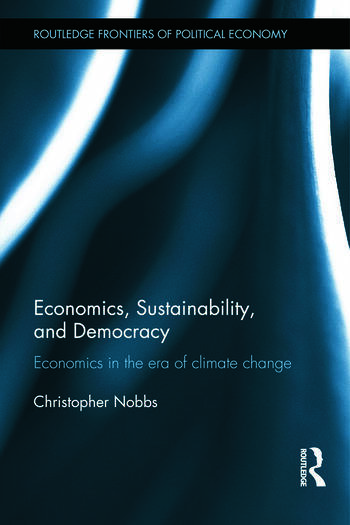
Economics, Sustainability, and Democracy - Economics in the Era of Climate Change by Christopher Nobbs

Economics, Sustainability, and Democracy - Economics in the Era of Climate Change
By Christopher Nobbs

Published 10th July 2012 by Routledge – 280 pages

Description
Large ImageHow should we conduct economics in an era of climate change, natural resource depletion and population increase? These issues are systemic, and involve great uncertainties and long time horizons. This book contends that the free-market economics that has dominated capitalist democracies in recent decades is not up to the task; that the welfarist economics that preceded it, while preferable, also has inadequacies; and that what is required is an economics founded on ecological principles, greater respect for the laws of natural science, and a moral commitment to a sustainable future.

The book commences with an exposition of major aspects of orthodox macroeconomic and microeconomic theory. It then explores the bounds of orthodox theory in relation to ethics, liberalism, ideology, society, the international economy, globalization, and the environment, and seeks lessons for a future economics. Issues raised by natural resource use and climate change are given particular prominence. Many of the issues of critical importance in coming decades involve not private goods but public goods: goods which markets are ill-equipped to deal with. In the resolution of these issues political processes will need to be engaged. The availability to each individual of clean air, clean water and adequate sustenance, goods which cannot be provided for by economic production alone, are of central concern.

While acknowledging the importance of market processes, the author argues in favour of a more deliberative and democratic economy, the greater engagement of civil society, environmental human rights and responsibilities, and in favour of a World Environment Organization, change in the conduct of the World Trade Organization, and for economists to accept moral responsibility for the policies they advocate. Specific case studies are given and potential policies outlined.

This book will be of interest not only to economists but also to citizens generally and students concerned with public affairs.

For more info: http://www.routledge.com/books/details/9780415524407/