Showing posts with label environment. Show all posts

Friday, March 14, 2014

Event: Call for Stronger Focus on Inclusive, Green Growth: Independent Evaluation at ADB ( 4 March 2014)

Call for Stronger Focus on Inclusive, Green Growth: Independent Evaluation at ADB

Thursday, December 19, 2013

Vietnam News: Rural Environmental Protection In Northern Delta (7 Dec 2013)

RURAL ENVIRONMENTAL PROTECTION IN NORTHERN DELTAThứ bẩy, ngày 30 tháng 11 năm 2013 cập nhật lúc 12:09


1. Overview of natural, socio-economic and environmental conditions
North Delta includes provinces of Hanoi, Hai PhongBac NinhVinh PhucHai DuongHung YenThai BinhHa NamNam Dinhand Ninh Binh.
Its natural area is 1,481.2 hectaresaccounting for 4.5of the national areaThe population in 2009 was 19.625 million, accounting for 22.75of the population of the whole countrymainly Kinh people.
The Northern Delta is surrounded by forests, mountains and the Gulf of TonkinThe highland around the Delta separates the forestsof the Northeast and Northwest mountainsSea here is shallow without major ocean currents so that people along the coastal areas mainly earn their living by agriculture, salt making and inshore fishing.
2. Traditional economic structure of farmers is mainly: Cultivation, breeding, aquaculture and fishing
The economic structure establishes the balance and maintains the relative stability for the surroundings.
In the economic structure of traditional agriculturecultivation and breeding are traditional with close relationshipIn this traditionalrelationship, breeding not only acts as a plant which processes waste products and crop products into animal protein to meet dailynutritional requirements for peoplebut also provides traction and organic fertilizer for the cultivation.
As organic agricultureusing manual labour for irrigation, as well as cultivation techniques by the ancestor’s experienceits productis basically clean, has low productivity, and little affects the surroundings.
3. Organizational structure of traditional rural society
The village is seen as a social and cultural unitIn terms of form: Village is a gathering point of residentsIn terms of the origin:Village is the expansion and development of a family and line... Village is not an administrative organization but in history plays an important role in the management and organization of all aspects of the farmersTherefore, the village conventions are established besidesthe State current laws.
Conventions clearly state rules of each village on life, production, organization and social relations, natural environment protection, cultural and spiritual activities etc.
The convention’s contents cover the essential issues of the village such as security protection, livestock wandering prevention, environmental protection, and support in the community.
4. Socio-economic development
Until the 1970s of the 20th century, the use of chemicals in agricultural production was still very limited in our country in general and in the northern delta region in particular. At that time, the population density was low, the land was fertile, fresh brown and rich in phosphorus and potassium; in agricultural production, the farmers mainly used organic fertilizers and green manure. Accordingly, the characteristic of the agricultural production was still organic agriculture in this period.
Along with the socio-economic development, the population began to increase rapidlyRapid population growth and mostly no land expansion for agricultural production, thus, the farmland scale per household is very low » 0.24 ha/householdThereforeincome fromtraditionally agricultural production is not enough to meet the needs of people life.
5. Land policy and policy of science and technology application started changing in 1980s.
Starting with the Party Secretariat’s Directive 100 issued on January 13, 1981 on improving contractual work and expanding the piece work system to groups and laborers, (often referred to as Contractual system 100), following by Resolution 10 of the Politburo in 1988, and then the 1993 land law granting the long-term land use rights for peasant households, all have created the initiative in agricultural production.
Thus, in the early 1990s, along with the policy of market-oriented economy development, plant protection chemicals were used with a large volume; the farmers took the initiative in plant and domestic animal restructuring, intensive cultivation, increase in crops, and agricultural product diversification towards goods production that has increased the food output and developed the rural economy.

However, the environmental protection has not been given due attention, the social management is loose, the farmers pursue the enrichment strategy "by all means" despite the harm to the environment and consequently, the environment is heavily polluted.

source from: 

Monday, September 30, 2013

New Books: Environmental and Human Security in the Arctic Edited by Gunhild Hoogensen Gjørv, Dawn Bazely, Goloviznina Marina, Andrew Tanentzap (30 Sep 2013)

Environmental and Human Security in the Arctic

Edited by Gunhild Hoogensen GjørvDawn BazelyGoloviznina MarinaAndrew Tanentzap

Routledge – 2014 – 288 pages
Descriptions:
This is the first comprehensive exploration of why human security is relevant to the Arctic and what achieving it can mean, covering the areas of health of the environment, identity of peoples, supply of traditional foods, community health, economic opportunities, and political stability. The traditional definition of security has already been actively employed in the Arctic region for decades, particularly in relation to natural resource sovereignty issues, but how and why should the human aspect be introduced? What can this region teach us about human security in the wider world?
The book reviews the potential threats to security, putting them in an analytical framework and indicating a clear path for solutions.Contributions come from natural, social and humanities scientists, hailing from Canada, Russia, Ukraine, Finland and Norway.
Environmental Change and Human Security in the Arctic is an essential resource for policy-makers, community groups, researchers and students working in the field of human security, particularly for those in the Arctic regions.
Contents:
Preface:Remarks by Ambassador Shirley Wolff Serafini at the Human Security in the Arctic Seminar 1. Introduction: Hoogensen Gjørv and Goloviznina 
Part 1: The Diversity of Arctic Security
2. Competing Perceptions of Security in the Arctic Hoogensen Gjørv and Goloviznina3. Cold War Legacies in Russia’s Svalbard Policy Åtland and Pedersen
4. A New Northern Security: Environmental Degradation and Risks, Climate Change, Energy Security, Trans-nationalism and Flows of Globalization and Governance Heininen 
Part 2: Arctic Security in a Changing Environment 5. Arctic Environmental Security and Abrupt Climate ChangeBriggs 6. Climate Change Impacts, Adaptation, and the Technology Interface David Malcolm 7. The Sustainability Transition: Governing Coupled Human/Natural systems Oran Young 
Part 3: Health and Human Security 8. Health and Human Security Communicable Diseases in the Post-Soviet ArcticRowe, Wilson Rowe and Hønneland 9. Telemedicine as a Tool for Improving Human Security Linstad
10. Health Security vs Economic Security? The Case of KomiHoogensen Gjørv and Goloviznina 
Part 4: Human Security in Focus: Women and Aboriginal Peoples
11. Aboriginal Self-Determination and Resource Development Activity: Improving Human Security in the Canadian Arctic Slowey 12. Human Security and Women's Security in North West Russia Kirsti Stuvøy
13. Democratization in Russia: the Political Exclusion and Commodification of Women Maria Lvova
14. Bridging the GAPS between Ecology and Human Security Dawn R. Bazely, Julia Christensen, Andrew J. Tanentzap, Gunhild Hoogensen Gjørv and J. Zoe Wilson Chapter
15: Examining Arctic Security Marina Goloviznina and Gunhild Hoogensen Gjørv

Friday, September 27, 2013

South Korean Updates: ‘Car-Free Week’ to be held from Sep 30 to Oct 6 (26 Sep 2013)

MINISTRY OF ENVIRONMENT REPUBLIC OF KOREA


‘Car-Free Week’ to be held from Sep 30 to Oct 6
webmaster
2013.09.26

Marking World Car Free Day on September 22 every year, the Ministry of Environment (MOE) will hold ‘Car-Free Week’ for one week from September 30 to October 6 across the nation.

World Car Free Day, first led by the town of La Roche in France in 1997, has become a global event joined by 2,158 cities in 39 countries worldwide with an aim to give up using cars at least for one day.

MOE has carried out campaigns to reduce greenhouse gas emissions by using fewer cars with local governments and civic groups since 2008.  

The dates of this year’s Car-Free Week, which is supposed to fall from September 22, are adjusted considering Chuseok holidays. The theme of Korea’s Car-Free Week is ‘Clean Air- It’s your move!’ quoting the slogan of European Mobility Week.

MOE and Metropolitan Air Quality Management Office (MAMO) opened an official website for car-free campaign (www.carfreeday.kr) to raise citizens’ awareness and participation in the event.

As a part of street events, a polar bear’s free hug event and photo session will be held on the 30th in Gwanghwamun square, and an exhibition of environmentally-friendly works will be staged by October 6 in Gwanghwamun station.

In addition, the officials working in Government Complex in Seoul, Gwacheon and Sejong will voluntarily join the event of ‘commuting without a car’ on September 30.
The local governments and civic groups across the nation will designate a specific day for car-free day from September 30 and carry out campaigns to promote the use of public transportation.

Source: 

Vietnamese Updates: Strategy sets targets for biodiversity preservation (25 Sep 2013)

Strategy sets targets for biodiversity preservation
25/09/2013 | 17:22:38


The Vietnam Red Book 2007 listed 882 species as endangered (Source: VNA)

Vietnam will improve the quality and expand the area of protected natural reserves by 2020 as set in the National Strategy on Biodiversity, which was introduced at a workshop in Hanoi on September 24. 

The function, organised by the Ministry of Natural Resources and Environment, was also to receive opinions to the draft master plan on biodiversity preservation until 2020 with a vision to 2030. 

Accordingly, the area of natural reserves on land will account for 9 percent of the territory while marine reserves will covers 0.24 percent of the sea by 2020. 

During this time, the strategy targets forest coverage of 45 percent and 0.57 million hectares of primeval forests. Meanwhile, the area of mangrove forests will be maintained at the current level, and 15 percent of the degraded important natural ecosystem area rehabilitated. 

Under this strategy, Vietnam will house 10 Ramsar sites, 10 biosphere reserves and 10 ASEAN heritage parks by 2020. 

By 2030, it will recover 25 percent of the area of degraded natural ecosystems, preserve and sustainably use its biodiversity to benefit people and the national socio-economic development. 

The Vietnam Red Book 2007 listed 882 species (including 418 fauna and 464 flora species) as endangered, 161 species more than the figure in 1992. Nine species have been listed as extinct in the wild in Vietnam. 

Vietnam is one of the five countries most vulnerable to climate change, which critically threatens its biodiversity.-VNA


Source: 
http://en.vietnamplus.vn/Home/Strategy-sets-targets-for-biodiversity-preservation/20139/39352.vnplus

Wednesday, September 25, 2013

Indonesian Updates: Indonesia introduces 'school of climate change' program to reduce emission (25 Sep 2013)


Indonesia introduces 'school of climate change' program to reduce emission

Xinhua, September 25, 2013

Indonesia is introducing the " school of climate change" aimed at speeding up efforts in reducing emission in the country, a senior official from the environment ministry said Tuesday. "The aim of the school of climate change'is to provide a forum to build up the capacity of decision makers in environment preservation issue. This program is essential to encourage and remind them of the importance of environment and climate change factors that should be integrated in their considerations process before issuing final decision both in state institutions and in the business world," Environment Damage Control and Climate Change Deputy Minister in the environment ministry Arief Yuwono said in a session to introduce the program.
He said that the program was initiated by the environment ministry in cooperation with the House of Change, an education institution led by a prominent educator Rhenald kasali.
Yuwono added that such an education program was now crucially important for Indonesia due to its geographical position that makes the world's largest archipelago country prone from the impacts of climate change.
He said that Indonesia has already experienced the impacts of climate change in the last few years, including rising temperature, changing of rain season period, the shifting period of dry to rain seasons and the rising of sea surface level, among others.

New Books: Urban Smellscapes Understanding and Designing City Smell Environments By Victoria Henshaw (23 Sep 2013)

Urban Smellscapes

Understanding and Designing City Smell Environments

By Victoria Henshaw

Routledge – 2014 – 272 pages

Descriptions:
We see the city, we hear the city, but above all: we smell the city. Scent has unique qualities: ubiquity, persistence, and an unparalleled connection to memory, yet it has gone overlooked in discussions of sensory design. What scents shape the city? How does scent contribute to placemaking? How do we design smell environments in the city?
Urban Smellscapes makes a notable contribution towards the growing body of literature on the senses and design by providing some answers to these questions and contributing towards the wider research agenda regarding how people sensually experience urban environments. It is the first of its kind in examining the role of smell specifically in contemporary experiences and perceptions of English towns and cities, highlighting the perception of urban smellscapes as inter-related with place perception, and describing odour’s contribution towards overall sense of place. With case studies from factories, breweries, urban parks, and experimental smell environments in Manchester and Grasse, Urban Smellscapes identifies processes by which urban smell environments are managed and controlled, and gives designers and city managers tools to actively use smell in their work.

Contents:
List of Figures and Charts Acknowledgements Glossary 
Chatper One: Introduction 
PART I: SMELL, SOCIETY AND CITIES 
Chapter Two: Perspectives on Smell and the City: Part I Chapter Three: Perspectives on Smell and the City: Part II Chapter Four: Smellwalking and Representing Urban Smellscapes 
PART 2: SMELL SOURCES IN THE CITY
Chapter Five: Air Quality, Pollution and Smell
Chapter Six: Food and Smell
Chapter Seven: Urban Policy and Smell 
PART 3: SMELLSCAPE CONTROL, DESIGN AND PLACEMAKING
Chapter Eight: Processes of Odour Management and Control in the City
Chapter Nine: Designing with Smell – Restorative Environments and Design Tools
Chapter Ten: Odour, Placemaking and Urban Smellscape Design 
Conclusion References

Sunday, September 22, 2013

Indian Updates: Bring states with rhinos under one conservation plan: WWF (22 Sep 2013)


Bring states with rhinos under one conservation plan: WWF
Bring states with rhinos under one conservation plan: WWFTNN | Sep 22, 2013, 03.50 AM IST


GUWAHATI: Expressing concern over spurt in rhino poaching in Assam, WWF-India has said that adoption of National Rhino Conservation Plan (NRCP) has become imperative for the protection of the species.

"After decades of conservation success, which resulted in the population of rhinos in Assam rising to more than 2,500 at present, the spurt in poaching over the last couple of years seems to indicate that poaching syndicates are strengthening. To avoid loss of these hard-fought gains, there is an urgent need for the adoption of NRCP for India," WWF-India said on the occasion of World Rhino Day on Saturday.

The NGO has asked Union minister of state for environment and forest, Jayanti Natarajan, to take the lead in putting NRCP in place by bringing together four rhino-bearing states of Assam,West Bengal, Bihar and Uttar Pradesh.

"The adoption of NRCP will increase coordination among the rhino-bearing states and enable sharing of best practices and information on poaching syndicates. This will help in better protection of Indians rhinos", said WWF-India's director of species and landscapes Dipankar Ghose.

The WWF-India has also pointed out that increasing use of firearms like AK-47 rifles in killing rhinos, especially at Kaziranga National Park, indicated growing sophistication and easy access to deadly weapons among poaching syndicates.

"The thirtieth rhino killed this year in India fell to poacher's bullets in Kaziranga on September 17. As India and rest of the world celebrate rhinos and their conservation successes on World Rhino Day, this latest killing is a grim reminder of the challenges being faces in protecting rhinos in India," the WWF-India said.

Of the 30 rhinos killed in the country, the majority of the casualties are from Assam which lost at least 25 one-horned pachyderms to poachers this year. In Kaziranga, 21 rhinos were killed by poachers, while Manas National Park and Pobitora Wildlife Sanctuary lost three and one rhinos respectively this year.

Source: 

Indian Updates: Indian scientist Veerabhadran Ramanathan to be awarded UN's highest environmental award (18 Sep 2013)

Indian scientist Veerabhadran Ramanathan to be awarded UN's highest environmental award

Last Updated: Wednesday, September 18, 2013, 10:29 

Mumbai: The name Veerabhadran Ramanathan may not sound familiar, but this atmospheric scientist of Indian origin has been doing wonders around the globe for many years and has recently been nominated to receive 'Champions of the Earth award', the UN's highest environmental award, United Nations Environment Programme (UNEP) announced on Tuesday. 

Ramanathan, who hails from Madurai, India received his bachelors degree in engineering from Annamalai University, India in 1965 and his masters degree from Indian Institute of Science, India in 1970. Later he completed his Ph.D. from State University of New York at Stony Brook on Planetary Atmospheres in 1974. 

Dr. Ramanathan is a Distinguished Professor of Atmospheric and Climate Sciences at the Scripps Institution of Oceanography, University of California, San Diego. He currently chairs an international science team from Asia, Africa and Latin America under the Atmospheric Brown Clouds Program sponsored by the United Nations Environmental Programme. 

For over 30 years, he has been conducting original research in Climate and Atmospheric Science. 

As Director of the Center for Clouds, Chemistry, and Climate at Scripps Institution of Oceanography, he conducts International field campaigns, develops unmanned aircraft platforms for tracking atmospheric brown cloud (ABC) pollution worldwide, and educates and trains the next generation of scientists. 

His major focus now is on developing practical solutions for mitigating global climate change and slowing down the retreat of the Himalayan glaciers. 

Project Surya, a cook-stove project which attempts to eliminate climate warming pollutants from traditional bio-mass cooking, is his first climate mitigation project. 

His landmark research showed that cutting emissions of ‘black carbon’ or soot can significantly lessen the impacts of climate change, improve the health of millions of rural poor, and avoid crop losses. 

Ramanathan has been among the most prominent scientific voices calling for collective action to cut emissions of short-lived climate pollutants to slow the pace of global warming, and achieve multi-billion dollar health benefits. 

A major UNEP study in 2011, on which Ramanathan acted as vice-chair and senior contributor, presented 16 actions to cut black carbon and methane emissions, which, if implemented, would save close to 2.5 million lives a year through reduced respiratory illnesses, avoid crop losses amounting to 32 million tonnes annually, and deliver near-term climate protection of about 0.5 °C by 2050. 

The prize is awarded annually to leaders from government, civil society and the private sector, whose actions have had a significant and positive impact on the environment. Other winners to receive Champions of the Earth award are Google Earth; Carlo Petrini, the founder of the Slow Food Movement; Izabella Teixeira, Minister of Environment, Brazil; Jack Dangermond, founder of the Environmental Systems Research Institute (ESRI), and Martha Isabel Ruiz Corzo from the Sierra Gorda Biosphere Reserve in Mexico. 

With inputs from: unep.com and veerabhadran ramanathan.com 

dnaindia.com/Pratik Rakshit 

DNA

First Published: Wednesday, September 18, 2013, 10:26

Source: 

Sunday, September 15, 2013

Results: ACQWA Project Assesses Climate Impacts on Water Quantity and Quality (4 Sep 2013)

ACQWA Project Assesses Climate Impacts on Water Quantity and Quality

WMO4 September 2013: The results of a project known as ACQWA (Assessing Climate Impacts on the Quality and Quantity of Water) were presented at a conference at World Meteorological Organization (WMO) headquarters on 4 September.

The project assessed the vulnerability of water resources in mountain regions, such as the European Alps, the Central Chilean Andes and the mountains of Central Asia (Kyrgyzstan), where declining snow and ice are likely to affect hydrological regimes in a warmer climate, impact on water availability, and increase competition among economic sectors, such as agriculture, tourism or hydropower.

The project aimed to use model results to quantify the environmental, economic and social impacts of changing water resources to assess the suitability of current water governance strategies and to consider adaptive measures to alleviate the negative impacts of climate change on water resources and use.

During the conference, project coordinator Martin Beniston, University of Geneva, said while mountains account for 20% or less of continental surface area, they are the source of more than half the world's rivers and 60% of surface water. Thus, the project examined how future shifts in temperature and precipitation patterns, and changes in the behavior of snow and ice in many mountain regions would change the quantity, seasonality, and possibly the quality of water originating in mountains and uplands. WMO Secretary-General Michel Jarraud told the conference that the ACQWA project would enhance the research base of the WMO-led Global Framework for Climate Services (GFCS), which aims to strengthen the provision of accessible, accurate climate services to meet the needs of users, with priority being given to the water, food security, disaster risk reduction (DRR) and health sectors.

The project was undertaken by a consortium of 30 partners from ten countries, with the participation of over 100 scientists, and with the EU contributing nearly €6.5 million.


For more information: http://climate-l.iisd.org/news/acqwa-project-assesses-climate-impacts-on-water-quantity-and-quality/214152/

ICF National Conference 2014: Trees, People and the Built Environment from 2-4 Apr 2014

TPBEII landscape Birmingham

ICF National Conference 2014

ICF CONF IDENT LAND v3
Location : University of Birmingham, Elgar Concert Hall, Bramall Music Building, Birmingham

Call for Papers now open (July 2013)

Conference Papers are welcomed that address any topic involving trees and the built environment, in both the social and natural sciences. Dowload the Call for Papers flyer for information on how to submit your abstract. (Deadline: 21 Oct 2013)

Trees, People and the Built Environment is back!

Following on from the highly successful event in 2011, the international urban trees research conference Trees, People and the Built Environment returns to Birmingham in 2014.
Again hosted by the ICF as its National Conference 2014, Trees, People and the Built Environment II continues its influential pan-industry partnership initiative between over 20 organisations representing professionals within the greenspace and built environment sectors. A Conference Steering Group, drawn from this partnership, will guide the programme content and format. 


Conference Aims

Urban trees and woodlands are essential elements of our green infrastructure and play a vital role in promoting liveable and sustainable towns and cities. The urban forest can have numerous environmental, economic and social benefits, contributing enormously to the health and welfare of everyone who lives and works in urban areas.
 For reference, you can download the Trees, People and the Built Environment Proceedings 2011.

Attend

Booking for Trees, People and the Built Environment II will open in the Autumn. To ensure that you receive notification of when bookings can me made join the TPBE LinkedIn Group (see below) or sign up for ICF's monthly free e-news.

Keep Up To Date

Join the TPBE LinkedIn Group and discussion forum to keep up to date with conference news, discuss urban tree issues and share information with this global network of 850+ tree professionals with an interest in the urban sector.


Conference Partners

The Arboricultural Association, Ancient Tree Forum, Bartlett Tree Research Laboratories, Forest Research, Forestry Commission, Institute of Chartered Foresters, Institution of Civil Engineers, International Society of Arboriculture (UK & I Chapter), Landscape Institute, London Tree Officers Association, Municipal Tree Officers Association, Myerscough College, National Association of Tree Officers, Natural England, Royal Institute of British Architects, Royal Institution of Chartered Surveyors, Trees and Design Action Group, University of Birmingham, University of Manchester, Utility Arboriculture Group.
Consultative supporters: English Heritage, Green Infrastructure Partnership, Royal Town Planning Institute

Contact Us

For more information on TPBEII please contact Allison Lock, ICF Communication and Events Manager by email or call +44 (0) 131 240 1425

ICF National Conference 2013

The ICF 2013 Conference: Woodlands and the Green Economy took place in April - visit the 2013 conference web page for more information.

For more information: http://www.charteredforesters.org/icf-events/icf-national-conference/

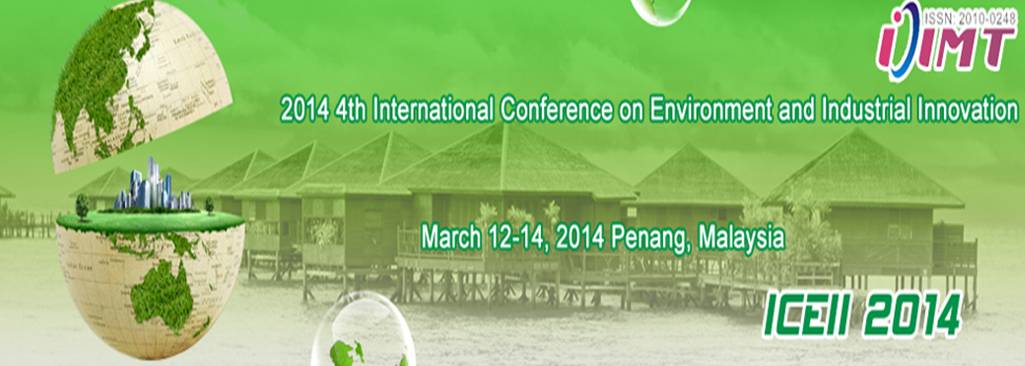
Call for papers: 2014 4th International Conference on Environment and Industrial Innovation (ICEII 2014) (deadline: 20 Oct 2013)

Welcome to ICEII 2014 
Welcome to the official website of the 2014 4th International Conference on Environment and Industrial Innovation (ICEII 2014). ICEII 2014 will be held during March 12-14, 2014 in Penang, Malaysia. ICEII 2014, is to bring together innovative academics and industrial experts in the field of Environment and Industrial Innovation to a common forum.

The primary goal of the conference is to promote research and developmental activities in Environment and Industrial Innovation. Another goal is to promote scientific information interchange between researchers, developers, engineers, students, and practitioners working in Malaysia and abroad. The conference will be held every year to make it an ideal platform for people to share views and experiences in Environment and Industrial Innovation and related areas.

ICEII 2014 papers will be published in the International Journal of Innovation, Management and Technology (IJIMT, ISSN: 2010-0248), and all papers will be included in the Engineering & Technology Digital Library, and indexed by   Google Scholar,Cross ref, ProQuest and sent to be reviewed by Ei Compendex and ISI Proceedings.

Publication Ethics - Penalty against Plagiarism
We firmly believe that ethical conduct is the most essential virtual of any academic. Hence any act of plagiarism is a totally unacceptable academic misconduct and cannot be tolerated.

English is the official language of the conference. We welcome paper submissions. Prospective authors are invited to submit full (and original research) papers (which is NOT submitted or published or under consideration anywhere in other conferences/journal) in electronic (DOC or PDF) format through the easy chair conferences management system website or via email iceii@cbees.org » Call for Papers »

One Excellent Paper will be selected from each oral session. The Certificate for Excellent Papers will be awarded in the Welcome Banquet on March 13, 2013.

Important Date
Paper Submission (Full Paper)                                                              Before October 20, 2013
Notification of Acceptance                                                                       On November 10, 2013
Final Paper Submission                                                                     Before November 30, 2013
Authors' Registration                                                                          Before November 30, 2013
ICEII 2014 Conference Dates                                                                         March 12-13, 2014
Academic Official Visit (Half Day)                                                                       March 14, 2014


Disclaimer: The content of the website is subject to change. The information on hyper linked or referred to web sites is neither investigated nor analyzed by the conference organizers. No warranty or representation, express or implied, is given as to the accuracy or completeness of that information. In no event will the conference organizers accept any liability with regard to the information contained in this web site or any other hyper linked or referred to web sites.
For more information: http://www.iceii.org/