Showing posts with label waste water. Show all posts

Tuesday, November 12, 2013

Hong Kong News: New milestone for Harbour Area Treatment Scheme (10 Nov 2013)


     The breakthrough of the Harbour Area Treatment Scheme (HATS)
Stage 2A sewage tunnel (North Point - Wan Chai section) has marked a new milestone for the project and further improvement of the water quality of Victoria Harbour. The tunnel is the deepest one in Hong Kong.
    
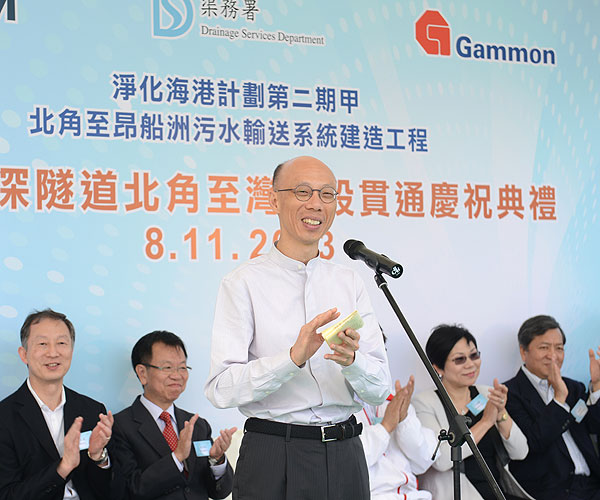
     Officiating at the breakthrough ceremony today (November 8), the Secretary for the Environment, Mr Wong Kam-sing, said HATS commenced in 1994 with an aim of improving the water quality of Victoria Harbour by collecting and treating sewage generated from both sides of the Harbour. At a total cost over $20 billion, HATS is the largest sewerage infrastructure project in Hong Kong, demonstrating the Government's commitment to upgrading the water quality of Victoria Harbour.

     Since their opening in late 2001, the facilities under HATS Stage 1 have provided daily treatment for about 75 per cent of the sewage generated from both sides of Victoria Harbour, significantly improving the water quality in the eastern and central parts of the Harbour. Stage 2A will mainly collect sewage from the northern and southwestern parts of Hong Kong Island and convey it to the Stonecutters Island Sewage Treatment Works (SCISTW).

     The works under Stage 2A have commenced progressively since July 2009. They comprise construction of a 21-kilometre sewage tunnel with sections with depths varying from about 70 metres to 160m below sea level. A drill-and-blast method has been adopted for dropshaft excavation works and deep tunnel construction. The section between North Point and Wan Chai is about 3.2km long, with the lowest point being about 160m below sea level, making the tunnel the deepest one in Hong Kong. The 160m vertical distance is equivalent to the height of a 50-odd storey commercial building. The first blast for the North Point - Wan Chai section was carried out in July 2011 and the breakthrough was completed on October 26.

     Also officiating at the ceremony, the Director of Drainage Services, Mr Chan Chi-chiu, said over 5 600 blasts had been conducted under Stage 2A, which is probably the highest number of blasts for one single project in Hong Kong ever. Under this project, the department has trained up 13 blasting supervisors and 87 competent persons for supervising delivery of explosives, bringing in more construction professionals for the industry.

     At present, the project team is striving to complete the remaining works including the expansion and upgrading of the SCISTW and eight preliminary treatment works on Hong Kong Island. The major engineering works of Stage 2A are scheduled for completion in late 2014.

     Other officiating guests at today's ceremony included the Permanent Secretary for the Environment/Director of Environmental Protection, Ms Anissa Wong; the Deputy Director of Drainage Services, Mr Tsui Wai; the Chairman of the Eastern District Council, Mr Wong Kin-pan; the Chairman of the Wan Chai District Council, Mr Suen Kai-cheong; and the District Officer (Wan Chai), Ms Angela Luk.
Photo Photo Photo

Monday, November 11, 2013

Hong Kong News: Hong Kong's deepest sewage tunnel built (08 Nov 2013)


Photo
Clean-up action:  Secretary for the Environment KS Wong speaks at the breakthrough ceremony.

HK's deepest sewage tunnel built

November 08, 2013
The breakthrough of the Harbour Area Treatment Scheme Stage 2A sewage tunnel's North Point to Wan Chai section marks the near completion of Hong Kong's deepest tunnel.

Officiating at the breakthrough ceremony today, Secretary for the Environment KS Wong said the project demonstrates the Government's commitment to upgrading Victoria Harbour’s water quality


The Harbour Area Treatment Scheme began in 1994 to improve the harbour’s water quality by collecting and treating sewage generated from both sides of the harbour.

At a total cost of over $20 billion, it is the largest sewerage infrastructure project in Hong Kong.

Stage 2A works began in July 2009, and include a 21-km sewage tunnel at depths from around 70 metres down to 160m below sea level – deeper than a 50-storey building.

Breakthrough of the 3.2km section between North Point and Wan Chai was completed on October 26.

Thursday, October 3, 2013

Chinese Update: 5 cities barred from water-polluting projects (1 Oct 2013)

5 cities barred from water-polluting projects

Xinhua, October 1, 2013 (China.org.cn)
New projects that risk causing water pollution will not be approved in counties and districts of five Chinese cities after they failed to meet pollution control targets, a spokesman with the Ministry of Environmental Protection said on Monday.
The districts and counties of cities of Siping, Hefei, Liu'an, and Kunming as well as Enshi Tujia and Miao Autonomous Prefecture have failed to meet the standards set in a five-year water pollution control guideline released in 2012.
The decision to call off such projects was made after the ministry evaluated the implementation of two water pollution control guidelines that cover China's major drainage areas including the Yangtze River and Yellow River.
Under the plans, the Chinese government will allocate 500 billion yuan (82 billion U.S. dollars) for prevention and control of water pollution in major drainage areas from 2011 to 2015, up from 300 billion yuan for the previous five-year period.
The water pollution situation remains "grave," the ministry spokesman said, adding that the implementation of some pollution control projects was not efficient enough and there was widespread pollution in rural areas.
Cities' pollution control efforts are hampered by the shortage and poor use of wastewater treatment facilities, he added.
China unveiled the 2011-2015 guideline on fighting water pollution in 2012, setting the goal that 60 percent of the country's major rivers and lakes should be clean enough to be sources of drinking water supply by the end of 2015.

Tuesday, July 9, 2013

Taiwanese Updates: 環保機關將24小時連線監視廢水排放大戶 (9 Jul 2013)


環保機關將24小時連線監視廢水排放大戶
提供單位:行政院環境保護署水保處
發布日期:2013.07.09

新聞圖片
環保署將於本(102)年7月15日起,分二期啟動大型水污染源的水量水質監測連線管制措施,實施對象包含許可排放量每日2千立方公尺以上之工業區專用污水下水道系統、許可排放量每日1萬5千立方公尺以上之事業,及排放未接觸冷卻水或採海水排煙脫硫空氣污染防制設施之發電廠,至103年12月底全部完成設置後,將可即時掌握我國56.8%的工業廢水量排放情形。 

        環保署指出,監測連線第一期實施對象為許可排放量每日1萬立方公尺以上,或其所屬工業區係經環境影響評估審查通過之工業區專用污水下水道系統,依規定應於103年7月14日前,完成水量水質自動監測(視)設施之設置,並將監測數據傳送至地方環保局。第二期實施對象則為許可排放量每日1萬5千立方公尺以上之事業、排放未接觸冷卻水或採海水排煙脫硫空氣污染防制設施之發電廠及許可排放量介於每日2千至1萬立方公尺間之工業區專用污水下水道系統,最遲需於103年12月31日前,完成監測連線工作。目前規定應設置之項目為於放流口設置水量、水溫、氫離子濃度指數(pH)、導電度(EC)、化學需氧量(COD)、懸浮固體(SS)及攝錄影監視設施,另針對工業區專用污水下水道系統,規定應於進流口設置水量自動監測設施,於指定之雨水放流口設置攝錄影監視設施,以提升對工業區內廢(污)水流向之掌握。 

Monday, April 29, 2013

Publication: Urban wastewater and agricultural reuse challenges in India by P. Amerashnghe (Apr 2013)

Eldis Logo - Return to home page

Urban wastewater and agricultural reuse challenges in India by P. Amerashnghe


View full report


Urban wastewater management has become a major challenge in India as infrastructural development and regulations have not kept pace with population growth and urbanisation. This stuudy argues that against the backdrop of water scarcity and climate change, it is important to examine issues related to wastewater reuse more holistically and to investigate the challenges and opportunities for its safe and efficient reuse. The study attempts to analyse the current status of wastewater generation, its uses and livelihood benefits especially in agriculture, based on national data and case studies from Ahmedabad, New Delhi, Hyderabad, Kanpur and Kolkata. Specifically, the objective is to provide estimates of wastewater generation and treatment, synthesise existing data on agricultural use of wastewater, and assess the related benefits and economic value, as well as the potentially adverse environmental and human health impacts.

For more information: 
http://www.eldis.org/go/display&type=Document&id=65073?utm_source=feedburner&utm_medium=feed&utm_campaign=Feed%3A+eldis-climate_change+%28Eldis+Climate+Change%29#.UX5m7aITIVg

Saturday, January 26, 2013

Events: "The Seminar for Promoting Japanese Wastewater Treatment Technology in Vietnam" to be held on February 20, 2013


"The Seminar for Promoting Japanese Wastewater Treatment Technology in Vietnam" to be held on February 20, 2013


The Ministry of the Environment of Japan, the Kansai-Asia Environmental and Energy-Saving Business Promotion Forum, the Osaka Chamber of Commerce and Industry, and the Environmental Management and Technology Center will hold the above-mentioned seminar in Osaka, Japan. (Venue: Osaka Museum of History) 

This seminar will be held as part of policies for contribution of environmental protection and enhancement of environment management capacity in Asian countries applying Japanese technologies and experiences. 

This seminar is open to the public. 

For participation, registration via FAX or e-mail is required. 

Submit to: Environmental Management and Technology Center 
FAX: +81-6-6583-3274 
E-mail: seminar@ematec.or.jp 

Sunday, January 6, 2013

Vietnamese Updates: People’s Opinion to Get Appreciation in Law on Water Resources (3 Jan 2013)


People’s Opinion to Get Appreciation in Law on Water Resources Thứ năm, ngày 03 tháng 01 năm 2013 cập nhật lúc 04:11

       On Jan 1st, 2013 amended Law on Water Resources is officially effective. Although our country has 2,360 rivers and 26 distributaries with more than 7.000km of river and sea dikes, and many of the rivers having damsreservoirs and irrigationhydroelectric power ... onethird of people do not know what to do to protect the rivers.

Center for Humans and Nature made a survey of 1,300 households in nine villages in three provinces in the basins of the Red, Thai Binh, La, Vu Gia and Thu Bon Rivers so as to investigate the impact of development on rivers, water resources, and their effects to livelihoods. Only 30% of people expressed their concerns about river degradation problems. Over 30% did not know what and how to do to protect rivers when facing shallow river and water pollution. As a matter of fact, people are subjects depending on the river for water and irrigation.

Currently, most of the projects and works are carried out without asking opinion of people. As a result, people suffer the consequences when these projects are put into use.

The international experts also advised that Vietnam should equip community experience and promote community participation in waterresource protection and enhance community’s awareness of environment protection.

The community participation is a prerequisite and plays a decisive role to the effective implementation of programs and projects of environmental water resources protection. To minimize water environment pollution, the community participation is considered a decisive factor so that lawmakers have added a new point to the Law on Water Resources.  "Employers of projects which exploit and use waterresource and discharge of wastewater into water sources have to consult relevant communities, organizations and even individuals."According to Le Huu ThuanDeputy Director of the Water Resources Management DepartmentMinistry of Natural Resources &Environmentthis content is to carry out the policy of democratization at the grassroots level, to highlight the responsibility of the investors, to respect people's opinions, and to make information transparent in order to avoid possible negative impacts which possibly happen from the beginning of preparation.

M.Dung

Source: 

Saturday, November 17, 2012

New Book: Optimization of Urban Wastewater Systems using Model Based Design and Control: UNESCO-IHE PhD Thesis


Optimization of Urban Wastewater Systems using Model Based Design and Control: UNESCO-IHE PhD Thesis
Optimization of Urban Wastewater Systems using Model Based Design and Control: UNESCO-IHE PhD Thesis


Published: November 15, 2012 by CRC Press - 200 Pages
Author(s): Carlos Alberto Velez Quintero, UNESCO-IHE Institute for Water Education, Delft, The Netherlands


Features: 

  • describing a methodology developed to optimize the design and control of sewers and wastewater treatment plants considering the dynamic interaction between the components of an urban wastewater system.
  • providing a detailed description of the steps required for the implementation of an integrated model of the urban wastewater system including the sewer, the wastewater treatment and the receiving system (river).
  • describing benefits and limitations of using multi-objective optimization tools
  • presenting two alternatives to reduce the computing demand: parallel computing in the cloud and surrogate modelling

Summary

A considerable amount of scientific evidence has been collected leading to the conclusion that urban wastewater components should be designed as one integrated system, in order to protect the receiving waters cost-effectively. Moreover, there is a need to optimize the design and operation of the sewerage network and wastewater treatment plant (WwTP) considering the dynamic interactions between them and the receiving waters. This book introduces a method called Model Based Design and Control (MoDeCo) for the optimum design and control of urban wastewater components. The book presents a detailed description of the integration of modelling tools for the sewer, the wastewater treatment plants and the rivers. The complex modelling structure used for the integrated model challenge previous applications of integrated modelling approaches presented in scientific literature. The combination of modelling tools and multi-objective evolutionary algorithms demonstrated in this book represent an excellent tool for designers and managers of urban wastewater infrastructure. This book also presents two alternatives to solve the computing demand of the optimization of integrated systems in practical applications: the use of surrogate modelling tools and the use of cloud computer infrastructure for parallel computing.