Showing posts with label animal conservation. Show all posts

Tuesday, April 22, 2014

India News: CBI takes over tiger poaching probe (10 April 2014)

CBI takes over tiger poaching probe

NAGPUR: Eight months after it was approached to investigate poaching of tigers in the region, the Central Bureau of Investigation, took over the on Friday.

The state government had written to CBI director Ranjit Sinha on July 26, 2013 requesting for probe in the poaching of tigers. State notification to this effect was published in August last week. The CBI started collecting relevant papers from September.

"Finally, the probe has been handed over to the CBI officials from Navi Mumbai who were in the city on Friday," confirmed principal chief conservator of forests (wildlife) Sarjan Bhagat.

Bhagat added the probe was handed over to CBI last year but Central government notification was issued in March first week.

In August last year, the CBI was given a mandate to probe three tiger poaching cases. The arrest of 21 poachers and tiger skin traders revealed that it was not just three tigers but nearly 25. Forest officials have reached a figure of 16 so far.

When asked, APCCF for wildlife (east) SS Mishra said the CBI probe will expose national and cross-border links of organized poachers. "The CBI probe will have no affect on the ongoing court cases. We will continue to fight them," Mishra added.

However, official sources said the list of wanted poachers has touched 56. Of these 21 have been arrested and 35 remain absconding. The CBI will help the forest department to nab absconders. "We will now work jointly," said Mishra.

9 poachers nabbed

Nagpur: Nine hardened wildlife poachers were nabbed inside the Umred-Karhandla Wildlife Sanctuary on Thursday night. Two of their accomplices managed to escape. Divisional forest officer SB Bhalavi said that the accused had sneaked into the park on seven bicycles and two motorcycles with an intention to poach wild animals. A dozen weapons like spears, sickles, and knives used to kill and skin animals, besides huge thick nets were confiscated from them. "The nets could have trapped not only herbivores but also carnivores," said Bhalavi. P

source from: http://timesofindia.indiatimes.com/home/environment/flora-fauna/CBI-takes-over-tiger-poaching-probe/articleshow/33638206.cms

India News: Gautala sanctuary to get cameras for tracking animals (9 April 2014)

Gautala sanctuary to get cameras for tracking animals
AURANGABAD: The Gautala Autrumghat wildlife sanctuary in Aurangabad district, a 250 sq km expanse of dense forest, will be first in the Marathwada region to get cameras to track the movement of animals and to keep a hawk eye on poaching activities.

The wildlife division has sent a proposal seeking 12 trap cameras for the sanctuary, which will also help in the bi-annual animal census activity. The trap cameras will have motion sensors and night vision to capture the image of any wildlife passing in front of it. The cameras are waterproof, heat resistant and have global positioning system (GPS).

Such cameras have been installed in Tadoba Andhari tiger reserve and other wildlife sanctuaries of the state, but will be used for the first time in the Marathwada region. The Gautala Autrumghat sanctuary, located on the boundary of the Aurangabad and Jalgaon districts, was notified in 1997.

Sunil Ohol, deputy conservator of forest (wildlife), said that the proposal has been sent to the forest division in Nashik and some permissions were still to be granted by the state government. The wildlife department expects to receive camera during next census scheduled for May.

An official said, "The cameras will help during the annual census exercise as they provide visual record of the animals. As the cameras capture the movement of animals within the sanctuary, it also helps protect and track the animals. Moreover, the cameras help keep a watch in possible poaching activity."

In addition to this, the forest department has also initiated a study of impact of human presence on animals, as vehicles use the national highway (NH-211) located near the forest area. It has carried out various development plans within the sanctuary to boost ecological activities and tourism.

Range forest officer R A Nagapurkar said that a four-member team of experts from Cohort For Bio-Research, Jalgaon has started a study of the impact of traffic and noise disturbances on wildlife, possible movement of animals and connection between major water and food resources. The team would submit its recommendations in the report likely to be ready in the next couple of months.

The RFO added that an information centre has been established at Hivarkheda, where the sanctuary starts. "The centre has the information of all the species found in the sanctuary. In future, guides would be appointed," he added. 10 locals have already undergone training to be guides under the eco-development scheme of the joint forest management committee (JFMC).

Fire-fighting equipment has been procured to tackle any wild fires, but no such instances have been reported in last two years. "The staff has been trained to deal with fires and adjoining villages have been alerted to notify fires. Fire extinguishers, helmets and jackets will be stored in a room," he added.

Four villages, Hivarkheda, Bildari, Haraswadi and Junona, have been identified to reduce the impact on forest area. "Smokeless stoves and solar cookers have been provided to villagers, street lights operating on solar energy have been installed. Majority of the houses have solar system capable of lighting 2-3 bulbs," Nagapurkar said.

Measures have been taken to conserve water. About 35 artificial and an equal number of natural water ponds have been built provide for animals. About 12 cement check dams have also been constructed to conserve water.

The historical sites of Gautam Rishi temple and Sita Nani have been developed to attract visitors and affordable residential arrangements have been made. Four rest houses and a dormitory can accommodate around 70 people. The rooms can be booked through the wildlife office located in Aurangabad. "The bamboo hut is entirely eco-friendly and has been set up at the edge of a mountain for a great view," he said.

Adequate safety arrangements have been put in place for the tourists with nakas and watch towers, with one guard and two forest workers stationed especially during night hours. Another chowk has been created at a central location of the sanctuary.

Sign boards are placed at significant places indicating directions to spots about 12 pagodas have been constructed for resting and sight seeing purposes.

source from: http://timesofindia.indiatimes.com/home/environment/developmental-issues/Gautala-sanctuary-to-get-cameras-for-tracking-animals/articleshow/33523892.cms

Sunday, April 20, 2014

India News: Parties unconcerned about wildlife: Animal welfare body (7 April 2014)

Parties unconcerned about wildlife: Animal welfare body

IMPHAL: People for Animals (PFA) Thoubal, an animal welfare organization, is unhappy that none of the political parties have mentioned animal conservation in their manifestos for the upcoming Lok Sabha election.

Almost all the poll manifestos have omitted the issue of wildlife uplift in the state, one of the PFA members lamented.

Issues like employment, right, minority welfare, irrigation, power and integrity are being given due importance as those are meant for making human lives better. People are in the habit of forgetting that for a good and healthy life, a good habitat is a necessity, a PFA statement read.

"We should remember that more than 50,000 rare species are hunted or killed annually in the state. In a few years, hundreds of species would be extinct from the state and this would affect the ecology and life sustaining capacity of the state," the PFA said in a statement.

Manipur experienced early and a hotter summer this year and this is not a normal phenomena. "Human life can only sustain in the areas where different species of wild animals and plants thrive. Ways of conserving them is one of the most important agendas which the political parties should put up in their manifestos," the PFA said.

Some parties, however, spare only a few words on wildlife, environment and ecology, which only indicate the lack of political will towards the issues.

It is unfortunate that nothing on 'Sangai' (Brow-Antlered deer) has been mentioned in the manifestos. Sangai, the state animal, is incorporated in Scheduled I (the most endangered animal of the country) under the Wildlife Protection Act. Sangai should be a major agenda in the manifestos and the political parties should chalk out plans to conserve these animals more effectively, it said and added that they should also pledge to enact new schemes to protect the animal.

"We expect the manifestoes to touch upon points like modernization of forest department, implementation of new laws and regulations to control poaching, hunting, over harvesting and illegal export of wildlife from the state," the PFA said.

Priority should be given to improvement of the living standards of the people living in and around national parks, sanctuaries and forest areas of the valley and hills to minimize human trespassing on forest areas.

source from: http://timesofindia.indiatimes.com/home/lok-sabha-elections-2014/news/Parties-unconcerned-about-wildlife-Animal-welfare-body/articleshow/33380710.cms?

Friday, April 18, 2014

Japan News: Banned Japanese whalers expect Southern Ocean hunt to resume (12 April 2014)

Banned Japanese whalers expect Southern Ocean hunt to resume

The Institute of Cetacean Research has indicated that whaling could resume despite the International Court of Justice ruling
A Japanese whaling vessel with a minke whale in the Southern Ocean.
A Japanese whaling vessel with a minke whale in the Southern Ocean. Photograph: Glenn Lockitch/AFP/Getty Images
Japan expects that its whaling program in the Southern Ocean will resume next year, court documents indicate.
The International Court of Justice last month ruled the program invalid, finding that it was a commercial activity disguised as scientific research.
Japanese leaders have said the country plans to abide by the ruling, but the Institute of Cetacean Research has indicated that whaling could resume in a different format.
In a memorandum lodged in a US lawsuit against the anti-whaling group Sea Shepherd, the institute says whaling permits would not be issued for the 2014-15 season because of the ICJ decision, but they could be issued in the following summer.
"Plaintiffs expect that they will be conducting a Southern Ocean research program for subsequent seasons that would be in accord with the ICJ decision," the memorandum says.
Australian Greens senator Peter Whish-Wilson said the federal government needed to take action to ensure the ICJ decision was enforced.
"The prime minister needs to immediately issue a public statement that he will not accept a return to Southern Ocean whaling and will pursue all legal avenues to prevent it happening," he said on Saturday.
source from: http://www.theguardian.com/environment/2014/apr/12/banned-japanese-whalers-expect-southern-ocean-hunt-to-resume

Thursday, April 17, 2014

India News: 9 poachers nabbed in Umred-Karhandla (12 April 2014)

9 poachers nabbed in Umred-Karhandla
NAGPUR: In a timely action, Umred-Karhandla Wildlife Sanctuary officials nabbed nine hardened wildlife poachers inside the sanctuary who were on hunt for wild animals on Thursday night.

The poachers have been identified as Shankar Tambekar, Rajeram Nanhe, Vinod Dighore, Vishnu Mandhre, Krishna Nanhe, Prakash Nanhe, Harichandra Dighore, Baiju Tambekar, and Suraj Kare. All the accused are residents of Budhwaripeth, Umred. Two of their accomplices managed to escape.

Assistant conservator of forests (ACF) and investigating officer Nandkishore Kale produced all the accused before judicial magistrate first class (JMFC) VL Bhosale on Friday. The court sent them to forest custody till April 14.

According to divisional forest officer (DFO) SB Bhalavi, the gang was nabbed at 10.30 pm in compartment number 1415 in Karhandla beat when RFO GF Luche was on patrolling round. The accused had sneaked into the park on seven bicycles and two motorcycles with an intention to poach wild animals.

A dozen weapons like spears, sickles, and knives used to kill and skin animals, besides huge thick nets were confiscated from them. "The nets could have trapped not only herbivores but also carnivores," said Bhalavi. The poachers were initially evasive saying they were going for fishing.

Officials said the accused are habitual offenders and must be frequenting the area even before it was notified a sanctuary but have been caught for the first time. When the accused were produced in court, their 60-70 supporters including relatives thronged the court premises.

source from: http://timesofindia.indiatimes.com/home/environment/flora-fauna/9-poachers-nabbed-in-Umred-Karhandla/articleshow/33638121.cms

Wednesday, April 16, 2014

Philippines News: Behind Munti condos, a treat for birding eyes (12 April 2014)

Behind Munti condos, a treat for birding eyes

By 


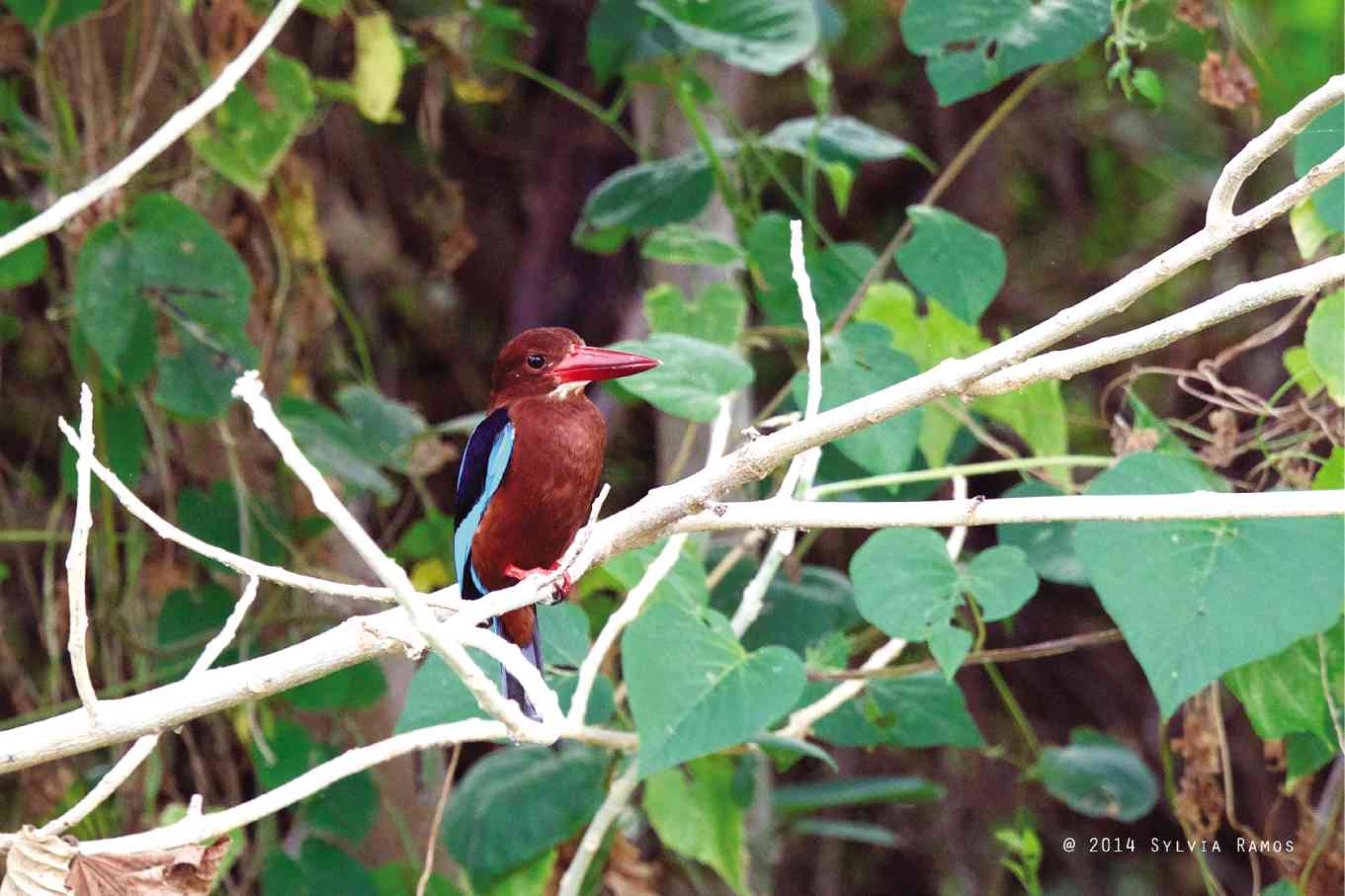
ROYALTY IN RESIDENCE The White-throated Kingfisher is just one of the 70 bird species documented by the Wild Bird Club of the Philippines in a “mini-forest” surprisingly thriving in the Ayala-Alabang area. SYLVIA RAMOS/CONTRIBUTOR
MANILA, Philippines —To celebrate Earth Month, wild bird photographers and environmental conservation advocates Sylvia and Tonji Ramos recently held a bird-watching walk for a small group of residents at Filinvest Corporate City in Muntinlupa City.
“We are always happy to share our love for birding with other people. It’s a fun and rewarding hobby,” Sylvia said.  “People usually say they only see Eurasian Tree Sparrows (maya) in the city. I tell them there are other birds too—kingfishers, woodpeckers, sunbirds, flycatchers and more. They just haven’t seen them because their birding eyes have not yet been opened.”
“We have documented more than 70 bird species in Ayala Alabang alone,” she said. “It has made us realize that the simplest things such as planting the right trees or vines can make a place more bird-friendly. We want urban planners, real-estate developers and community members to be aware of this.”
The couple are members of the Wild Bird Club of the Philippines (WBCP), which was organized in July 2003 to promote bird watching to the general public and keep records of bird sightings in the country.
Since 2005, the WBCP has hosted annual bird festivals that offer guided tours and venues for information-sharing. The number of local and foreign participants from the east Asian region has grown steadily by the thousands through the years, making the festival one of the largest ecological projects in the country today.
Also joining the March 29 walk were retirees Imelda and Heinz Stumpf, who spend half of the year in Germany and half in the Philippines.
“My husband and I were very eager to join the bird-watching tour,” Imelda said. “We’ve seen many interesting birds when we go on our regular walks and we were curious to know their names. It is the first outdoor activity we have joined and it’s suitable for senior citizens like us since the sports and social events held in the area are extremely noisy and cater only to more physically active groups.”
In Germany, she noted, there are strict regulations protecting both wildlife and communities from being disturbed by loud music and construction noise.
As she spoke, an olive-brown flyer darted over a nearby house. “Isn’t that the bird we often hear singing on our morning walks?” she asked her husband, who hurriedly adjusted his binoculars to see the bird more clearly.
Stream offers haven
“That’s a Yellow-vented Bulbul,” Sylvia said. “It’s a resident bird that breeds in the Philippines and is found here year round.”
“We’ll see more birds at the water source,” she added, pointing to an undeveloped area with a running stream behind several condominiums, where the vegetation had largely remained untouched.
THE SIGHT of a Pied Triller rewards participants in a recent bird-watching tour in Muntinlupa City. SYLVIA RAMOS/CONTRIBUTOR
As Sylvia promised, the “mini-forest” behind the condos revealed a Barred Rail, a White-breasted Waterhen and a White-throated Kingfisher, perched either on the fallen branches or on the rocks by the grassy banks. The Kingfisher was hard to miss even from a distance, thanks to the bright blue spot on its plumage.
“There’s also a Little Egret, with its black legs and yellow feet, standing motionless in the water. It must be waiting for a fish,” adds Tonji, almost in a whisper, as he looked through his binoculars. “This stream is a great habitat for birds, some of them here to hunt for insects while others eat the fruits of the ficus trees along the banks.”
Nonstop sightings
The sightings continued: “Those are Black Crown Night Herons. The ones colored black, white and grey are the adults and the brown ones with white markings are their young.”

And then some more: “Those birds near the water are Yellow Bitterns,  Cinnamon Bitterns,  Barred Rails and  White-breasted Waterhens. They like to hunt for food around the edges of the water and near the tall grass.”
Cut the grass and you rob species like Grass Owls of their habitat, he explained.
Still, most of the “migrants” prefer the tree tops, like Brown Shrikes, Grey Wagtails and Arctic Warblers. The last are insectivores who visit the Philippines from August to May. Drive them out and you lose a major partner in controlling the insect population, Sylvia added.

Another group of 12 birds resting in a tree caught Tonji’s attention. “Those are  Chestnut-cheeked Starlings. It’s the first time we’ve seen them in the area. We’ve seen them flying north from Laguna province in big numbers, so this may have been a good pit stop.  They’re probably moving north to breeding grounds in Japan and Russia.”
The Ramoses have made it their calling to educate children and adults about endemic birds and environmental conservation.

Every year, schoolchildren visit the WBCP bird fair. Sylvia sadly noted, however, that while they could easily identify swans, flamingoes, penguins and other foreign birds because of the western shows or cartoons they watch, they could name only the maya and the Philippine Eagle among the 673 local species.
“There is a lack of information dissemination and environmental awareness in many of our schools. On one occasion, we were at La Mesa EcoPark waiting quietly to photograph a bird, when a school bus full of students arrived and they began running under the trees. They were laughing, shouting, trampling on tree saplings and pulling at plants. The reason? Their teacher made a game of gathering different leaves with no clear educational purpose, not bothering to identify the trees they came from.”

Wild but ‘proper’
People need to observe “proper behavior” when in the wild, whether it’s for bird watching, taking pictures or participating in an outdoor event, Tonji said. “Treat the habitat with respect; don’t leave your trash, destroy the plants and disturb the wildlife. The old adage of ‘take nothing but pictures’ applies to any site.”
“If you play loud music or speak loudly, you don’t get to hear the sounds of nature,” he stressed. “With a lot of sporting events now being held in mountains and (nature) trails, participants and organizers shouldn’t use loudspeakers, for example.  It signifies a higher level of learning and a higher class of event if they realize that biking or running through nature is about bonding with it rather than driving it away.”
Groups interested in taking a bird-watching tour in Filinvest City are advised to secure permission from the management


Read more: http://newsinfo.inquirer.net/593885/behind-munti-condos-a-treat-for-birding-eyes#ixzz2yjqzXpO7

Tuesday, April 15, 2014

India News: Two more vulture species decline in population drastically over the years (11 April 2014)

Two more vulture species decline in population drastically over the years
BANGALORE: In a recent paper published in the Cambridge Journal - Bird Conservation International, researchers from BNHS-India and Royal Society for the Protection of Birds (RSPB), it has been stated that like the three Gyps species, even Egyptian Vulture Neophron percnopterus and Red-headed Vulture Sarcogyps calvus had declined by nearly 80% and 91% respectively in the Indian subcontinent since the mid-1990s and are now globally threatened. Both species are likely to have showed similar physiological intolerance and exposure risk to diclofenac through a common ancestry and foraging niche with Gyps vultures. The paper examined the records of Red-headed and Egyptian Vultures obtained on road transects in and near protected areas between 1992 and 2011, particularly in northern India. This study comes as one of the strongest evidence that these two vulture species have also been affected by diclofenac.
Commenting on the impact on these two species, Chris Bowden, International Species Recovery Officer and SAVE Programme Manager said, "This study clearly shows that not just the Gyps species, but also other vulture species, have been affected by drugs such as diclofenac to varying extents. Future conservation efforts should cover all such species that have been affected, through a broader framework of research and advocacy".
Diclofenac ban to the rescue
After the ban on veterinary diclofenac by the government of India due to sustained efforts by BNHS and RSPB, the two organizations have been actively advocating for smaller doses of human diclofenac, under the wider international consortium SAVE (Saving Asia's Vultures from Extinction), so that the same may not be illegally used on cattle. The positive fallout has been that the prevalence and concentration of diclofenac in domesticated ungulate carcasses has decreased and population declines of Gyps vultures have slowed down or even reversed in a few cases. The observations in the later years of the study reveal that the declines in Red-Headed and Egyptian Vultures also seem to have slowed down after the ban. Their numbers have even possibly increased in some areas.
Illustrating the development Asad Rahmani, Director, BNHS said, "The partial recovery of vulture numbers after the ban shows that strong research and advocacy go a long way in effective conservation. Further research should also focus on the current status of Red-headed and Egyptian vultures".
The way ahead
The level of sensitivity to diclofenac in these other two species, when ingested by feeding on cattle carcasses is yet to be known completely. Hence, further research is underway, since till now the sample size for the study of these two species has been smaller than in the case of the Gyps species. Thus, continued ban on such drugs, widespread advocacy and search for safer alternatives may benefit a wider range of vulture species in the Indian subcontinent than was previously thought.
source from: http://timesofindia.indiatimes.com/home/environment/pollution/Two-more-vulture-species-decline-in-population-drastically-over-the-years/articleshow/33618473.cms

Thursday, March 20, 2014

India News: Rhino census to start in north Bengal forests (13 March 2014)


Rhino census to start in north Bengal forests

JALPAIGURI: The forest department will conduct rhino census at Gorumara National Park spread over an area of over 88 square kilometres and other adjacent forestlands on Wednesday and Thursday.

More than 100 groups comprising three persons each would conduct the census on Wednesday morning. On Thursday the process will be repeated. The department is using 15 kunki (tamed) elephants for the purpose. Ten elephants have been brought from Jaldapara in addition to the five 'kunki' jumbos that Gorumara already has. About 150 foresters, 200 members of eco development committees and 30 representatives from different NGOs will take part in the census.

The forest department is also conducting rhino census in Chapramari Wildlife Sanctuary, Mahahanda Wildlife Sanctuary, Nathua, Lataguri, Panjhora, Ramsai and Baikunthapur forests.


"Often rhinos stray out of Gorumara and therefore we are covering the adjacent forest tracts to ensure that every rhino is counted. There are three rhinos in Nathua, one in Chapramari and another in Baikunthapur, which had strayed out of Gorumara a few years ago. The census will disclose whether there are more rhinos anywhere else," said Tapas Das, conservator of forests, wildlife, northern circle.

Rhinos live in small groups in a confined area they are habituated of and every such area is dominated by the strongest male member of the group. Whenever a male rhino gets out of its area, it has to confront the dominant rhino of the area where it enters. This leads to a fight which often ends up with the death of one rhino.

In the last census conducted in 2012, over 40 rhinos were found present in the national park of which 20 were male, 14 female and six cubs. Foresters expect this number to increase this time.


source from : http://timesofindia.indiatimes.com/home/environment/flora-fauna/Rhino-census-to-start-in-north-Bengal-forests/articleshow/31864263.cms

Friday, March 14, 2014

India News: Leopard found in sanctuary; curbs on visitor entry (13 March 2014)


Leopard found in sanctuary; curbs on visitor entry

Leopard found in sanctuary; curbs on visitor entry
The presence of a leopard in Ralamandal Sanctuary here for a second time in a month has led the forest authorities to restrict the entry of visitors in the reserve area.
Times of India
INDORE: The presence of a leopard in Ralamandal Sanctuary here for a second time in a month has led the forest authorities to restrict the entry of visitors in the reserve area.

Last month, the forest officials had caught a leopard from the sanctuary and released it in the Choral forest area.

However, forest guards recently discovered pugmarks of another leopard which had killed a blue bull. Following this, entry of visitors in the reserve area has been restricted to avoid any harm to them, Ralamandal Sanctuary's superintendent Ashok Kharate told to mediapersons on Wednesday.

As a precautionary measure, the entry of visitors in the sanctuary has been limited to between 10am and 3pm, he said.

The forest guards have launched a hunt to catch the big cat and set up cages with dogs as a bait, Kharate said.

Wednesday, February 26, 2014

World News: Wildlife board to clear key projects this week (18 Feb 2014)

Wildlife board to clear key projects this week


http://timesofindia.indiatimes.com/home/environment/developmental-issues/Wildlife-board-to-clear-key-projects-this-week/articleshow/30580510.cms

Monday, February 24, 2014

China News: Zambia sees rising trend in elephant poaching (18 Feb 2014)

Zambia sees rising trend in elephant poaching

Xinhua, February 18, 2014

Zambia has recorded a steady rise in elephant poaching in recent years, signifying that the country was still far from ending the fight against illegal trade in ivory, the Post of Zambia reported on Monday.
Last year, the southern African nation lost a total of 135 elephants to poaching as compared to 124 in 2012 and 96 in 2011, according to the country's position paper presented at an illegal Wildlife Trade Conference held in London, Britain last week.
Minister of Tourism and Arts Sylvia Masebo said the country currently has an ivory stockpile of 10, 031 pieces due to a surge in illegal trade and poaching of elephants, adding that Zambia has been affected by a surge of illegal trade and poaching.
The elephant population, she said, has dwindled from an estimation of over 200, 000 head of elephants in the 1970s and 1980s to about 26, 382 according to a 2008 survey.
"Current figures indicate that Zambia lost a total of 135 elephants to poaching in 2013 as compared to 124 elephants in 2012 and 96 elephants in 2011, respectively. This has been a stable but steady increase in poaching levels," she was quoted as saying by the paper.
The Zambian minister however said the steady rise in elephant poaching in Zambia was relatively low as compared to other neighboring countries that have seen unprecedented high levels of poaching.
Last year, the Zambian government banned the hunting of big cats and elephants and the Zambian minister said funding to a government agency that manages wildlife has been increased to help it improve the management of wildlife.
The high-level meeting in London was called to inject a new level of political commitment into efforts to tackle the problem of illegal wildlife trade.

Friday, February 21, 2014

China News: US-Pacific trade deal disappoints environmentalists (16 Feb 2014)

US-Pacific trade deal disappoints environmentalists


Trade deal between the US and Pacific countries including Japan, Malaysia and Vietnam would fail to protect against illegal logging, trade in endangered wildlife and overfishing
article image
The trade deal should enforce stronger rules on the trade in illegal animals parts, such as the Pacific Walrus, say campaigners (Image by USFWS)

Since 2010 a potentially massive free trade agreement known as the Trans-Pacific Partnership (TPP) has been quietly taking shape. Though negotiations have been taking place behind closed doors, last monthWikileaks released a leaked version of the text of the TPP’s “Environment Chapter,” the latest of a handful of chapters to be brought to light.

While negotiators prepare to convene for another round of talks later this month, environmental advocates have been loudly criticising the lack of ambition and enforceability of the environmental provisions in the text.

“We were extremely disappointed with the status of the Environment Chapter,“ said Ilana Solomon, Director of the Sierra Club’s Responsible Trade Program. “It is essentially so weak, it steps back from the trade agreements negotiated by George W. Bush in 2007.”

The trade deal

The expansive trade deal would govern roughly 40% of the world’s gross domestic product and one-third of global trade.

According to Kevin Gallagher, co-director of the Global Economic Governance Initiative at Boston University and author of "Free Trade and the Environment,” the TPP would be the “the biggest North-South trade deal in world history.”

The deal today involves a cast of twelve Pacific Rim nations -- Australia, Brunei, Chile, Japan, Malaysia, New Zealand, Peru, Singapore, Vietnam, Canada, Mexico, and the United States -- and is seen in the US as a crucial component of President Obama’s so-called “Asia pivot” in foreign policy.

It is also supposed to represent an “ambitious, 21st-century trade agreement” that President Obama heralded in his first official speech on trade in 2009, one that prioritises labour rights and environmental protections.

Critics argue that the TPP falls far short on the environmental front, and actually backtracks and conflicts with a major recent piece of US domestic trade policy.

In 2007, President George W. Bush signed a landmark agreement with Congress that ushered in a new era of environmentally-conscious free trade. According to Solomon, the May 2007 deal stated that “all US free trade agreements should include an Environment Chapter that is not just aspirational but is legally enforceable and binding in the same way that are other commercial chapters of the agreement.”

The provisions in a deal’s Environment Chapter matter, says Solomon, because “as trade expands as a result of free trade agreements, there is often stress on natural resources and forests or wildlife or fisheries.”

Historically, as was the case in the North American Free Trade Agreement (NAFTA), environmental protections were handled in a separate, non-binding aspirational side-agreement, that had no enforcement measures whatsoever. The May 2007 deal ensured that environmental provisions would be included in the agreement.

The May 2007 agreement also states that countries are required to uphold their own domestic environmental laws in the course of trade, and fulfill any commitments made in multilateral environmental agreements, like the Montreal Protocol ozone treaty.

The TPP, argues Vanessa Dick, a senior policy officer specialising in trade at World Wildlife Fund, sends the US “back to a pre-2007 world.” If one country raises a complaint about another’s compliance, explains Dick, “parties agree on a mutually satisfactory ‘action plan.’ And that’s the end of the text. There’s a final report, but no recourse.”

“Full enforceability,” says Dick, “would mean there are steps beyond that ... the extreme being sanctions.”

Illegal logging, wildlife trade and overfishing

The alleged purpose of the TPP’s Environment Chapter is to address the core conservation challenges of the Asia Pacific region, with regards to trade. In response to the leaked text, experts at the Natural Resources Defense Council, Sierra Club, and World Wildlife Fund (WWF), identified three major problem areas.

First, illegal logging is rampant in many of the TPP countries, and the deal as written does little to curtail the trade of illegally harvested timber.

Second, there are major problems with the illegal wildlife trade. Solomon points to rhino horns and tiger pelts, both of which are supposedly protected by international endangered species laws, but are still vulnerable to black market trading. The TPP should, advocates say, introduce stronger enforcement of those laws.

Finally, the environmental groups say that the TPP does little to discourage overfishing, a serious omission considering that the countries engaged in these negotiations account for roughly one-third of global fish production. “There’s tremendous stress on fisheries” says Solomon, “and some of these countries offer subsidies that lead to overfishing.” Conservation advocates also want to see an outright ban on shark-finning to be included in the text.  

Though the text does mention these conservation challenges, Solomon says that in “all of the provisions that were supposedly designed to protect timber and wildlife and fisheries, the language is full of caveats like ‘shall strive to’ and ‘shall endeavor to’ that essentially make them meaningless,” as they are not legally enforceable.

Dick worries that without ambitious obligations that are fully enforceable, countries will actually suffer in the long term. “A fully ambitious and enforceable Environment Chapter is actually in the interest of all countries. It’s beneficial to the US. It’s beneficial to Vietnam. It’s beneficial to Chile. Ultimately, scarcity is not helpful for economic opportunity.”

There’s bad news for the environment beyond the Environment Chapter itself, warns Solomon. She points to the Investment Chapter, leaked in 2012, which includes provisions that allow foreign corporations to sue governments over laws and policies that allegedly reduce their profits or the value of their investments. “Similar language was included in NAFTA,” Solomon explains, “and it’s been used by ExxonMobil, Chevron, and Cargill, to challenge public interest and environmental policies.” She gives a recent example of a US energy firm, Lone Pine Resources that, citing NAFTA law, sued Canada for US$250 million over the Quebec moratorium on fracking.

The TPP would also legally require the US to automatically approve all exports of natural gas to other countries in the agreement, including Japan, the largest natural gas importer in the world. In the US, this little-publicised rule would eliminate the Department of Energy’s legally-mandated review of any potential natural gas exports.

US forced to back down?

The Obama administration has pushed back against some of the criticism of the leaked text. In a blog post, United States Trade Representative Michael Froman wrote that "environmental stewardship is a core American value, and we will insist on a robust, fully enforceable environment chapter in the TPP or we will not come to agreement."

According to Solomon, the US position going into the negotiations was indeed ambitious. Supplemental reports leaked alongside the negotiating text, says Solomon, “do show that the US put a stronger draft forward.” But when other countries pushed back on the environmental issues, the US didn’t hold firm.

“It just shows that the commitment really isn’t there,” says Gallagher, who also served on an advisory committee to President Obama on trade, and describes himself as “very familiar with these negotiations.”

“One of the key things that these countries want is a safeguard to prevent a financial crisis,” says Gallagher. “If [the US] gave them that, they’d be more than happy to take the environmental provisions.”

Gallagher believes that the Obama administration is now rushing to ratify the TPP as China works on the ASEAN+6 trade deal. “This is an attempt to get a foothold in Asia to put a counterweight against China.”

Although the TPP has notoriously missed a number of self-imposed deadlines, President Obama has said that he hopes to conclude the agreement this year, possibly at the Asia-Pacific Economic Cooperation meetings in April. 

Thursday, November 21, 2013

Book: Whales and Elephants in International Conservation Law and Politics (18 Nov 2013)

Whales and Elephants in International Conservation Law and Politics

A Comparative Study

By Ed Couzens

Routledge – 2014 – 246 pages

Whales and elephants are iconic giants of the marine and terrestrial animal world. Both are conspicuous representatives of wildlife conservation. The issues of whaling and the ivory trade are closely linked, both legally and politically, in many ways; some obvious, and some surprising. The treatment of both whales and elephants will be politically and legally contentious for years to come, and is of great significance to conservation in general.
This book examines the current state of international environmental law and wildlife conservation through a comparative analysis of the treatment of whales and elephants. In particular, it describes the separate histories of international governance of both whales and elephants, presenting the various treaties through which conservation has been implemented. It is shown that international environmental law is influenced and shaped by important political actors – many with opposing views on how best conservation, and sustainable development, principles are to be implemented. Modern environmental treaties are changing as weaknesses and loopholes are exposed in older, and possibly outdated, treaties such as the Convention on International Trade in Endangered Species of Wild Fauna and Flora (CITES) and the International Convention for the Regulation of Whaling (ICRW). Such weaknesses can be seen in the efforts made by some states to circumvent or weaken CITES and the International Whaling Commission and to resume commercial whaling, and further in the efforts of countries to resume trade in ivory. The argument is made that the Convention on Biological Diversity could be used to begin reconciling opposed views and to focus conservation efforts.
The argument is made that effective conservation of species cannot be achieved through individual treaties, but only through a synergistic approach involving multilateral environmental agreements – 'ecosystems of legal instruments'.