Showing posts with label world news. Show all posts

Friday, April 25, 2014

World News: UN urges more efforts on sustainable development (23 April 2014)

UN urges more efforts on sustainable development

The United Nations observed the International Mother Earth Day on Tuesday with senior officials appealing for greater efforts to promote sustainable development and use of renewable energy sources.
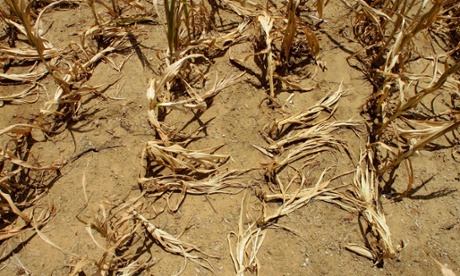
Desertification in Namibia. [Photo/UNEP]
In his message for the day, marked annually on April 22, UN Secretary-General Ban Ki-moon urged worldwide changes in attitude and practice to curb the negative impact of human activity on the planet.
"From tropical deforestation to depleted ocean fisheries, from growing freshwater shortages to the rapid decline of biodiversity and increasingly polluted skies and seas in many parts of the world, we see the heavy hand of humankind," he said.
Reflecting on humankind's relationship with the planet, Ban said, the air we breathe, the water we drink and the soil that grows our food are part of a delicate global ecosystem that is increasingly under pressure from human activities.
As such, and with a growing population, everyone must recognize that consumption of the planet's resources is unsustainable. "We need a global transformation of attitude and practice. It is especially urgent to address how we generate the energy that drives our progress," he said.
The UN chief also emphasized that burning fossil fuels is the principal cause of climate change, which increasingly threatens prosperity and stability in all regions.
He said that action on climate change presents multiple opportunities to "reset our relationship" with Mother Earth and improve human well-being, especially for the poorest and most vulnerable.
"Sustainable energy for all can increase health, wealth and opportunity for billions of people, as can climate-smart agriculture, more efficient cities and better managed and protected forests," Ban said.
As a part of the world organization's efforts to drive home the importance of respecting and protecting the planet towards ensuring 'the future we want', the General Assembly is convening an interactive dialogue on "Harmony with Nature" to commemorate the international day.
Following a high-level segment Tuesday morning, member states, UN agencies and independent stakeholders will discuss in a series of roundtables ways to promote a balanced integration of the economic, social and environmental dimensions of sustainable development.
Meanwhile, General Assembly President John Ashe called on the UN family to promote sustainable development and the use of renewable energy sources throughout cities and communities.
"As we confront the unique sustainable development challenges of our time; our understanding of the economic, social and environmental needs of present and future generations must be rooted in the most up to date scientific information," Ashe said in his message.
Our global strategy must promote sound environmental ethics, and continually emphasize humanity's interconnectedness with nature, he noted.
In 2009, the UN General Assembly proclaimed April 22 as International Mother Earth Day, in a bid to achieve a just balance among the economic, social and environmental needs of present and future generations.
source : http://www.china.org.cn/environment/2014-04/23/content_32180078.htm

Thursday, April 24, 2014

World News: Earth Day: Last places with their original looks (23 April 2014)

Earth Day: Last places with their original looks

April 22 is World Earth Day. Environmental problems have long been seen as serious topics and many parts of the planet have lost their true colors and natural landscapes. Following are some of the places which still manage to preserve their original characteristics.
Ruunaa hiking area, Finland.

source : http://www.china.org.cn/environment/2014-04/23/content_32179101.htm

Monday, April 21, 2014

WOrld News: Carbon cuts possible for manageable warming: Experts (7 April 2014)

Carbon cuts possible for manageable warming: Experts

BERLIN: The world, acting urgently, can curb carbon emissions enough to avert worst-case scenarios for climate change, UN experts said on Monday as envoys met in Berlin to weigh the options for action. 

"The literature here shows that deep cuts in greenhouse gas emissions to limit warming to 2 C... remain possible," said Ottmar Edenhofer, who helped oversee the latest volume in a report by the UN's Intergovernmental Panel on Climate Change (IPCC). 

But achieving this goal, Edenhofer warned, will require a break from today's relentlessly upward trend in emissions. 

It will entail "challenging technological, economic, institutional and behaviour change," he said. 

Envoys and scientists from the panel's 195 member countries are meeting after the IPCC issued its starkest-ever warning about the perils of a ravaged climate system for future generations. 

The risk of conflict, hunger, floods and mass displacement increase with every upward creep of the mercury, the IPCC said. 

"The impacts of climate change will leave no part of the world untouched and unaffected," IPCC chairman Rajendra Pachauri told Monday's opening session. 

The upcoming volume is the last major piece of the Fifth Assessment Report -- the first overview by the Nobel-winning climate panel since 2007. 

The product of four years' work by over 200 experts, it aims at providing governments with the latest scientific knowledge and informing the struggling effort to forge a worldwide pact on climate change by the end of next year. 

A draft summary of the report, seen by AFP, expresses no preferences for how to tame the problem, nor does it state what a safe level of warming would be. 

But it says there is a 15-year window for affordable action to safely reach the UN's target of limiting warming to two degrees Celsius (3.6 degrees Fahrenheit) over pre-industrial times. 

The goal remains attainable if "all countries" act quickly to ease carbon emissions, it says. "Delaying mitigation through 2030 will increase the challenges." 

In raw terms, global carbon emissions of 49 billion tonnes of CO2 equivalent in 2010 will have to be pegged to 30-50 billion tonnes in 2030. 

Most scenarios that meet the 2 C target entail a "tripling to nearly a quadrupling" in the share of energy from renewable and nuclear sources and the capture and storage of emissions from fossil fuel plants, according to the draft. 

Government representatives and scientists will go through the summary line by line over the next few days. 

"In the plenary, all countries can voice their concerns and all of them are heard," said co-chairman Youba Sokona. 

"In the end, it is scientific accuracy that decides." The summary will be publicly released in the German capital on Sunday, and the full 2,000-page report -- authored by scientists and not subject to this week's scrutiny -- will be released shortly afterwards. 

Green group Friends of the Earth International said the science demanded a reduction in the use of fossil fuels, coupled to a massive investment in renewable alternatives. 

"So far, world leaders have sorely lacked the political will to make the shift to low-carbon societies," it said. 

Oxfam, for its part, said climate change would have a severe impact on hunger. 

"It is estimated there could be 25 million more malnourished children under the age of five in 2050 compared to a world without climate change - the number of all under-fives in the US and Canada combined," it said.

source from: http://timesofindia.indiatimes.com/home/environment/global-warming/Carbon-cuts-possible-for-manageable-warming-Experts/articleshow/33405099.cms

Saturday, April 19, 2014

World News: UN urges huge increase in green energy to avert climate disaster (13 April 2014)

UN urges huge increase in green energy to avert climate disaster

'Triple or quadruple renewables', say experts, as pressure grows for UK to deliver on eco priorities

UN urges huge increase in green energy to avert climate disaster
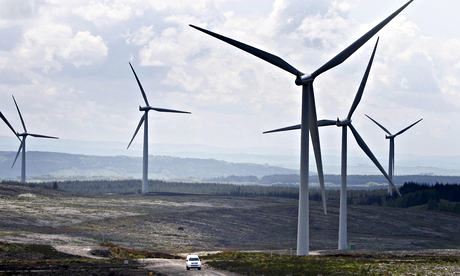
The Conservatives have been planning to block further onshore windfarm construction. Photograph: Danny Lawson/Photograph: Danny Lawson/PA
David Cameron's commitment to the green agenda will come under the fiercest scrutiny yet this week when top climate-change experts will warn that only greater use of renewable energy – including windfarms – can prevent a global catastrophe.
A report by the world's leading authorities will expose a growing gulf between a Tory party intent on halting construction of more onshore windfarms and the world's leading scientists, who see them as one of the cheapest ways to provide energy while at the same time saving the environment.
Mitigation of Climate Change, by the UN's Intergovernmental Panel on Climate Change (IPCC), a panel of 200 scientists, will make it clear that by far the most realistic option for the future is to triple or even quadruple the use of renewable power plants. Only through such decisive action will carbon dioxide levels in the atmosphere be kept below the critical level of 480 parts per million (ppm), before the middle of the century. If levels go beyond this figure, the chances of curtailing global mayhem are poor, they will say.
The report – the third in a series by the IPCC designed to highlight the climate crisis now facing the planet – is intended as an urgent wake-up call to nations to commit around 1-2% of GDP in order to replace power plants that burn fossil fuels, the major cause of global warming, with renewable sources.
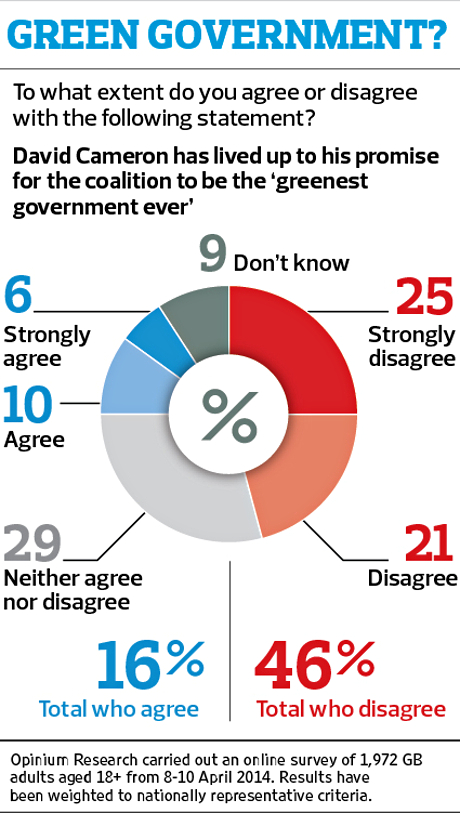
Opinium pollPhotograph: Opinium
Its conclusions represent a huge challenge for Cameron and the Conservative party – which is now laying plans to block the construction of new onshore windfarms in Britain, the country's only realistic, reasonably priced renewable energy option other than solar power, which has limited potential in the UK.
Having promised to lead "the greenest government ever", Cameron now stands accused by the green lobby of watering down his commitments in response to the threat of Ukip, which campaigns heavily against windfarms.
The prime minister's green credentials have also been called into question by the appointment in 2012 of Owen Paterson, a climate-change sceptic, as environment secretary. Paterson said in September 2013: "People get very emotional about this subject and I think we should just accept that the climate has been changing for centuries."
An Opinium/Observer poll – which today puts Ukip on 18% support – also finds that just 15% of voters think Cameron has lived up to his promises on the environment, against 46% who think he has not. In addition, only 20% disagreed with the suggestion that the government was giving priority to short-term economic growth over the sustainable use of the environment.
Last week local government secretary Eric Pickles announced he had taken personal control over all future decisions about new onshorewindfarms, while Grant Shapps, the Conservative party chairman, said wind turbines were no longer "environmentally friendly". Shapps also suggested that the Tories would pledge to curb them in their 2015 election manifesto and instead approve only offshore windfarms.
However, the move would cripple the ability of the government to play a full part in curtailing carbon dioxide emissions, and experts warn it could lead to higher energy prices.
Onshore wind power costs around £90 per megawatt hour to generate, but for offshore windfarms this rises to £150. Other renewable energy sources are either of limited use in Britain or are not yet fully developed, such as tidal power. Nuclear energy is one alternative, but is controversial, and a major construction programme would take decades to approve and construct.
"Renewable energy is backed by the public; wind power has the support of two thirds (66%) of Britons and the CBI has called on action to tackle climate change," said Christian Aid's senior climate change advisor, Mohamed Adow. "The government should be doing all it can to put the UK at the forefront of this energy revolution not blowing hot and cold on the issue.
Joss Garman, Greenpeace's deputy political director, said: "These scientists have shown us that it's not too late and we can still avoid the worst impacts of climate change, but only if we get behind the clean energy solutions that can slash carbon pollution. Renewable energy technologies are already the least-cost option in a growing number of major markets, and they're getting cheaper all the time.Rather than turning back towards dirty fuels like coal and gas, now is the time for Ministers to double down on our transition towards a cleaner energy system. This report shows that the sooner we act, the cheaper it will be."
The new report has taken four years to compile. It is expected to say the UN target – to limit global warming to 2 degrees celsius (3.6 degrees fahrenheit) – is feasible only if surging carbon emissions are swiftly braked and then reversed.
The first report forecast that global temperatures would rise by 0.3-4.8C this century, on top of roughly 0.7C since the industrial revolution. Seas are forecast to rise by 26-82cm by 2100. The second report, which was issued last month, dwelt on the likely impacts and warned that the risk of conflict, hunger, floods and mass displacement increased with every minuscule rise in temperature.
The panel will issue a résumé of all three reports in Copenhagen in October, prior to the next major UN climate summit, which is scheduled to open in Paris in December 2015.
The last IPCC assessment report, published in 2007, formed the core of the international debate on climate at the UN's Copenhagen Summit in 2009. The event degenerated into a political brawl and climate negotiations have been stuttering ever since. Climate experts say this failure to act cannot be allowed to continue. UN members must agree to a climate pact that will come into force in 2020. Any later and the costs of mitigating climate change will soar exponentially because there will then be so much carbon dioxide in the atmosphere.
UK economist Sir Nicholas Stern said: "All political leaders should recognise that a powerful case has been presented for accelerating action against climate change by building cleaner and more efficient economies."Dr Stephan Singer, WWF director of global energy policy, added: "Renewable energy can no longer be considered a niche market. Renewables must – and should – eventually take the full share of the global energy market within the next few decades."
source from: http://www.theguardian.com/environment/2014/apr/12/un-urges-increase-green-energy-avert-climate-disaster-uk

Friday, April 18, 2014

World News: El Nino looms larger in latest forecasts (10 April 2014)

El Nino looms larger in latest forecasts
NEW DELHI: In what could be bad news for Indian agriculture, conditions in the Pacific Ocean seem to be increasingly favouring the onset of an El Nino this summer. In its latest update on Tuesday, the Australian Bureau of Meteorology said there was now a more than 70% chance that the unusual weather pattern will develop in the next few months. 

The Australian agency has been updating its El Nino forecast every fortnight. Tuesday's update, however, was the most categorical about the onset of an El Nino till date. An El Nino increases the chances of poor monsoon in India although there have been several exceptions in the past. 

El Nino is the name given to unusual warming of waters in the central and eastern equatorial Pacific, which is linked to changes in wind patterns and anomalous weather in many parts of the globe. 

"It is now likely (estimated at a greater than 70% chance) that an El Nino event will develop... Surface and sub-surface ocean temperatures have warmed considerably in recent weeks, consistent with a state of rapid transition," the Australian met bureau said. 

The agency said most international climate models it surveyed predict that sea surface temperatures will reach El Nino thresholds during the coming summer. 

Another update released on Monday by US's meteorological agency, NOAA, maintained a 50% probability of El Nino setting in this summer. These predictions are likely to impact the India Meteorological Department's monsoon forecast, slated to be released next month. 

On the brighter side, it must be pointed out that not all El Nino years coincide with weak monsoons in India. For instance, the strongest El Nino event in recent years occurred in 1997 but it did not depress rains in India.

source from: http://timesofindia.indiatimes.com/home/environment/global-warming/El-Nino-looms-larger-in-latest-forecasts/articleshow/33529521.cms

Thursday, April 17, 2014

WOrld News: Crude oil leak blamed for China water contamination that hits 2.4 million people (13 April 2014)

Crude oil leak blamed for China water contamination that hits 2.4 million people
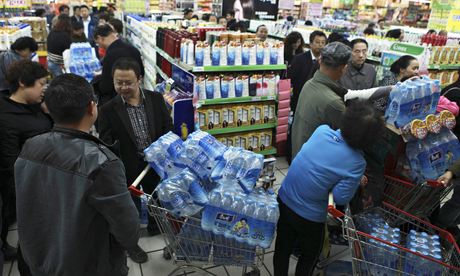
People line up to buy cartons of bottled water at a supermarket after reports on heavy levels of benzene in local tap water, in Lanzhou, Gansu province. (Reuters Photo)
BEIJING: A crude oil leak from a pipeline owned by a unit of China National Petroleum Corp (CNPC) is to blame for water contamination that has affected more than 2.4 million people in the Chinese city of Lanzhou, media reported on Saturday. 

The official Xinhua news agency cited Yan Zijiang, Lanzhou's environmental protection chief, as saying that a leak in a pipeline owned by Lanzhou Petrochemical Co, a unit of CNPC, was to blame for the water contamination. 

The leak poisoned the water source for a water plant, introducing hazardous levels of benzene into the city's water, he told Xinhua. 

Levels of benzene, a cancer-inducing chemical, in Lanzhou's tapwater on Friday rose 20 times above national safety levels, Lanzhou authorities said in a statement. The high benzene levels forced the city to turn off the water supply in one district and city officials warned citizens not to drink tapwater for the next 24 hours. 

The city official Yan told Xinhua on Saturday that the leak had been located and repairs were underway. 

Lanzhou city authorities said on Friday they found 200 micrograms of benzene per litre of water. The national safety standard is 10 micrograms. 

By late Saturday morning, Xinhua said benzene levels were confirmed safe at five out of the six water monitoring sites. 

The water supply company, Lanzhou Veolia Water Co, is majority-owned by the city government, with Veolia China, a unit of French firm Veolia Environment , holding a 45-percent stake. 

On Friday, Veolia said in a statement an initial investigation found the high levels of benzene were caused by contamination at one of the two culverts that transfer raw water from a sedimentation plant to the water treatment plant. 

According to Xinhua, investigators found crude oil in soil along a duct between two water works owned by Veolia Water. 

"The channel has been carrying water to Veolia Water's No.1 and No.2 plants for decades. Under this ditch lies Lanzhou Petrochemical's oil pipeline," the city's environmental protection chief Yan told Xinhua. 

A Veolia spokeswoman in Hong Kong declined to comment on Saturday and referred all questions to city authorities. 

Lanzhou, a heavily industrialised city of 3.6 million people in the northwestern province of Gansu, ranks among China's most polluted centres. 

CNPC is parent company of PetroChina Co. A PetroChina spokesman could not immediately be reached for comment. 

Lanzhou Petrochemical is a major refinery in China's landlocked northwest. It has a total refining capacity of 280,000 barrels per day (bpd) and plans to process 195,000 bpd of crude this year, industry sources have said.

source from: http://timesofindia.indiatimes.com/home/environment/pollution/Crude-oil-leak-blamed-for-China-water-contamination-that-hits-2-4-million-people/articleshow/33666712.cms

World News: Climate targets: Australia can't be caught napping while others take action Neither the government nor the ALP want us to discuss what contribution Australia is going to make to the Paris agreement on emission goals in 2015 (13 APril 2014)

Climate targets: Australia can't be caught napping while others take action

Neither the government nor the ALP want us to discuss what contribution Australia is going to make to the Paris agreement on emission goals in 2015
Global warming makes feeding the world harder and more expensive.
Global warming makes feeding the world harder and more expensive. Photograph: Seth Perlman/AP
On Sunday night Australian time, the intergovernmental panel on climate change (IPCC) will release its final working group report on reducing carbon pollution. These “mitigation” reports have been historically the bridesmaids to the earlier reports on climate science which get more of the media attention.
Because the report's conclusions will shape the global discussion about what all major emitters should be doing next on climate change policy, it may be more important for Australian and global climate policy than the other two reports combined.
Based on leaked drafts of the work of the world’s leading climate economists, the IPCC are likely to make three important overall conclusions.
The first is that avoiding dangerous global warming of 2oC is possible, but urgent action is required across all major countries and emitting sectors. Turning our coal, oil and gas based energy system to one based on clean energy sources like wind and solar, improving the energy efficiency of our buildings, industries and transport sector, stopping deforestation and deploying technologies that remove carbon pollution from the air are all essential ingredients to effective action. This is possible with political will and sensible, consistent policy.
Secondly, the IPCC is likely to also illustrate that well executed climate policy decisions can provide broader benefits to communities, such as reductions in air pollution and improvements in energy security. Delaying effective action will also substantially increase the cost of achieving long-term climate goals. Those factors are a key driver behind growing global action on renewable energy and energy efficiency.
Thirdly, effective national climate policy should include a suite of policies: carbon pricing, regulations to overcome barriers to action, and long-term investment signals (such as Australia’s renewable energy target scheme) are all essential.
But beyond all this common sense, the real sting in the tail for the government will be what the IPCC says around the scale of emission reductions needed to contribute our fair bit to global action.
In its last report, the IPCC indicated that countries like Australia would need to reduce emissions by 25-40% on 1990 levels by 2020, and 80-95% by 2050, to give a 50/50 chance of avoiding a 2oC increase in global temperature. This target range became a benchmark by which national targets were discussed. Many – including Australia, the USA, the EU, Norway and Japan – indicated their willingness to reduce emissions across this scale in advance of the Copenhagen climate summit.
The new IPCC report will have a similar impact, likely pointing out that countries like Australia need to reduce emissions by 50% on 2010 levels by 2030 to be consistent with the agreed global goal of avoiding 2oC, while major emerging economies like China would need to see emissions peak and begin to fall.
These conclusions are not emerging in a void.
Last December, countries agreed to advance new post 2020 emission targets by April 2015. European Union member countries are likely to be the first to come forward with a 2030 emission target. The US is working with China on sharing information on their targets, and the US government has established an interagency working group to develop their new target by April 2015. These targets will be examined internationally before the new global climate agreement is finalised in Paris in December 2015.
Of course, countries want to see the commitments others are making before they sign on the dotted line in Paris. They want to look under the bonnet at what others are putting forward, so they don’t buy a clunker. A key criterion in this evaluation will be whether each country’s target is consistent with a fair contribution to avoiding warming of 2oC. The IPCC’s conclusions will shape this global conversation.
The government is yet to outline what preparations Australia is making for its post-2020 target, or whether we will join other major emitters in advancing our initial target offer by April 2015 (as we have agreed to do in Warsaw last year).
The ALP has been no less committal, and continues a slip and slide on emission targets that started in 2009. Its policy to reduce emissions through an internationally linked carbon limit and price can achieve emission targets at low cost. However, the ALP keeps deferring a decision on its exact targets, despite initiating a number of independent expert reviews on what they should be. Those experts have recommended at least a 15% reduction in emissions by 2020.
It’s clear that neither the government nor the ALP want us to discuss what contribution Australia is going to make to the Paris agreement and what emission goals we should set post 2020. Other governments are asking politely now, but as the 2015 climate summit gets closer, these questions will get more pointed. This weekend’s report from the IPCC will just be the start.
source from: http://www.theguardian.com/commentisfree/2014/apr/11/climate-targets-australia-cant-be-caught-napping-while-others-take-action

Wednesday, April 16, 2014

World News: IPCC report: world must urgently switch to clean sources of energy UN panel's third report explains how global dependence on fossil fuels must end in order to avoid catastrophic climate change (12 APril 2014)

 IPCC report: world must urgently switch to clean sources of energy UN panel's third report explains how global dependence on fossil fuels must end in order to avoid catastrophic climate change

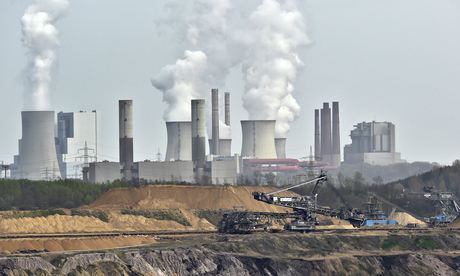
Coal mine and power station in Germany
An open-cast coal mine and power station near Grevenbroich, Germany. After concluding that global warming is almost certainly man-made and poses a grave threat to humanity, the UN-sponsored expert panel on climate change is moving on to the next phase: what to do about it. Photograph: Martin Meissner/AP
Clean energy will have to at least treble in output and dominate world energy supplies by 2050 in order to avoid catastrophic climate change, a UN report is set to conclude on Sunday.
The report produced by hundreds of experts and backed by almost 200 world governments, will detail the dramatic transformation required of the entire globe's power system, including ending centuries of coal, oil and gas supremacy.
Currently fossil fuels provide more than 80% of all energy but the urgent need to cut planet-warming carbon emissions means this must fall to as little as a third of present levels in coming decades, according to a leaked draft of the Intergovernmental Panel on Climate Change (IPCC) report seen by the Guardian.
There is heavy emphasis on renewable energy, such as wind and solar power, and cutting energy waste, which together need hundreds of billions of dollars of investment a year.
But despite the scale of the challenge, the draft report is upbeat: "Since [2007], many renewable energy technologies have substantially advanced in terms of performance and cost and a growing number have achieved technical and economic maturity, making renewable energy a fast growing category in energy supply," the report says.
It also highlights that the benefits of clean energy, particularly in reducing deadly air pollution and providing secure energy supplies, "outweigh the adverse side effects". The IPCC report is the last part of a trilogy compiled by thousands of the world's most eminent scientists which gives the most definitive account of climate change to date.
The first report, released in September, showed climate change was "unequivocally" caused by human activity and prompted Ban Ki-moon, the UN secretary general, to say: "The heat is on. Now we must act."
The second, published in March, warned that the impact of global warming, from extreme weather to reduced food production, posed a grave threat to humanity and could lead to wars and mass migration. TheInternational Energy Agency said the IPCC's work showed "the urgent need of enabling a global transition to clean energy systems".
The report will address how to avert the worst dangers by cutting carbon emissions, which have been rising despite the global recession of 2007-08.
Nuclear power is cited among the low-carbon energy sources needed, but the draft report warns it "has been declining since 1993" and faces concerns about "safety, nuclear weapon proliferation risks, waste management security as well as financial and regulatory risks".
Another way to produce low-carbon energy is to burn fossil fuels but capture and bury the carbon emissions.
The IPCC experts note that, unlike renewable energy, this technology "has not yet been applied at a large, commercial scale".
The draft report concludes that increasing carbon emissions are due to rising coal use, along with increasing demand for energy from the world's growing population. But it notes that policies implemented to cut carbon emissions will also cut the value of fossil fuel reserves, particularly for coal. It also says increased use of gas could cut emissions in the "short term", if it replaces coal.
China's vast coal burning represents a huge challenge but a new analysis from Greenpeace, published on Friday, suggests it may have reached a turning point. "The range of coal caps and anti-smog measures put in place by the Chinese authorities could see the country cut its carbon emissions by more than twice the UK's annual footprint by 2020, making it possible for global carbon levels to peak before climate change spirals out of control," said Li Shuo, Greenpeace East Asia's climate and energy campaigner.
On Thursday, Nobel peace prize winner Archbishop Desmond Tutucalled in the Guardian for an anti-apartheid-style campaign against fossil fuel companies. "It is clear that [the companies] are not simply going to give up; they stand to make too much money," he wrote.
Over half a trillion dollars a year are spent subsidising fossil fuels – six times more than spent supporting renewable energy – and US president Barack Obama and other leaders have pledged to phase these out. The draft IPCC report states this could be done without harming the poor: "Many countries have reformed their tax and budget systems to reduce fuel subsidies, that actually accrue to the relatively wealthy, and used other mechanisms that are more targeted to the poor."
The draft report runs counter to some of the UK's key energy policies. It states that decarbonising electricity is key to cost-effective cuts in emissions, but the coalition government voted down a plan to do this by 2030. The report also warns that building high-carbon energy infrastructure developments will lock societies into high emissions and may be "difficult or very costly to change", but UK ministers are strongly pushing shale gas exploration. The UK's carbon plan includes significant burning of biofuels and biomass (usually wood), which is supposed to be carbon neutral. But the IPCC report says scientific debate about whether biofuels cut emissions "remains unresolved" and that without policy safeguards "large scale bioenergy deployment could increase emissions".
Friends of the Earth's executive director, Andy Atkins, said: "We can only avoid catastrophic climate change if we reduce our dependency on fossil fuels – we're already on track for four degrees warming, which will be impossible for human society to adapt to. We have the technology to prevent dangerous climate change. What we lack is the political will of our leaders to strongly champion renewable power and energy efficiency."
Li said: "We stand at a fork in road. One way leads to more dependence on dwindling fossil fuels that are wrecking our climate and damaging our health; the other to a world powered by a booming clean energy sector that is already driving growth and creating jobs. The sooner we act, the cheaper it will be."
source from: http://www.theguardian.com/environment/2014/apr/12/ipcc-report-world-must-switch-clean-sources-energy

Tuesday, April 15, 2014

World News: World Bank drops funding for hydro power project on Sutlej, environmental groups rejoice (10 April 2014)

World Bank drops funding for hydro power project on Sutlej, environmental groups rejoice
NEW DELHI: Local people and environmental activists under the banner of Sutlej Bachao Jan Sangharsh Samiti celebrated the victory of their campaign to save river Sutlej after the World Bank dropped funding for the controversial Luhri Hydro project in Himachal Pradesh. The World Bank, which was to provide a USD 650 million to the project, on its website indicated the status of the project as "dropped." 

According to a statement issued by the South Asia Network of Rivers, Dams and People (SANDRP) on Friday, World Bank's decision comes after an appraisal by an USAID team that reviewed the environmental and social impacts of the project. The team had visited last November and interacted with stakeholders like the project developer, World Bank, affected people organisations like Himdhara Collective in Himachal Pradesh and SANDRP in Delhi, said the statement. The total cost of the project is 1150 million dollars. 

Nek Ram Sharma of the Satluj Bachao Jan Sangharsh Samiti said, "This will boost the confidence of local people in deciding their own future." The samiti which has challenged the environment clearance (EC) granted to the project last year. They were concerned about the environmental impacts of the proposed 38 kms long tunnel to be constructed as part of the project. 

In response to submissions by the samiti and groups like SANDRP and Himdhara the project capacity was reduced from 775mw to 612mw by MoEF earlier. However, objections were raised again with the government in March 2013, they demanded scrapping of the project. 

"We have been under constant pressure from the administration to support this ecologically disastrous project. It is time that our governments wake up and realize the magnitude of the crisis that is unfolding as a result of Hydro projects," said a statement from Himdhara, a local group on Friday.

source from: http://timesofindia.indiatimes.com/home/environment/developmental-issues/World-Bank-drops-funding-for-hydro-power-project-on-Sutlej-environmental-groups-rejoice/articleshow/33668283.cms

World News: UN: greenhouse gas emissions nearly doubled in first decade of 21st century Leaked draft shows emissions grew nearly twice as fast from 2000-10 as in previous 30 years – despite economic slowdown (11 April 2014)

UN: greenhouse gas emissions nearly doubled in first decade of 21st century

Leaked draft shows emissions grew nearly twice as fast from 2000-10 as in previous 30 years – despite economic slowdown
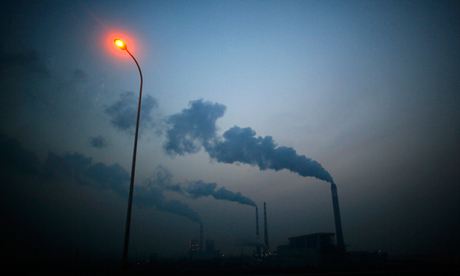
Greenhouse gas emissions : Smoke rises from chimneys of a coal power plant near Shanghai
Smoke rises from the chimneys of a power plant near Shanghai, China. Carbon emissions emissions grew 2.2% a year on average between 2000 and 2010. Photograph: Carlos Barria/Reuters
Greenhouse gas emissions grew nearly twice as fast over the past decade as in the previous 30 years, bringing the world closer to warming that will bring dramatic and dangerous changes to the climate, according to a leaked draft of a United Nations' report.
The report from the Intergovernmental Panel on Climate Change (IPCC) said the growth rate in emissions over the from 2000-10 was higher than expected – even after taking into account the economic slowdown.
"Global GHG [greenhouse gas] emissions have risen more rapidly between 2000 and 2010," said the draft obtained by the Guardian. "Current GHG emissions trends are at the high end of projected levels for the last decade."
The draft went on to warn that delaying emissions cuts beyond 2030 would make it harder to avoid the severe consequences of climate change.
Leading scientists and government officials are in Berlin this week to approve the exact wording of the report before it is formally released on 13 July.
The IPCC report is the third part of a trilogy intended to serve as the definitive account of climate change.
The first report, released last September, found climate change was caused by human activity.
The second, released in Japan last month, warned climate change posed a grave threat to humanity, was already putting food security in jeopardy and could lead to wars and mass migration. It also set out the impacts global warming was having on wildlife.
This third part was supposed to be focused on solutions. Instead, the report made increasingly clear the large and growing gap in the scale of the threat and the readiness of those solutions.
The draft said emissions grew 2.2% a year on average between 2000 and 2010, compared to 1.3% a year over the entire period from 1970-2010. In 2010-11, global emissions from the burning of fossil fuels grew 3%, the draft went on.
The rapid growth in emissions has defied efforts by governments to deal with climate change, and even though the historic recession saw some slowdown it was eventually reduced to a blip in the continuous upward path.
"The global economic crisis 2007-08 has temporarily reduced emissions but not changed the trend," the draft said.
The culprit for the upward line on the graph was coal, the draft said. The decade saw a big jump in the number of new coal-burning power plants that came online.
Coal plants are the most polluting of all power stations, and there are more than 1,000 new plants under construction worldwide.
Most of those are earmarked for China and India – although the report pointed out that many of those power plants are supplying factories making goods whose ultimate destination is America or Europe.
Other developing countries have also stepped up their use of coal. Germany, Britain and France have also been burning coal, because of low worldwide prices.
But their consumption pales beside China, which on its own accounts for about 15% of total global emissions from coal. The expansion of coal-fired power plants – China gets two-thirds of its electricity from coal – have polluted the air and the water.
A recent World Bank study estimated 750,000 people died in China every year as a result of air pollution, in large part because of the burning of coal.
source from: http://www.theguardian.com/environment/2014/apr/11/un-greenhouse-gas-emissions-doubled-decade-ipcc-report

Sunday, April 13, 2014

World News: Drinking water in China's Lanzhou city unsafe to drink, say authorities (14 April 2014)

Drinking water in China's Lanzhou city unsafe to drink, say authorities

Water in city found to contain levels of benzene, a cancer-inducing chemical, at 20 times above safety levels
Residents buy bottled water after authorities said Lanzhou's drinking water contained benzene
Residents buy bottled water after authorities said Lanzhou's drinking water contained high levels of benzene. Photograph: China Stringer Network/REUTERS
China's western city of Lanzhou saw a rush for supermarket bottled wateron Friday after authorities said the city's drinking water contained levels of benzene, a cancer-inducing chemical, at 20 times above national safety levels.
With Beijing having identified the environment as one of its top priorities after years of unfettered economic growth, the government has struggled to make local governments and industries comply with laws.
Lanzhou, a heavily-industrialised city of 3.6 million people in Gansu province, ranks among China's most polluted cities.
The government found 200 micrograms of benzene per litre of water, it said, triggering the rush to stock up on bottled water. The national safety standard is 10 micrograms per litre.
Water supply was turned off in one city district, and the government warned citizens not to drink the city's water for the next 24 hours.
"Lanzhou has shut down the contaminated water supply pipe and deployed activated carbon to absorb the benzene," the government said in a statement. Activated carbon has small pores that enable it to absorb chemicals.
Preliminary inspection showed the benzene came from nearby chemical factories, the local government said on its website, although no culprit was named. The environmental bureau is carrying out further investigations.
The water supply company is majority-owned by the local city government, with British firm Veolia Water, a unit of French firm Veolia Environnement, holding a 45% stake.
source from: http://www.theguardian.com/world/2014/apr/11/drinking-water-lanzhou-china-unsafe