Sunday, September 8, 2013

Publications: “Climate Change, Water Conflicts and Human Security” Report Released (2 Sep 2013)

“Climate Change, Water Conflicts and Human Security” Report Released

2013•09•02     BONN
Climate change has — and will continue to have — far-reaching impacts on environmental, social and economic conditions.
Increasingly, climate change and the associated increase in the frequency of extreme weather events (such as floods, droughts and rising sea level) are acknowledged as not only having humanitarian impacts, but also creating national/regional political and security risks. While people and governments can adapt to these impacts, their capacity to do so varies.
The UNU Institute for Environment and Human Security (UNU-EHS) joined 13 other international research teams on the project Climate Change, Hydro-conflicts and Human Security (CLICO). The CLICO project sought to discover to what extent the effects of climate change — in terms of water scarcity, droughts and floods —present a threat to human security in the Mediterranean, Middle East and Sahel region, not least by exacerbating social tensions and intra- and inter-state conflicts. Conversely, the study also considered whether climate change might be a catalyst for cooperation and peace.
Results confirm that climate and hydrological factors, and socio-economic, institutional and political conditions, are all important drivers of human (in)security, but their relative importance depends on the specific context in which they interact.
Adaptation plays a key role in determining whether climate change is likely to undermine human security. The study found that adaptation processes — either undertaken by individuals/groups or governed and led by the state — can both reduce and increase insecurities.
The final CLICO synthesis report — “Climate Change, Water Conflicts and Human Security:Regional Assessment and Policy Guidelines for the Mediterranean, Middle East and Sahel” — presents a comprehensive assessment of the region in terms of climate change impacts, vulnerabilities, conflict/cooperation and human security at various geographical scales and in a variety of historical contexts.
With regard to water-related conflict and cooperation, the study found slightly more cooperative than conflictive events in the region. CLICO research also points toward stronger links between political,
economic and social factors and water-related conflict than between climate-related variables and water conflict (although in the future these relationships could change).
The report makes several recommendations to guide policymakers in terms of improving adaptive capacities, reducing vulnerabilities and, hence, increasing human security in the face of climate change.
The full CLICO report can be downloaded directly by clicking on the link above, or via the Climate change, water conflicts and human security page on the UNU-EHS website.

Greenpeace report: Palm oil now biggest cause of deforestation in Indonesia (3 Sep 2013)

Palm oil now biggest cause of deforestation in Indonesia
Rhett A. Butler, mongabay.com
September 03, 2013
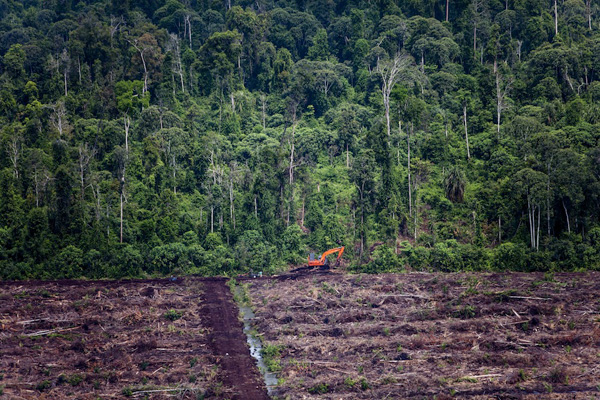
An excavator at the rainforest's edge in recently cleared peatland within the Duta Palma group's PT. Bertuah Aneka Yasa palm oil concession in Indragiri Hulu, Riau
An excavator at the rainforest's edge in recently cleared peatland within the Duta Palma group's PT. Bertuah Aneka Yasa palm oil concession in Indragiri Hulu, Riau. Taken 05/04/2013 © Kemal Jufri / Greenpeace


Conversion of forests for palm oil production now appears to be the single largest driver of deforestation in Indonesia, accounting for roughly a quarter of forest loss between 2009 and 2011, asserts a new Greenpeace report that accuses the sector's main certification standard of failing to stop forest destruction.

The report, titled Certifying Destruction, uses satellite imagery, government concession data, field investigations, and third party analysis to conclude that several recent and current members of the Roundtable on Sustainable Palm Oil (RSPO) — the industry's chief eco-certification body — are continuing to buy or trade palm oil produced via the conversion of rainforests and carbon-dense peatlands in the Southeast Asian nation.

"The RSPO wants its members to be industry leaders in sustainability, but its current standards leave them free to destroy forests and drain peatland," said Bustar Maitar, head of Greenpeace International’s Indonesia forest campaign, in a statement. "Year after year, Indonesia’s forest fires and haze wreak havoc on the region, and the palm oil sector is a main culprit."

300,000 hectares

Analyzing satellite data, Greenpeace finds that some 300,000 hectares of forest were cleared for oil palm plantations between 2009 and 2011, accounting for nearly 25 percent of the 1.24 million hectares of forest the Indonesian government says were cleared during the two-year period. Deforestation for oil palm plantations was disproportionately high in three provinces in Indonesia Borneo: West Kalimantan (75 percent of total deforestation was attributed to palm oil), East Kalimantan (55 percent), and Central Kalimantan (38 percent).

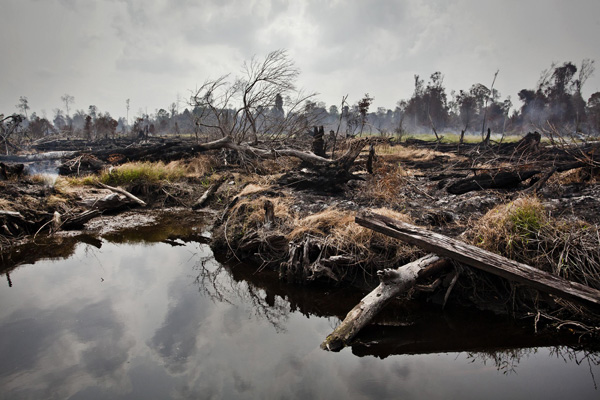
Charred tree stumps against the smoldering background in an area of recently deforested peatland near Tanjung Baru village, Pangkalan Kerinci subdistrict in Pelalawan regency, Riau province, Indonesia. The village lies beside PT. Pusaka Megah Bumi Nusantara (PMBN) – a palm oil company belonging to the Asian Agri group, a member of the Roundtable on Sustainable Palmoil (RSPO). This area, according to the most recent official charts, is covered by the Indonesia government’s moratorium on the issuance of new permits in primary forests and peatlands.Thousands of peatland fires in the province - the majority within pulp and palm oil concessions - have caused record-breaking air pollution in Singapore and Malaysia, with the haze extending as far as Thailand.
Charred tree stumps against the smoldering background in an area of recently deforested peatland near Tanjung Baru village, Pangkalan Kerinci subdistrict in Pelalawan regency, Riau province, Indonesia. The village lies beside PT. Pusaka Megah Bumi Nusantara (PMBN) – a palm oil company belonging to the Asian Agri group, a member of the Roundtable on Sustainable Palm Oil (RSPO). This area, according to the most recent official charts, is covered by the Indonesia government’s moratorium on the issuance of new permits in primary forests and peatlands.Thousands of peatland fires in the province - the majority within pulp and palm oil concessions - have caused record-breaking air pollution in Singapore and Malaysia, with the haze extending as far as Thailand. Taken June 29, 2013 © Ulet Ifansasti / Greenpeace


Greenpeace: RSPO falling short

Worryingly for environmentalists, Greenpeace's report suggests that RSPO member companies are falling short of the initiative's goals. Notably, RSPO-certified companies continue to clear forest and peatlands for new plantations. And during the ongoing haze crisis, a large number of hotspots have been detected within their concessions.

"In 2009, identified oil palm concessions currently affiliated to members of the RSPO held 14% of the natural forest within Indonesian oil palm concessions. However, these concessions accounted for a disproportionate 21% of deforestation in oil palm concessions – 63,000 hectares, including nearly 20,000 hectares of carbon-rich forested peatland," states the report. "Genting, Surya Dumai and Wilmar were the three privately-owned RSPO members with the largest areas of identified deforestation."

"Concessions affiliated with RSPO members accounted for 39% of the fire hotspots on palm oil concessions in Riau during January-June 2013 – a total of 720 hotspots in RSPO-related concessions."

The problem, says the activist group, is that while RSPO criteria prohibit conversion of old-growth and "high conservation value" (HCV) forest, they do not exclude clearing of secondary forests and peatlands for plantations. Because these areas lock large amounts of carbon in their soils, clearing vegetation and draining the water table can trigger substantial emissions. The RSPO sets no limits of emissions from palm oil production — emissions reporting is strictly voluntary.

"RSPO rules fail to prevent peatland and forest fires," states the report. "The RSPO bans deliberate use of fire for land clearance, but it has failed to address the source of devastating fires in Sumatra in June 2013. The RSPO allows its members to clear rainforest and to clear and drain peatland. Drained peat is like a tinderbox: once dry, the dense, carbon-rich soil catches fire easily; once lit, it can spread rapidly."

For its part, the RSPO says upon receiving complaints from Greenpeace, it investigated five members for alleged fires. It found that three registered hotspots, one of which — PT Jatim Jaya Perkasa — had dozens of fires.

"[PT Jatim Jaya Perkasa] has been escalated to a formal complaint case," the RSPO told mongabay.com. "The other two companies with hotspots were advised to immediately appease the fires which were prevalent for less than 24 hours while it was confirmed that it was not due to systemic issues as they adopt a no burning policy, as directed by the RSPO. The RSPO continues to monitor this."

The body also faulted Greenpeace's choice in reference maps for establishing concession boundaries.

"The discrepancy of the hotspots analysis is because the concession maps provided by Greenpeace differed from the maps which should be the accurate base for reference (HGU boundaries / Business Use Rights)," the body said. "The RSPO has advised Greenpeace several times on the use of incorrect reference maps and for stronger accountability towards reliable information in the public domain."

A worker from PT. Raja Garuda Mas Sejati – a palm oil company belonging to the Asian Agri group, a member of the Roundtable on Sustainable Palmoil (RSPO) – tries to extinguish a peatland fire within the company concession near Tanjung Muara Sako village, Langgam subdistrict in Pelalawan regency, Riau province, Indonesia.
A worker from PT. Raja Garuda Mas Sejati – a palm oil company belonging to the Asian Agri group, an RSPO – tries to extinguish a peatland fire within the company concession near Tanjung Muara Sako village, Langgam subdistrict in Pelalawan regency, Riau province, Indonesia. Taken 06/29/2013 © Ulet Ifansasti / Greenpeace


Lack of supply chain traceability

The Greenpeace report also criticizes what it terms laundering of palm oil from non-certified sources via the RSPO. It notes that RSPO-certified palm oil is rarely segregated from conventional palm oil. Worse, RSPO-members have been caught buying palm fruit from developers who have illegally cleared rainforests for plantations.

"Producers can be RSPO members without having any certified concessions. RSPO members can freely trade fresh fruit bunches (FFB) and oil produced by non-members who have made no sustainability commitments: some of the most prominent RSPO processor members, including IOI, Wilmar and Musim Mas, are heavily dependent on sourcing and trading FFB or palm oil products from third party suppliers," says the report. "FFB from unlicensed plantations and areas cleared by fire can end up in mills belonging to RSPO members. A recent investigation by WWF Indonesia showed that mills, some RSPO certified, owned by RSPO members Wilmar and Asian Agri were receiving FFB from illegal plantations inside Tesso Nilo National Park as recently as 2012, though both companies now say they are introducing procedures to stop this."

According to Greenpeace, many seemingly well-intentioned companies are sidestepping the issue by purchasing Greenpalm certificates, which effectively allow buyers to offset their conventional palm oil purchases with credits representing an equivalent volume of RSPO-certified palm oil. The initiative aims to serve as a bridge until segregated palm oil becomes more readily available. Until then, companies won't know whether the palm oil they are using in their products is actually sourced under any social or environmental standards, which is at issue for Greenpeace.

But a more fundamental problem is consumers don't seem willing to pay much of a premium for certified palm oil. Greenpalm certificates currently fetch a premium of 0.4 percent, far below the 10 percent sought when the first certified palm oil began shipping in 2008. The lack of a price premium is a disincentive for producers to bother with the costly certification process. Or for that matter, push to strengthen it.

Greenpeace's chart showing the current state of palm oil production in Indonesia

Greenpeace's chart showing the current state of palm oil production in Indonesia


Greenpeace to companies: don't abandon RSPO

While Greenpeace's report comes down hard on the RSPO, it stops short of calling for corporate customers to abandon the initiative. Instead the activist group asks buyers to "go beyond" RSPO standards and source from suppliers who have set the bar higher.

"The RSPO remains the largest inter-sectoral body, with a critical mass of membership among producers, traders and corporate consumers. While RSPO standards on forest conversion and on other areas such as land rights are clearly inadequate, they remain an important improvement over no standards at all," the report states. "Hence, Greenpeace is not calling for companies to abandon the RSPO; rather, we call for them to go beyond RSPO standards."

"Companies that have ‘gone beyond the RSPO’ and committed to policies to ensure forest protection include Golden Agri-Resources, New Britain Palm Oil and Agropalma, whose ‘no deforestation’ commitments demonstrate that a responsible palm oil sector is possible. Meanwhile, some consumer companies are setting standards for truly responsible purchasing policies. For example, Nestlé has made a clear commitment to break the link between palm oil and deforestation in its own supply chain."

Greenpeace cites a new initiative, Palm Oil Innovation Group, as a potential model for companies wanting to move toward stricter standards. POIG, which currently involves a handful of NGO's and "progressive" palm oil companies, will establish additional criteria to improve the social and environmental performance of palm oil, including "requirements on reserving enough land for local communities’ food crops, greenhouse gas emissions and no development on peatlands."

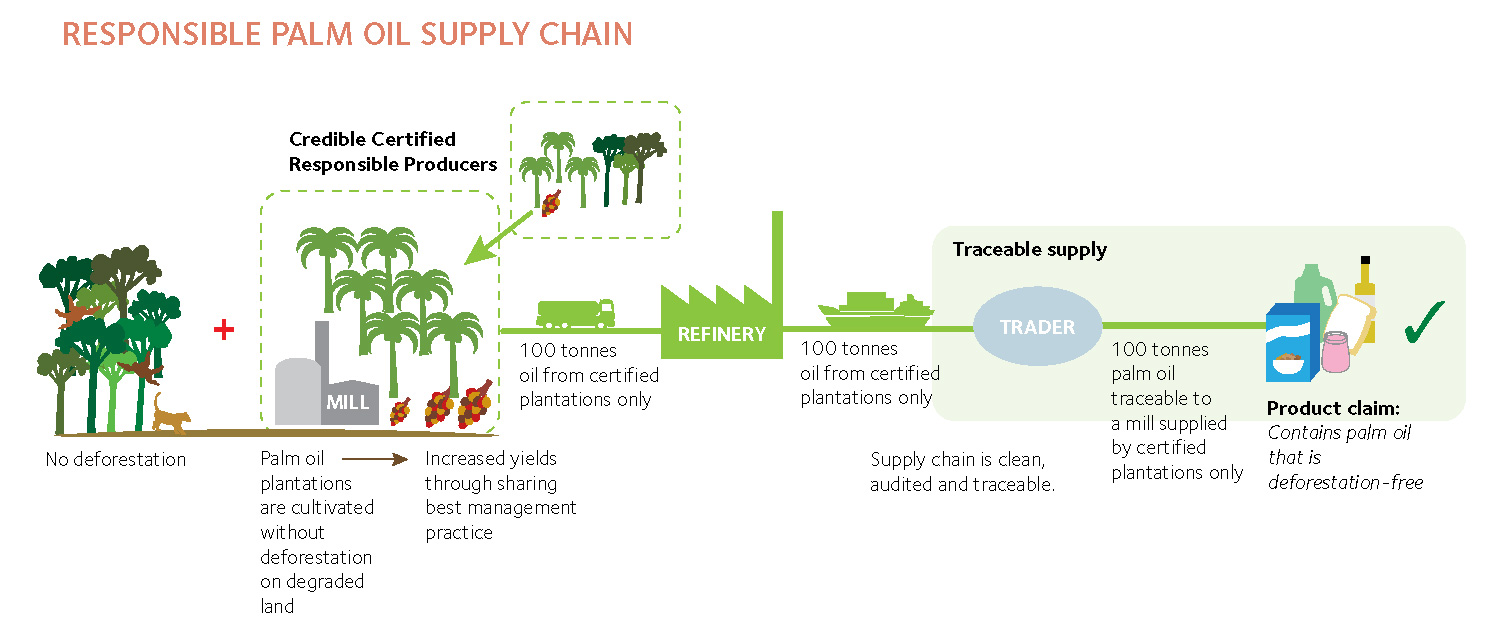
Greenpeace's idealized vision for sustainable palm oil production
Greenpeace says the RSPO should also move toward stronger standards, including banning conversion of peatlands and deforestation. The group calls on the RSPO to close some of the loopholes that allow companies to produce and trade un-certified palm oil while still operating under the banner of RSPO membership.

Greenpeace's report comes at a challenging time for the palm oil industry, relative to recent boom. Slowing demand for palm oil has severely cut profit margins in the sector this year. Meanwhile planned expansion in tropical Africa, mainland Asia, and Latin America could usher in an era of oversupply in the near-term, further undercutting prices.

It's unclear what impact these trends would have on demand for certified palm oil. Past gluts have led producers to walk away from marginal plantations and abandon plans for new development, potentially reducing pressure on forest lands. Whether this will increase interest in producing and sourcing premium RSPO-certified palm oil remains to be seen.

Nonetheless, in the short- to medium-term, palm oil production will likely continue to be a lucrative option relative to other forms of agriculture in the tropics, putting it in direct competition with forest preservation.


Source: http://news.mongabay.com/2013/0903-rspo-vs-greenpeace-palm-oil-deforestation.html

Malaysian Updates: Malaysia to launch palm oil certification scheme to compete with RSPO (6 Sep 2013)

Malaysia to launch palm oil certification scheme to compete with RSPO


September 06, 2013


Malaysia will launch its own certification standard for palm oil produced by local firms by 2014, reports Reuters. The initiative aims to differentiate Malaysian palm oil from that produced in other countries, while offering a less stringent alternative to the Roundtable on Sustainable Palm Oil, the sector's leading certification body.

"To move forward in the palm oil industry, we decided to have our own Malaysian standard," Embas, a Malaysian official, was quoted as saying. "This will be the branding that we hope to make for Malaysian palm oil."

"The RSPO is more of a burden to the industry. It has certain conditions that are too stringent, it is very costly, and they keep changing their goals. The premium that we get is also minimum."


Oil palm vs rain forest in Malaysia.


Embas said the program will start out as a voluntary initiative but would likely become compulsory over time. He added that the standard would help counter criticism about the environmental impact of palm oil.

Whether that proves to be the case is an open question. Vast areas of rainforest and peatlands in Malaysia have been destroyed for oil palm plantations, making the sector a top target for environmental campaigners. For example, the state of Sarawak is currently in the midst of a plan to convert a million hectares of forest -- much of which is native customary rights land -- to plantations.

Internationally, concerns about these practices tend to hang over the entire sector, including those companies that haven't converted forests for plantations. How the standard will reconcile those issues remains to be seen.

Malaysia is the world's second largest palm oil producer. Indonesia, the top producer, is also developing its own certification standard. The Indonesia Sustainable Palm Oil (ISPO) standard is based on compliance with environmental laws.

Oil palm plantation chopped out of the rainforest in Malaysia.


Source: http://news.mongabay.com/2013/0906-mspo-malaysia-palm-oil.html

Indonesian Updates: Indonesia finally establishes REDD+ agency to tackle deforestation (7 Sep 2013)

Indonesia finally establishes REDD+ agency to tackle deforestation

September 07, 2013


Indonesia has finally established an agency to implement the country's Reducing Emissions from Deforestation and Degradation (REDD+) program.

The REDD+ agency, established by a decree from President Susilo Bambang Yudhoyono on Friday, is a ministry-level body that will coordinate a national REDD+ strategy between various ministries that influence and control land use policy across the sprawling archipelago. The agency will also oversee monitoring, reporting, and verifying emissions reductions as required under a billion dollar agreement signed with Norwayin 2010. Norway is compensating Indonesia on a performance-basis for reducing greenhouse gas emissions from deforestation.

The pact with Norway stipulated the creation of the agency, but the process has lagged behind schedule due to disagreements between various bureaucracies. Nonetheless, REDD+ has been slowly moving forward in pilot provinces, including Central Kalimantan in Indonesian Borneo. The first REDD+ project —Rimba Raya— was approved in May.

Indonesia is also in the third year ofa moratorium on granting new logging and plantation concessionsin some 14 million hectares of previously unprotected rainforests and peatlands. The moratorium was also part of the Norway deal.

REDD+ has been strongly supported by President Yudhoyono under his plan to reduce emissions 26 percent relative a projected 2020 baseline. That target could rise to 41 percent with international aid. Indonesian is one of a handful of large developing countries that has set such goals.

More than 80 percent of Indonesia's greenhouse gas emissions result from land use, mostly peatlands degradation and rainforest destruction. Therefore curtailing logging and conversion of natural forests for plantations have emerged as top priorities for the country. More than half of forest loss in Indonesia is attributed to timber, pulp and paper, and palm oil production.

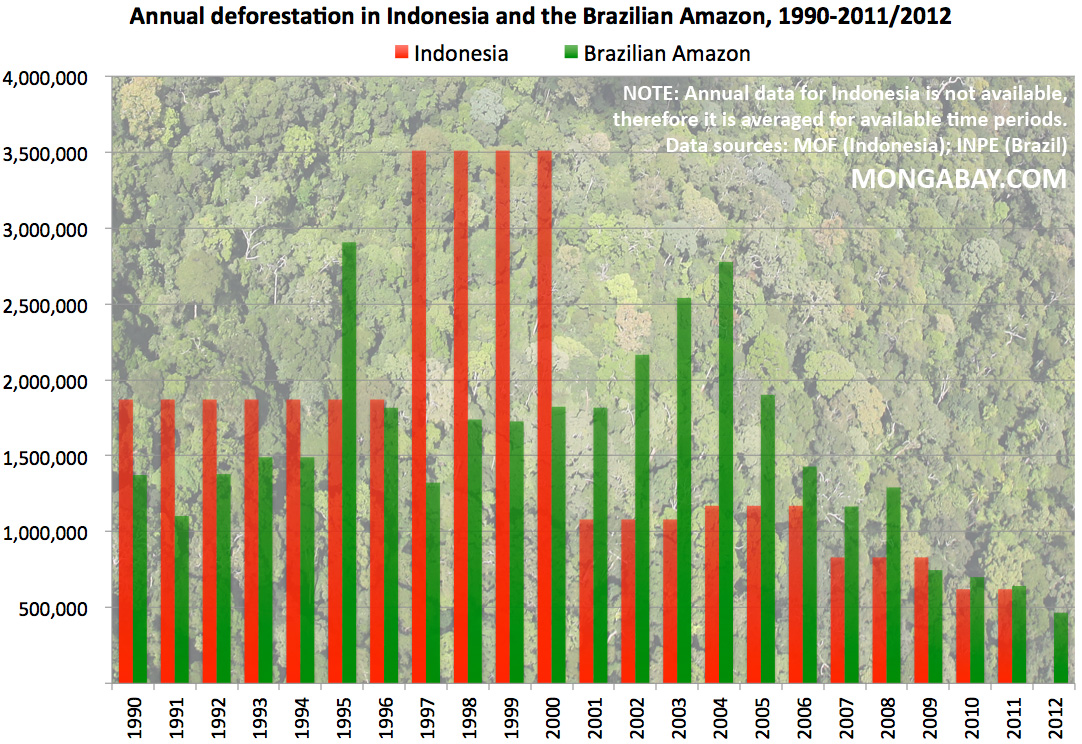
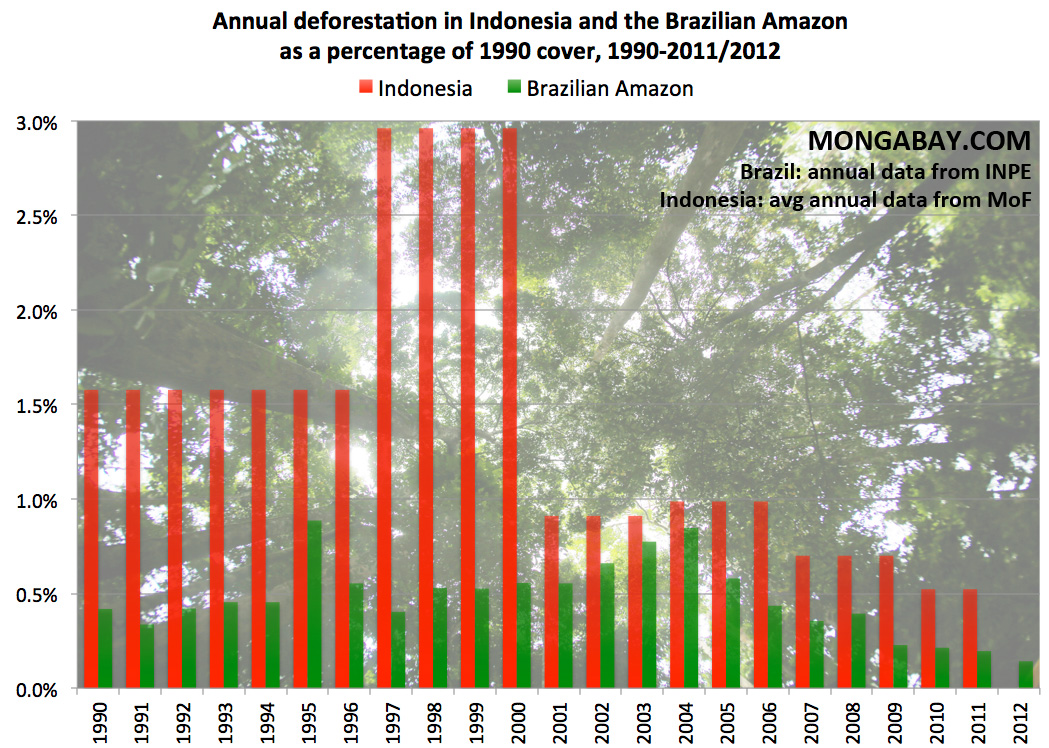
Chart: deforestation in the Brazilian Amazon and Indonesia, 1990-2011
Chart: deforestation in the Brazilian Amazon and Indonesia, 1990-2011Chart comparing annual deforestation between Brazil and Indonesia, 1990-2011
Chart comparing annual deforestation between Brazil and Indonesia, 1990-2011Indonesia has one of the highest deforestation rates in the world. Click images to enlarge.

The Indonesian government is expected to announce the REDD+ agency's head in coming weeks, according to Mongabay-Indonesia. The REDD+ Task Force, which the REDD+ agency replaces, was run by Kuntoro Mangkusubroto, a close advisor to the president.

The REDD+ agency will have 60 staff based in Jakarta.

Source: http://news.mongabay.com/2013/0907-indonesia-redd-agency.html

Malaysian Updates: FRIM develops DNA markers for karas species identification (2 Sep 2013)

FRIM Official PortalFRIM develops DNA markers for karas species identification

FRIM Genetic Laboratory will be ready to offer Aquilaria species identification and verification services once it has completed the development of the DNA markers.
FRIM Genetic Laboratory will be ready to offer Aquilaria species identification and verification services once it has completed the development of the DNA markers.
2 September 2013 (Monday) – Forest Research Institute Malaysia (FRIM) has successfully developed DNA markers for five Aquilariaspecies (karas), while still working on three (3) others, in an effort to help ensure the accurate identification and verification of the species.
FRIM has been approached by plantation owners to assist in this since 2011 to ensure compliance with requirements under the International Trade in Endangered Species Act 2008 (Act 686), gazetted on 14 February 2008 and enforced from 1 July 2010.
Under the Act, karas planters are required to register and submit relevant information on the species to be planted including its verification certificate. The problem with the species identification is that it is difficult to distinguish the species at sapling stage given they share similar features.
Aquilaria malaccensis, one of the species found in Terengganu.
Therefore, in support of the implementation of this Act and to assist the plantation sector, FRIM has taken the initiative to conduct the research project using DNA Marker Technology in 2012. The project, funded by the Ministry of Science, Technology and Innovation (MOSTI), is undertaken with support of the Forestry Department Peninsular Malaysia and Sarawak Forest Department.
The study covers all five major local species, namely A. malaccensis(agarwood, karas or depu), A. microcarpa (garu), A. hirta (candan), A. rostrata and A. beccariana (gaharu tanduk), and three exotic species—A. crassna, A. subintegra and A. sinensis.
“Once the study is completed end of this year, FRIM will be able to start offering Aquilaria species identification and verification services to karas planters by 2014,” said FRIM Director General Dato’ Dr Abd Latif Mohmod.
He said the high commercial value of its resin known as agarwood (gaharu), used in the perfume industry as well as for medical purposes and religious ceremonies, has resulted in the increasing interest in establishing karas plantations for agarwood in the country.
The value of agarwood can fetch up to RM25,000/kg depending of the grade and quality, and with the introduction of inoculation technology, agarwood production has increased.
Due to uncontrolled harvesting, Aquilaria species have been listed in the schedule species under Appendices I, II and III to the Convention on International Trade in Endangered Species (CITES).
For any query on the research project, please contact Dr Norwati Muhammad or Dr Siti Salwana Hashim via email: norwati@frim.gov.my / salwana@frim.gov.my.

Sunday, September 1, 2013

Events: APEC Climate Symposium 2013 organized by APEC Climate Center in Jakarta, Indonesia from 11-13 Nov 2013

APCC
APEC Climate Symposium 2013

The APEC Climate Symposium (APCS) is an annual event, held since 2005, that brings together around 100 scientists, representatives of National Hydrological and Meteorological Services, academics, policy-makers and students from around the world to discuss emerging issues in climate prediction and its applications. This year’s APEC Climate Symposium will be held in Jakarta, Indonesia from November 11 -– 13. The theme of the 2013 symposium is “Regional Cooperation on Drought Prediction Science to Support Disaster Preparedness and Management”.

This international symposium will explore the importance of advance climate information for supporting drought preparedness and disaster management. This event will be the first of its kind to specifically examine drought in the Asia-Pacific region. Over three days, the event will examine topics such as the latest innovative techniques in drought and seasonal climate prediction, the development of Early Warning Systems (EWS), drought response and risk management planning, regional cooperation on drought response, and information transfer and communication networks. The event will bring scientists and researchers together with representatives from government agencies, NGOs, and the private sector in order to foster a collaborative dialogue on drought prediction and management.

More information may be found in the First Announcement.

First Announcement download