Showing posts with label forest. Show all posts

Thursday, November 28, 2013

World News: BBC, 'Signature' achievement on forests at UN climate talks (22 Nov 2013)

'Signature' achievement on forests at UN climate talks


Forests in Peru
Countries with forests will have to provide information on safeguards for local communities

Nations meeting in Warsaw at UN talks have agreed a significant step forward towards curbing emissions from deforestation.
A package of measures has been agreed here that will give "results-based" payments to developing nations that cut carbon by leaving trees standing.
One observer told the BBC that this was the "signature achievement" of these talks.
Deforestation accounts for about 20% of global emissions of carbon dioxide.
Earlier this week the UK, US, Norway and Germany agreed a $280m package of finance that will be managed by the World Bank's BioCarbon fund to promote more sustainable use of land.
Now negotiators have agreed a package of decisions that will reduce emissions from deforestation and forest degradation plus pro-forest acitivities (known as Redd+).
The conference agreed a "results based" payments system that means that countries with forests will have to provide information on safeguards for local communities or biodiversity before they can receive any money.
'Thrilling' outcome
The delegates agreed to finalise the technical requirements and establish a process to allocate money.
According to Paul Bledsoe, an energy research fellow at the German Marshall Fund, who is attending the talks, it is a significant step.
"The ministers have been working for almost 10 years to finalise the rules which will allow donors to invest in forest management practices in the developing world and get a way to verify the emissions reductions," he said.
"I think this agreement allowing for investments in forests in developing countries is probably the signature achievement of these talks."
This view was echoed by Pipa Elias from the Union of Concerned Scientists.
With the technical and financing decisions signed and sealed at today's plenary, the Redd+ house is built, though there will be a bit more work in terms of furnishing it.
"The biggest issue is that developed countries still need to ante up the $20-$35bn a year necessary for a global Redd+ programme. But, in the meantime, developing countries can get started now. We couldn't be more thrilled with this outcome," she said.

Tuesday, November 26, 2013

India News: First National Taxonomic Congress - (December 5-7, 2013)

First National Taxonomic Congress - December 5-7, 2013

Home

The Ministry of Environment & Forests, together with the Botanical Survey of India (BSI), Zoological Survey of India (ZSI) and the National Biodiversity Authority (NBA), is organising first  National Taxonomic Congress at Scope Complex, 7, Lodhi ROad, New Delhi - 110003 during December 5-7, 2013 to bring together multiple stakeholders of taxonomic knowledge, including the users, and to provide a platform to foster collaborative partnerships amongst disparate groups, the institutions and the universities.

Wednesday, November 6, 2013

Event: India, First National Taxonomic Congress (13 Dec 2013)

First National Taxonomic Congress - December 4-6, 2013

Home
 The Ministry of Environment & Forests, together with the Botanical Survey of India (BSI), Zoological Survey of India (ZSI) and the National Biodiversity Authority (NBA), is organising first  National Taxonomic Congress at Scope Complex, 7, Lodhi ROad, New Delhi - 110003 during December 4-6, 2013 to bring together multiple stakeholders of taxonomic knowledge, including the users, and to provide a platform to foster collaborative partnerships amongst disparate groups, the institutions and the universities.

For further details visit http://bsienvis.nic.in, http://zsi.gov.in, http://nbaindia.org.

source from :http://envfor.nic.in/national-taxonomic-congress-2013

Monday, October 21, 2013

India Update: Constitution of a Team for immediate site inspection off the Uran coast near Mumbai, Maharashtra (11 Oct 2013)

Constitution of a Team for immediate site inspection off the Uran coast near Mumbai, Maharashtra

Printer-friendly version
The Ministry of Environment & Forests has constituted a team headed by the Member Secretary of the CPCB for immediate site inspection of oil spill from pipeline off the Uran coast near Mumbai, Maharashtra

Saturday, September 21, 2013

New Books: Quantitative Techniques in Participatory Forest Management Edited by Eugenio Martinez-Falero, Susana Martin-Fernandez,Antonio D. Garcia-Abril (22 Aug 2013)

Quantitative Techniques in Participatory Forest Management

Edited by Eugenio Martinez-Falero, Susana Martin-Fernandez,Antonio D. Garcia-Abril

CRC Press – 2013 – 608 pages
Descriptions:
Forest management has evolved from a mercantilist view to a multi-functional one that integrates economic, social, and ecological aspects. However, the issue of sustainability is not yet resolved. Quantitative Techniques in Participatory Forest Management brings together global research in three areas of application: inventory of the forest variables that determine the main environmental indices, description and design of new environmental indices, and the application of sustainability indices for regional implementations.
The book outlines a public participatory process to assess sustainability in forest management. It explores a new approach that links human and natural systems, reconsiders our interdependence with the diversity of life, and recognizes our role in a unique and complex system. The book also identifies quantitative indices that provide a vast amount of information on soil, landscape, and ecological functioning. It highlights the importance of these indices for public information programs on participatory processes and provides an operating procedure to identify the degree of convergence in the utility of multiple evaluators.
The last chapter describes a downloadable computer application that integrates the techniques explained in the book. Users accessing the application are offered a map representing their preferred forest management plan in the study zone. They are also given a map with the results of their corresponding community of evaluators, including the numerical and qualitative data for both. The system stores a record of the visit, including the visitor's profile and responses, to progress towards the joint forest management plan.
The quantitative techniques highlighted in this book create the basis for the development of scientific methodologies of participatory sustainable forest management. It details the methodology for the design of a forest management plan that best suits a specific preference system.

Contents:
Forest Sustainability and Public Participation, Fernando García-Robredo, Eugenio Martínez-Falero, Sigfredo Ortuño, and Rosario Tejera
Inventory Techniques in Participatory Forest Management, Cristina Pascual, Francisco Mauro, Ana Hernando, and Susana Martín-Fernández
Criteria and Indicators for Sustainable Forest Management, M. Victoria Núñez, Rosario Tejera, Antonio García-Abril, Esperanza Ayuga-Téllez, and Eugenio Martínez-Falero
Soil-Quality Indicators for Forest Management, Fernando Arredondo-Ruiz, Luis García-Montero, Inmaculada Valverde-Asenjo, and Cristina Menta
Functionality Indicators for Sustainable Management, José Antonio Manzanera, Susana Martín-Fernández, and Antonio García-Abril
Landscape Indicators for Sustainable Forest Management, Antonio García-Abril, M. Victoria Núñez, M. Angeles Grande, M. Dolores Velarde, Particia Martínez-Obispo, and Roberto Rodríguez-Solano
Assessment of Sustainability Based on Individual Preferences, Eugenio Martínez-Falero, Susana Martín-Fernández, and Antonio Orol
Optimization Methods to Identify the Best Management Plan, Susana Martín-Fernández, Eugenio Martínez-Falero, and Miguel Valentín-Gamazo
Multiparticipant Decision-Making, Esperanza Ayuga-Téllez, Concepción González-Garcia, and Eugenio Martínez-Falero
A Computer-Based Decision-Making Support System to Incorporate Personal Preferences in Forest Management, Eugenio Martínez-Falero, Antonio García-Abril, Carlos García-Angulo, and Susana Martín-Fernández

Sunday, September 8, 2013

Malaysian Updates: Malaysia to launch palm oil certification scheme to compete with RSPO (6 Sep 2013)

Malaysia to launch palm oil certification scheme to compete with RSPO


September 06, 2013


Malaysia will launch its own certification standard for palm oil produced by local firms by 2014, reports Reuters. The initiative aims to differentiate Malaysian palm oil from that produced in other countries, while offering a less stringent alternative to the Roundtable on Sustainable Palm Oil, the sector's leading certification body.

"To move forward in the palm oil industry, we decided to have our own Malaysian standard," Embas, a Malaysian official, was quoted as saying. "This will be the branding that we hope to make for Malaysian palm oil."

"The RSPO is more of a burden to the industry. It has certain conditions that are too stringent, it is very costly, and they keep changing their goals. The premium that we get is also minimum."


Oil palm vs rain forest in Malaysia.


Embas said the program will start out as a voluntary initiative but would likely become compulsory over time. He added that the standard would help counter criticism about the environmental impact of palm oil.

Whether that proves to be the case is an open question. Vast areas of rainforest and peatlands in Malaysia have been destroyed for oil palm plantations, making the sector a top target for environmental campaigners. For example, the state of Sarawak is currently in the midst of a plan to convert a million hectares of forest -- much of which is native customary rights land -- to plantations.

Internationally, concerns about these practices tend to hang over the entire sector, including those companies that haven't converted forests for plantations. How the standard will reconcile those issues remains to be seen.

Malaysia is the world's second largest palm oil producer. Indonesia, the top producer, is also developing its own certification standard. The Indonesia Sustainable Palm Oil (ISPO) standard is based on compliance with environmental laws.

Oil palm plantation chopped out of the rainforest in Malaysia.


Source: http://news.mongabay.com/2013/0906-mspo-malaysia-palm-oil.html

Saturday, August 10, 2013

Database: CIFOR Database Provides Insights into Forest Carbon Pools (1 Aug 2013)

CIFOR Database Provides Insights into Forest Carbon Pools

CIFOR1 August 2013: The Center for International Forestry Research (CIFOR) has released an online portal to share measurements of forest carbon pools globally. At present, the site includes data from 16 locations in seven countries in Asia and Central America.

The Forest Carbon Database (FCDB) provides resources for helping countries develop capacity to monitor national and sub-national activities, based on the work of the Sustainable Wetlands Adaptation and Mitigation Program (SWAMP), a collaboration between CIFOR and the US Forest Service.

In addition to providing maps of sample sites and measured carbon pools, the site includes default emission factors for wetlands to complement the Intergovernmental Panel on Climate Change (IPCC) 2013 supplemental guidance for national greenhouse gas (GHG) inventories on wetlands.

SWAMP invites those maintaining forest inventory data and those managing permanent sample plots to participate in the initiative. CIFOR is a member of the Consultative Group on International Agricultural Research (CGIAR). 

Saturday, August 3, 2013

Conference on Forestry and Forest Products 2013 organized by Forest Research Institute Malaysia and Forest Department Peninsula Malaysia from 11-12 Nov 2013

Conference on Forestry and Forest Products 2013

Date: 11-12 Nov 2013
Organizers: Forest Research Institute Malaysia and Forest Department Peninsula Malaysia


For more information: http://www.frim.gov.my/v1/seminar/CFFPR-2013.pdf

Workshop: Asia-Pacific Workshop on Forest Hydrology --- Water and Forests – Beyond Traditional Forest Hydrology organized by Forest Research Institute, Dehradun, INDIA on 23-25 Sep 2013

Asia-Pacific Workshop on Forest Hydrology

Water and Forests – Beyond Traditional Forest Hydrology

Dehradun, India 23-25 September 2013
The main objective of the workshop is to provide a forum for forging linkages between various international, regional and national agencies and institutions dealing with forest and water issues to share strategies, experiences and knowledge. The workshop will provide an opportunity for individuals and their associated agencies, organizations and networks to share lessons learnt from case studies in the Asia Pacific region on themes related to forests and water. This will give a fillip to collaborative research, allow for alignment of research priorities and help strategise long term research studies beyond traditional forest hydrology.
The workshop will cover the following themes:
  1. Forest Hydrology and Climate Change
    • Climate change impact on watershed hydrology
    • Climate change impact on forests and their implications to the forest hydrological regime
  2. Hydrological Regulatory Service of Forest
    • Forest ecosystem services including river flow
    • Impact on regulatory hydrological services due to changes in structure, composition and functioning of forest ecosystem
  3. Forest Influence on Precipitation and Micro-climate
    • Precipitation and forests linkages
    • Forest influence on ET, Temp., Humidity, Soil moisture, etc.
  4. Effect of Forest Management Practices and Disturbances on Quantity and Quality of Water
    • Managing forests for water and moisture
    • Forest disturbances and their impacts on quantity and quality of water
  5. Forests as Source of Water: Managing for Livelihoods and Food Security
    • Implications for forest biodiversity and livelihoods
    • Soil and water conservation for surface, springs and ground water recharge
  6. Frontiers of Research and Application of Modern Tools and Techniques in Forest Hydrology
    • Application of Remote Sensing & GIS
    • Frontiers of Research using isotope techniques, modeling and other modern tools
Abstract submission is now open. Registration deadline: 15 August 2013.
Organised by: Forest Research Institute, Dehradun, INDIA.

Thursday, August 1, 2013

Malaysian Updates: Malaysian NGOs form alliance to address palm oil concerns (31 Jul 2013)

Malaysian NGOs form alliance to address palm oil concerns

Rhett A. Butler, mongabay.com
July 31, 2013


Seven Malaysia-based NGO's have banded together to form an alliance to provide a Malaysian civil society perspective on social and environmental issues related to palm oil production. The initiative aims in part to counter Malaysian industry claims that concerns over palm oil are purely driven by Western NGO's.

The alliance, called the Malaysian Palm Oil NGO Coalition (MPONGOC), currently includes the Borneo Rhino Alliance (BORA), Bornean Sun Bear Conservation Centre (BSBCC), Indigenous Peoples Network of Malaysia (JOAS), Land Empowerment Animals People, (LEAP), Malaysian Nature Society (MNS) Sabah branch, Partners of Community Organisations (PACOS) Trust and WWF Malaysia, according to a statement issued by the group.

"MPONGOC aims to influence land use policy and decision making, and is also working towards advocating consumer responsibility," said the group. "Strengthening implementation of best environmental management practices including enforcement of pollution regulations, building capacity for smallholder verification and best practices, supporting community-based organizations largely made up of indigenous people to engage with the industry on their own terms, and mainstreaming awareness on human wildlife conflict are other objectives."


Conversion of rainforest for oil palm plantations in Malaysian Borneo


The move is significant because much of the dialog around social and environmental issues related to palm oil production is shaped by international NGO's, most of which are based in Western Europe or the United States. Therefore it has been relatively easy for the palm oil industry to brush off criticism by claiming that it simply represents a new form of colonialism, whereby Western nations use NGO's as a proxy to protect domestic soy, corn, and rapeseed producers. The Malaysian palm oil industry has spent millions of dollars on marketing and public relations since 2007 attempting to advance that message.

Now that messaging will be undercut by local NGO's expressing their own viewpoints on issues like deforestation, pollution, and land-grabbing. Some of those views may not necessarily match up with those of international NGO's. To start, MPONGOC says it will "engage in constructive and on-going dialogue with the industry via the Malaysian Palm Oil Association (MPOA), Malaysian Palm Oil Board (MPOB) and the Malaysian Palm Oil Council (MPOC)", industry groups that have had limited direct engagement with Western NGOs.


Clearing of natural forest for oil palm plantations in Malaysian Borneo


MPONGOC says it will also engage with international NGO's, which could help bridge the gap in understanding between Western activist groups — some of which call for measures, like banning palm oil imports, that play directly into industry messaging — and Malaysian palm oil producers.

“We intend to engage with all parties, bring our collective voice, leadership, skills and experience to the table to deepen and expand dialogue between civil society, industry and government in the vital conversation of sustainability for all," said LEAP Executive Director Cynthia Ong in a statement.

"We see MPONGOC as being able to offer solutions by involving all stakeholders," added PACOS Trust Executive Director Anne Lasimbang, noting that some of the most vulnerable people — indigenous communities — have been largely ignored in the debate over palm oil.

WWF-Malaysia Executive Director Dionysius Sharma said that the initiative could help provide a path toward more sustainable palm oil production.

“We hope that through MPONGOC, the industry, regulators, financiers, buyers and other stakeholders could work collectively to develop and promote the adoption of environmentally appropriate, socially beneficial and economically viable practices in the oil palm industry," he said.


Orangutans have become a symbol for concerns about uncontrolled expansion of oil palm plantations into native forests.


Palm oil is the highest-yielding source of vegetable oil grown on a commercial basis. But the industry's expansion in recent decades has been a major driver of deforestation across Malaysia and Indonesia. Biologists have thus called the crop the "single most immediate threat to the greatest number of species".

Source: http://news.mongabay.com/2013/0731-MPONGOC-palm-oil.html

Sunday, July 28, 2013

Forests: Near real-time deforestation monitoring system to go global (25 Jul 2013)

mongabay.com logo

Near real-time deforestation monitoring system to go global

Rhett A. Butler, mongabay.com
July 25, 2013


A near real-time deforestation monitoring system will soon cover all the world's tropical forests, report the researchers behind the initiative.

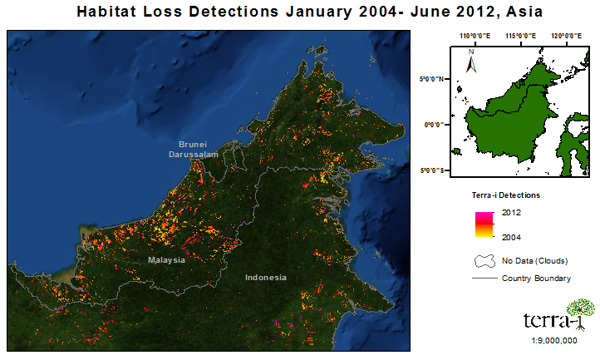
Terra-i — a collaborative project between Colombia's International Center for Tropical Agriculture (CIAT), the Nature Conservancy (TNC), the School of Business and Engineering (HEIG-VD) in Switzerland, and King’s College London — has been testing its system in tropical Asia, extending its reach beyond its stronghold in Central and South America. Terra-i uses data from NASA's satellite-based MODIS sensors to assess changes in forest cover at a 250-meter resolution every 16 days. The system is similar to the near real-time deforestation tracking system used in Brazil by the government and Imazon, a local NGO.

"We can now provide near real time data on land cover change in Latin America and we expect to be producing pan-tropical results over the next few months," Louis Reymondin, a researcher at CIAT, told mongabay.com. "Since this is the first continental scale system on operation and the first to work outside of the Brazilian Amazon, this allows a similar level of reporting and understanding of land cover change for other countries as Brazil has had in place for some time."

The system detects deforestation based on changes in "greenness" in natural vegetation. It normalizes seasonal vegetation response to rainfall to reduce false positives. The data is then mapped and made available for download viawww.terra-i.org. For Latin America, data is available at the national level and by protected area, ecosystem, and state or municipality.


Deforestation in Borneo 2004-2012, according to Terra-i


Reymondin says Terra-i has applications beyond serving as a deforestation alert system.

"Terra-i has a range of applications, such as: monitoring the effectiveness of conservation; assessing the impact on the environment of the construction of new infrastructure like roads; assessing the contribution of deforestation to climate change and understanding the likely impacts of deforestation on downstream and downhill populations."

Terra-i isn't the only near real-time deforestation alert system under development. The World Resources Institute (WRI) is putting the final touches on Global Forest Watch, a tool that will also track deforestation on a bi-weekly basis, while offering layers like plantation concession maps as well as providing a mechanism for users to share photos and reports from the field.

Source: http://news.mongabay.com/2013/0725-terra-i-deforestation-tracking-system.html

Sunday, July 21, 2013

Malaysian Updates: 80% of rainforests in Malaysian Borneo logged (17 Jul 2013)

80% of rainforests in Malaysian Borneo logged

Rhett A. Butler, mongabay.com
July 17, 2013


Bulldozer at a conventional logging site in Borneo

80 percent of the rainforests in Malaysian Borneo have been heavily impacted by logging, finds a comprehensive study that offers the first assessment of the spread of industrial logging and logging roads across areas that were considered some of Earth's wildest lands less than 30 years ago.

The research, conducted by a team of scientists from the University of Tasmania, University of Papua New Guinea, and the Carnegie Institution for Science, is based on analysis of satellite data using Carnegie Landsat Analysis System-lite (CLASlite), a freely available platform for measuring deforestation and forest degradation. It estimated the state of the region's forests as of 2009.
The study uncovered some 226,000 miles (364,000 km) of roads across Sabah and Sarawak, and found that roughly 80 percent of the two states have been impacted by logging or clearing. At best, only 45,400 square kilometers of forest ecosystems in the region remain intact.

"The extent of logging in Sabah and Sarawak documented in our work is breathtaking," said study co-author Phil Shearman of the University of Papua New Guinea. "The logging industry has penetrated right into the heart of Borneo and very little rainforest remains untouched by logging or clearfell in Malaysian Borneo."

"There is a crisis in tropical forest ecosystems worldwide, and our work documents the extent of the crisis on Malaysian Borneo," added lead author Jane Bryan of the University of Tasmania. "Only small areas of intact forest remain in Malaysian Borneo, because so much has been heavily logged or cleared for timber or oil palm production.

"Rainforests that previously contained lots of big old trees, which store carbon and support a diverse ecosystem, are being replaced with oil palm or timber plantations, or hollowed out by logging."

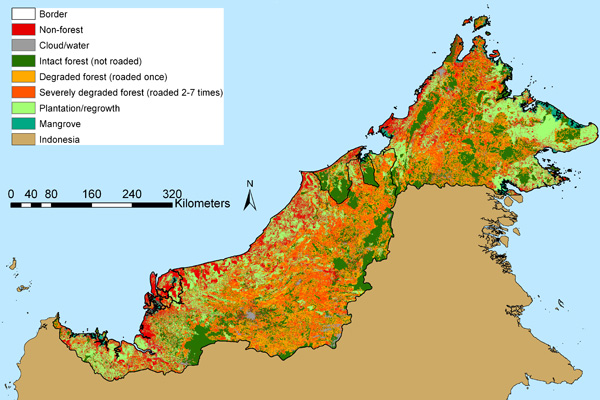
The state of forests in Malaysian Borneo (Sabah and Sarawak) in 2009


The state of forests in Malaysian Borneo (Sabah and Sarawak) in 2009. Note that the authors call their estimates of degraded forest "conservative". While the study didn't assess forest cover in Indonesian Borneo, the authors indicate the situation is similar.


Malaysian Borneo's rainforests are home to a number of charismatic species, including Bornean orangutans, pygmy elephants, clouded leopards, proboscis monkeys, and Sumatran rhinos, which are on the edge of extinction. Its ecosystems also store vast amounts of carbon, which is released through forest degradation and clearance, land-clearing fires, and peatlands drainage and conversion to plantations.

The new analysis shows that logging and conversion have taken a heavy toll in the two states. One reasonthe impact of logging has been greater in Borneothan regions like Latin America and Central Africa is the nature of the island's forests, which have a high density of commercially exploitable dipterocarp trees. Therefore loggers in Malaysian Borneo extract a much higher volume of trees per hectare, causing considerable damage and requiring longer harvest cycles. Low returns between harvests increase pressure to convert logged-over forests for timber and oil palm plantations.


Logging road in Malaysian Borneo in 2012. Photo by Rhett A. Butler.


"Under this logging regime, the majority of commercial Dipterocarps (> 60 cm diameter at breast height) are felled and harvested in the first cycle (> 45 cm in Sarawak for non-Dipterocarp species), generally yielding 50-150 m3ha-1 of timber in the first harvest, with the aim of securing sufficient regeneration of commercial trees to allow a second harvest 25-30 years later," the authors write. "Substantial damage to soil, waterways and forest structure and residual trees is caused by this form of logging, with progressive degradation of biomass over repeated harvest cycles. Bulldozers impact approximately 30-40% of the logged area and damage is caused to 40-70% of residual trees. For these reasons initial timber yields cannot be maintained over multiple harvest cycles, with 25-30 years between harvests too short a period to allow regeneration of timber stocks."

The result is severe damage to forests: 44 percent of the region's forests were classified as "degraded" or "severely degraded," while another 28 percent had been converted to plantations or was in the process of recovering from logging.

"There are very few areas of rainforest in the Malaysian states of Sabah and Sarawak that haven’t already been logged or cleared - and a lot of this has happened since 1990," Bryan told mongabay.com.


Time series showing roads and degraded forest metastasizing across an area in Sarawak.


The study also assessed forest cover in protected areas. It found that in 2009 only 8 percent of Sabah was covered by intact forest under designated protected areas. That represented 31 percent of Sabah's remaining intact forest cover. In Sarawak, the situation in 2009 was even bleaker: only 3 percent of land cover consisted of legally protected intact forest. The results indicate that 85 percent of Sarawak's intact forest cover is unprotected.


But the situation in Sabah is changing. Since 2009, the Forestry Department has moved to set aside several blocks of high conservation value within the Yayasan Sabah concession, an area of roughly a million hectares. These forests have been re-zoned as "Class I" forest reserves, making them off-limits to logging or conversion. In other areas, the Sabah Forestry Department is mandating certification when concessions in logged-over forests come up for renewal. The idea is to boost long-term productivity by making selective logging in secondary forests more sustainable, according to the agency's director, Sam Mannan.

"There is very little primary forests left in Sabah, but where they exist, we are working to ensure they are protected," Mannan told mongabay.com. "Recently added Class I areas consist of logged-over forests. The future of rainforests in Sabah lies with the logged over forests."

"All long term licensees, meaning 99 percent of Sabah, will need to be certified under any internationally recognized forest certification scheme, including the Forest Stewardship Council (FSC), by 2014."


Mannan added that more up-to-date satellite imagery would help countries like Malaysia better manage forest resources, including identifying areas that should be set aside for protection.

"Satellite companies should give rainforest nations images for free and in real time," he said.


Conventional logging operation in Sabah, Malaysian Borneo

The study is based on freely-available satellite imagery from NASA's Landsat, which captures images of every point on the planet every 16 days. The satellite data was analyzed using CLASlite, software that was developed by a team led by Greg Asner at the Carnegie Institution for Science.

Other researchers have mapped Malaysian Borneo's forest cover before, but the new study marks the first time that degradation and logging roads have been comprehensively documented across the region, according to the authors.

"The sheer extent of logging, that logging roads penetrate almost the entire area of remaining forests in Sabah and Sarawak may be a surprise to many – that’s because most previous studies have used low resolution imagery to map forests, and you simply can’t ‘see’ logging unless you use high resolution imagery like we did," the authors told mongabay.com via email, adding that separating logged and unlogged forests was a "major challenge."

RESPONSES: AUTHORS BRYAN & SHEARMAN

What are the most important findings?

There were two important findings. The first is that there are very few areas of rainforest in the Malaysian states of Sabah and Sarawak that haven’t already been logged or cleared - and a lot of this has happened since 1990. We estimate that only about 22% of the land area of Malaysian Borneo is still covered by forests that have not been logged, and that’s being conservative. The sheer extent of logging, that logging roads penetrate almost the entire area of remaining forests in Sabah and Sarawak may be a surprise to many – that’s because most previous studies have used low resolution imagery to map forests, and you simply can’t ‘see’ logging unless you use high resolution imagery like we did.

The second finding was that in contrast to Malaysian Borneo, the nation of Brunei which shares a border with Malaysian Borneo, has managed to keep the majority of its forests unlogged. The difference between the two countries is quite startling. On the Malaysian side of the border, we found that there was a really dense pattern of logging roads and logging skid trails built through the forest, which stops right at the border. On the other side in Brunei, the forests were largely unbroken by any roads or skid trails. On one side of the border, there was heavy logging since 1990, and on the other side virtually none. It’s quite a contrast. Over the past decades, Brunei built its wealth on oil and gas extraction and excluded logging, which has been vastly more successful in forest protection. It has meant that today Brunei still has more than half of its land area covered by intact forest ecosystems, while Malaysian Borneo has at most 22%. But that said, Brunei is much smaller – only about 3% of the area of Malaysian Borneo.

Do you have any conservation policy recommendations?

Comparing what has happened in Brunei where more than half of the land area is still covered by unlogged forests, with Sabah and Sarawak, where at most 22% remains is instructive. We think Brunei shows that excluding logging entirely is an effective way to protect forests in the long term, but it does mean that a nation would need an alternative income stream. For Brunei, that came from oil and gas. If you look at the United Nations Human Development Index, which includes life expectancy, education and national income, Brunei is ahead of Malaysia. This is good news for other mineral rich tropical nations with large areas of unlogged forests remaining - it shows that there is no need to rely on industrial scale, widespread logging to build national wealth and well being. Excluding the logging industry entirely to protect forests is a feasible option without necessarily harming national development and economic goals. The comparison of Brunei with Malaysian Borneo also shows that excluding logging entirely is likely to be much more successful at forest protection in the long term than relying on a small network of protected areas.

For Sabah and Sabah and Sarawak, where almost all forests have already been heavily logged, something different is needed. On the one hand, because there are so few unlogged forests remaining, strengthening protection of these areas in protected areas makes sense. But because so few forests remain unlogged in Sabah and Sarawak, the lion’s share of forest protection efforts need to focus on already logged forests. Logged forests in the tropics tend to be forests in transition. Logged forests are far more likely to be cleared than unlogged forests, with roads opening up the place to serial logging events. In Sabah and Sarawak in many places we found multiple roads being built through the same forests over a period of 20 years. Repeated logging within a short period of time means that forests are getting progressively hollowed out, with the end point being their conversion – either deliberately for oil palm, or ‘accidentally’ via fire. This is where the extensively logged forests we documented in Sabah and Sarawak are likely to go unless their regeneration is ensured by protection efforts.

This is where we think the REDD program could still have an important role to play. The original intent of REDD was to provide tropical forested nations with an alternative source of income to industrial logging or agriculture of the kind that involves deforestation. The Malaysian states of Sabah and Sarawak have a huge opportunity to wind back the logging industry, prevent further logging of large areas of already logged forest, allow their full regeneration, and replace the income with carbon payments. At the moment the alternative scenario is to pin forest conservation hopes solely on the protected area network, in which case we can expect about 8% of Sabah’s and 3% of Sarawak’s formerly vast forest ecosystems to remain undamaged in the future.
"You can only really tell remotely whether tropical rainforest has been logged or not using high resolution imagery (imagery with a pixel size of 30 meters or less), and the higher the resolution of the imagery, the more time and computer processing power is required. Luckily Greg Asner’s lab at the Carnegie Institution for Science has spent the past decade working on that problem. Their CLASlite program is excellent at resolving this issue. When you combine the output of CLASlite with a map of logging roads which we digitized as part of our study, we were able to construct a very detailed map of forest cover and the extent of logging activities."

Asner called the results of the study "sobering."

"The problem with previous monitoring reports is that they have been based on satellite mapping methods that have missed most of the forest degradation in Malaysian Borneo, and elsewhere throughout the tropics," he said in a press release. "I’m talking about heavy logging that leaves a wake of forest degradation, even though the area may still look like forest in conventional satellite imagery. With the CLASlite system, we can see the effects of logging on the inner canopy of the forest. The system revealed extremely widespread degradation in this case.”

As a point of comparison, the researchers used Brunei, the tiny oil-rich sultanate that separates Sabah and Sarawak. Brunei relies on offshore oil and gas — and associated services — to fuel its economy. Unlike Sabah and Sarawak, it has largely left its forests for the birds. The difference in policy offers a stark contrast when it comes to forest cover: nearly two-thirds of its forest cover is "intact" and only 15 percent is classified as "degraded" or "severely degraded."

"The difference between the two countries is quite startling," the authors said. "On the Malaysian side of the border, we found that there was a really dense pattern of logging roads and logging skid trails built through the forest, which stops right at the border. On the other side in Brunei, the forests were largely unbroken by any roads or skid trails."

The authors argue that Brunei's example shows that excluding logging from primary forests is a far more effective conservation strategy than trying to manage old-growth forests through reduced-impact logging.

"The history of forestry in Sarawak and Sabah indicates that attempting to reform the logging industry does not result in meaningful forest conservation," they write. "A far better approach, as shown in Brunei, is to prevent logging of natural forests in the first instance, or in places where logging has occurred, to exclude further logging from what remains."

"In Sarawak and Sabah in particular, and globally across the tropics, the crisis in tropical forests is now so severe that any further sacrifice of primary ecosystems to the industrial logging industry ought to be out of the question for all who seriously seek to maintain biodiversity and forest ecosystems."

The challenge for Sabah and Sarawak however will be making the transition away from forestry and plantation agriculture. At present there is intense political pressure to turn over non-productive logged-over forests for conversion to plantations rather than wait for them to recover or turn them over for protected areas. While both states have considerable offshore energy reserves, revenue flows from those resources accrue to the central government. So neither Sabah nor Sarawak can currently rely on Brunei's economic model.

Some, including the authors, have suggested that the Reducing Emissions from Degradation and Deforestation (REDD+) program could provide sufficient economic incentive for keeping forests standing in Malaysian Borneo. But as currently designed, only limited areas of the region's forests would quality for carbon payments. Furthermore, the current state of the carbon market means those carbon payments are unlikely to be competitive with the alternative: clearing forests for timber and palm oil. So in the near term, the fate of unlogged forests in Malaysian Borneo will likely be determined by the will of Malaysians to keep them standing.

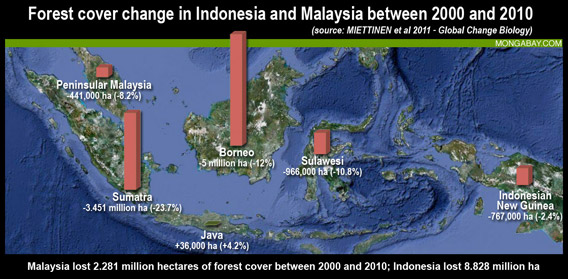
Deforestation on a regional scale
Deforestation in Indonesia and Malaysia between 2000 and 2010. Note that Borneo as a wholelost 12 percent of its forest cover(and 25 percent of its peatlands) during that time period, according to a paper published by Jukka Miettinen and colleagues in Global Change Biology in 2011.


CITATION: Jane E. Bryan, Philip L. Shearman, Gregory P. Asner, David E. Knapp, Geraldine Aoro, Barbara Lokes (2013).Extreme Differences in Forest Degradation in Borneo: Comparing Practices in Sarawak, Sabah, and Brunei. PLoS ONE 8(7): e69679. doi:10.1371/journal.pone.0069679


Source: http://news.mongabay.com/2013/0717-borneo-rainforest-logging.html

Thursday, July 18, 2013

Indonesian Updates: Billions lost to corruption in Indonesia’s forest sector, says report by Diana Parker, Mongabay-Indonesia correspondent (17 Jul 2013)

Billions lost to corruption in Indonesia’s forest sector, says report

Diana Parker, Mongabay-Indonesia correspondent

July 17, 2013


Corruption and mismanagement in Indonesia’s forest sector have cost the government billions of dollars in losses in recent years, including over $7 billion in losses from 2007-2011, Human Rights Watch said in a report released yesterday. The report also blasted the country’s “green growth” strategy, saying that despite recent reforms, Indonesia’s forestry policies as they are implemented today continue to allow widespread forest clearing and threaten the rights and livelihoods of forest-dependent communities.

“The Indonesian government has been selling the expansion of its forestry sector as an example of sustainable ‘green growth’ and an antidote to climate change and poverty, but the evidence suggests otherwise,” Joe Saunders, deputy program director at Human Rights Watch, said in a release to the media.

“Funds that could be used to improve public welfare are being siphoned off to enrich a handful of people or needlessly lost through mismanagement. And the regional smog crisis suggests the environment and rural livelihoods are the victims, not the beneficiaries, of the government’s forest policies.”

Mismanagement in Indonesia’s forestry sector has serious consequences for human rights and the environment, noted Human Rights Watch in the 61-page report, “The Dark Side of Green Growth: Human Rights Impacts of Weak Governance in Indonesia’s Forestry Sector.” Indonesia is one of the world’s top carbon emitters, largely due to the clearing of forests for agriculture, and increased pressure on land for the expansion of oil palm and pulp plantations has caused violent conflicts to erupt between companies and local communities who believe they have not been adequately compensated for their land.


New oil palm plantation established on peatland outside Palangkaraya, Central Kalimantan.


Loss of livelihood and agrarian conflicts

The report documents three of high-profile conflicts in Lampung province on the island of Sumatra in 2010 and 2011 in which a number of local residents and security personnel were killed. And with thousands of agrarian conflicts reported each year – the president received reports of 8,495 conflicts in 2012 alone – these cases are just the tip of the iceberg, the international rights watchdog said.

According to the report, companies are often not held accountable for failing to honor compensation agreements with communities. At the same time, residents can be harshly punished, often by police and military personnel who have been paid by the company, for reclaiming disputed land or “poaching” palm fruits or timber from land they feel they have not been properly paid for.

The Indonesian government has contributed to escalating conflicts, Human Rights Watch said, by failing to hold companies accountable for violating compensation agreements and by failing to comply with its own regulations for issuing concessions on land claimed by communities.

Under Indonesia’s current forest management system, the government often grants concessions for logging or plantation development without first guaranteeing buy in from local communities. This opens the door for land grabs, and the report documents cases in which local communities felt they did not receive proper compensated for land they lost. The report indicates that Indonesia’s forest communities, among the country’s poorest groups, have been the most harmed under this system.

“This has been an ongoing problem, but it does appear that things are getting worse because of the increasing pressure to convert land for pulp and oil palm concessions,” Arvind Ganesan, business and human rights director for Human Rights Watch, told Mongabay-Indonesia in an email. “This demand comes [from] the government’s own ‘green growth’ targets, as well as global demand for paper and biofuel.”

“[Plantation] concessions represent a more serious impact on forest-related livelihoods than the logging concessions that were prominent during the 1970s-1990s plywood and veneer boom, as the land is permanently converted to other uses,” Ganesan added.


Peat forest in Borneo


Loss of state revenue

From 2007 to 2011, illegal logging and forest sector mismanagement led to $7 billion in losses to the Indonesian government, the report, an update to the 2009 Human Rights Watch report, “Wild Money,” found. Those funds, the rights group said, could have been spent to provide important services so some of Indonesia’s poorest and most vulnerable communities.

Losses have also been increasing in recent years, despite attempts to reform the sector, with 2011 losses totaling over $2 billion, or more than the country’s entire health budget for that year.

Many people in rural areas in Indonesia still lack access to doctors and adequate health care. The report contends that by allowing large-scale losses of revenue from corruption in the forestry sector, the government is missing an opportunity to provide critical services to those communities and is instead allowing funds to be diverted into the pockets of a few wealthy individuals.


Illegal logging in Borneo


Inadequate reforms?

The report points to three key reforms that have recently come into force – a system to certify timber legality, a moratorium on plantation expansion in forests and peatlands, and Indonesia’s new freedom of information law. “Each are important steps to address the problem,” Ganesan told Mongabay-Indonesia. “But they do not go far enough and what they do cover hasn’t been effectively implemented.”

The timber legality certification system, or SVLK, was put in place in part as a response to requirements in the United States and the European Union that prohibit importing of illegally obtained timber. The system tracks the chain of custody of Indonesian timber, auditing companies to ensure that timber is acquired in accordance with Indonesian law. However, the report explained, these audits do not look into whether timber was harvested on land claimed by communities, whether local communities were consulted or gave their free, prior and informed consent, or whether communities were compensated by companies for their lost access to forests.

In its report, Human Rights Watch called Indonesian President Susilo Bambang Yudhoyono’s decision in May to renew a two-year moratorium on the issuing of new concessions in primary forests and peatlands a “bold, positive step.” However, the group also pointed out a number of serious loopholes. The moratorium is only for new licenses, so concessions issued before the policy was put in place in 2011 are exempt. As a presidential decree, there are also no legal sanctions for violating the policy. And the moratorium is temporary, meant to allow time to reform the country’s forestry sector. In the report, Human Rights Watch calls on the Indonesian government to define what specific reforms must take place before the moratorium can be lifted.


PSDH = Timber Royalty Fee, DR = Reforestation Fee. Data source: Indonesian Pulp and Paper Association. Annual reports from International Tropical Timber Organization, and Indonesian Ministry of Forestry. Courtesy of HRW.


Indonesia’s Freedom of Information Law, which entered into force in 2010, is another positive step toward forest-sector reform that Human Rights Watch acknowledged in its report, although the group contends that its implementation still falls short.

“The Freedom of Information Act is still not fully implemented and often sporadically enforced, even when the courts order disclosure of information,” Ganesan told Mongabay-Indonesia. He further explained that the lack of available forestry information “cripples oversight of the sector and provides avenues for corruption.”

The report also addressed Indonesia’s recent Constitutional Court ruling, which said the government’s practice of granting concessions on customary land was unconstitutional. This ruling could offer some hope for forest communities, Human Rights Watch said. However, the report also warned that the mapping and registration of customary lands necessary to implement this ruling was a “minefield of opportunities for continued corruption and disenfranchisement that could lead to increased conflicts.”


Illegal sawmill in Borneo


‘Not inherently bad’

While the report challenges Indonesia’s “green growth” objectives – claiming that growth in the forest sector as it is occurring today is causing deforestation and carries severe human rights consequences – the group also stressed that better management in the sector could lead to more sustainable and rights-respecting growth.

“Oil palm and pulp plantations are not inherently bad for the environment and human rights, it is the way that these sectors have been implemented,” Ganesan told Mongabay-Indonesia. The lagging progress on forest-sector reforms, he explained, has not kept pace with the increasing pressure to expand concessions due to global demand for these products and the government’s own growth plans. “[The problem] is more about developing oil palm and pulp in an unsustainable manner and without due regard for human rights.”

The solution? For plantation expansion, Ganesan said, concessions should be established on degraded lands, rather than logging natural forests, which is happening under the current system. To avoid conflicts with communities, obtaining free, prior and informed consent is key, and plantation operators should have agreements with communities so that concessions are managed in ways that benefit local residents and give residents access to credible grievance mechanisms.

Source: http://news.mongabay.com/2013/0717-hrw-dark-side-of-green-growth.html