Showing posts with label deforestation. Show all posts

Thursday, April 17, 2014

Malaysia News: Malaysian palm oil giant tied to social conflict, deforestation, says report (11 April 2014)

Malaysian palm oil giant tied to social conflict, deforestation, says report

Source: Mongabay.com
Published on 3rd April, 2014
Borneo rainforest
Rainforest conversion for an oil palm plantation in Malaysia 
Unlike other palm oil giants that have recently made strong commitments to eliminating deforestation and social conflict from their supply chains, Malaysia-based Kuala Lumpur Kepong (KLK) continues to source palm oil associated with forest destruction and community conflict, argues a new report published by the Rainforest Action Network (RAN).

The report, titled Conflict Palm Oil in Practice, cites several high profile cases from the past year involving KLK, including conflict with communities in Papua New Guinea and Liberia, use of child labor on an Indonesian plantation, and continued deforestation at two plantations in Indonesia. 

“The sheer magnitude of the abuse that KLK has engaged in is shocking,” said Robin Averbeck, senior forest campaigner with Rainforest Action Network. “From Liberia to Indonesia to Papua New Guinea, KLK is involved in everything from the destruction of endangered orangutan habitat to widespread child labor and the violation of the rights of Indigenous Peoples.” 
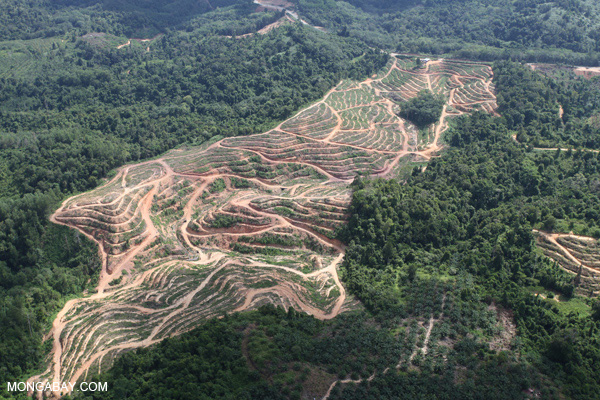
Deforestation for palm oil in Malaysia 

Deforestation for palm oil in Malaysia
Deforestation for palm oil in Malaysia 

The report aims to pressure American firms that buy from KLK to drop the company as a supplier. One of KLK’s major buyers, Wilmar, recently established a zero deforestation policy that would seem to compel it
to stop doing business with the palm oil producer. But Cargill, a KLK buyer that has been the target of a long-running RAN campaign, has no such policy. 

“KLK is able to continue to operate with impunity while major traders, like Cargill, continue to purchase the palm oil it produces to sell to food manufacturers in the United States and around the world,” noted Averbeck. 

Deforestation for palm oil in Malaysia
Deforestation for palm oil in Malaysian Borneo 

RAN’s hope is that convincing major traders to stop buying from KLK could push the company to adopt a zero deforestation, zero conflict policy like those established by Golden Agri-Resources in 2011 and Wilmar in 2013. 

Palm oil production is currently the biggest driver of deforestation in Indonesia and Malaysia. 

Read more at http://news.mongabay.com/2014/0402-klk-conflict-palm-oil.html#EjuYfk4rFSg2QYEG.99

Sunday, September 8, 2013

Greenpeace report: Palm oil now biggest cause of deforestation in Indonesia (3 Sep 2013)

Palm oil now biggest cause of deforestation in Indonesia
Rhett A. Butler, mongabay.com
September 03, 2013
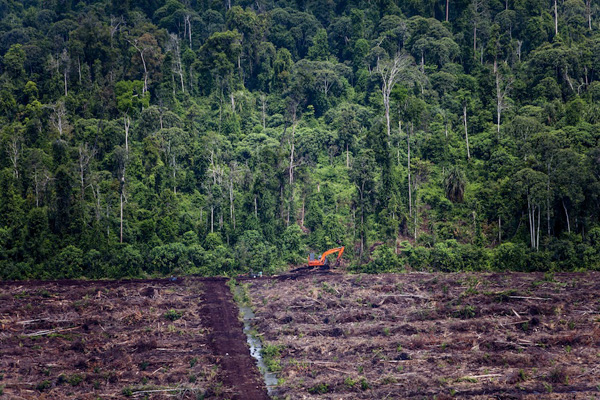
An excavator at the rainforest's edge in recently cleared peatland within the Duta Palma group's PT. Bertuah Aneka Yasa palm oil concession in Indragiri Hulu, Riau
An excavator at the rainforest's edge in recently cleared peatland within the Duta Palma group's PT. Bertuah Aneka Yasa palm oil concession in Indragiri Hulu, Riau. Taken 05/04/2013 © Kemal Jufri / Greenpeace


Conversion of forests for palm oil production now appears to be the single largest driver of deforestation in Indonesia, accounting for roughly a quarter of forest loss between 2009 and 2011, asserts a new Greenpeace report that accuses the sector's main certification standard of failing to stop forest destruction.

The report, titled Certifying Destruction, uses satellite imagery, government concession data, field investigations, and third party analysis to conclude that several recent and current members of the Roundtable on Sustainable Palm Oil (RSPO) — the industry's chief eco-certification body — are continuing to buy or trade palm oil produced via the conversion of rainforests and carbon-dense peatlands in the Southeast Asian nation.

"The RSPO wants its members to be industry leaders in sustainability, but its current standards leave them free to destroy forests and drain peatland," said Bustar Maitar, head of Greenpeace International’s Indonesia forest campaign, in a statement. "Year after year, Indonesia’s forest fires and haze wreak havoc on the region, and the palm oil sector is a main culprit."

300,000 hectares

Analyzing satellite data, Greenpeace finds that some 300,000 hectares of forest were cleared for oil palm plantations between 2009 and 2011, accounting for nearly 25 percent of the 1.24 million hectares of forest the Indonesian government says were cleared during the two-year period. Deforestation for oil palm plantations was disproportionately high in three provinces in Indonesia Borneo: West Kalimantan (75 percent of total deforestation was attributed to palm oil), East Kalimantan (55 percent), and Central Kalimantan (38 percent).

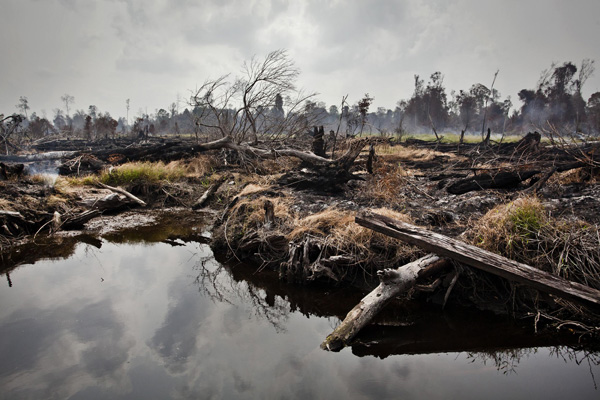
Charred tree stumps against the smoldering background in an area of recently deforested peatland near Tanjung Baru village, Pangkalan Kerinci subdistrict in Pelalawan regency, Riau province, Indonesia. The village lies beside PT. Pusaka Megah Bumi Nusantara (PMBN) – a palm oil company belonging to the Asian Agri group, a member of the Roundtable on Sustainable Palmoil (RSPO). This area, according to the most recent official charts, is covered by the Indonesia government’s moratorium on the issuance of new permits in primary forests and peatlands.Thousands of peatland fires in the province - the majority within pulp and palm oil concessions - have caused record-breaking air pollution in Singapore and Malaysia, with the haze extending as far as Thailand.
Charred tree stumps against the smoldering background in an area of recently deforested peatland near Tanjung Baru village, Pangkalan Kerinci subdistrict in Pelalawan regency, Riau province, Indonesia. The village lies beside PT. Pusaka Megah Bumi Nusantara (PMBN) – a palm oil company belonging to the Asian Agri group, a member of the Roundtable on Sustainable Palm Oil (RSPO). This area, according to the most recent official charts, is covered by the Indonesia government’s moratorium on the issuance of new permits in primary forests and peatlands.Thousands of peatland fires in the province - the majority within pulp and palm oil concessions - have caused record-breaking air pollution in Singapore and Malaysia, with the haze extending as far as Thailand. Taken June 29, 2013 © Ulet Ifansasti / Greenpeace


Greenpeace: RSPO falling short

Worryingly for environmentalists, Greenpeace's report suggests that RSPO member companies are falling short of the initiative's goals. Notably, RSPO-certified companies continue to clear forest and peatlands for new plantations. And during the ongoing haze crisis, a large number of hotspots have been detected within their concessions.

"In 2009, identified oil palm concessions currently affiliated to members of the RSPO held 14% of the natural forest within Indonesian oil palm concessions. However, these concessions accounted for a disproportionate 21% of deforestation in oil palm concessions – 63,000 hectares, including nearly 20,000 hectares of carbon-rich forested peatland," states the report. "Genting, Surya Dumai and Wilmar were the three privately-owned RSPO members with the largest areas of identified deforestation."

"Concessions affiliated with RSPO members accounted for 39% of the fire hotspots on palm oil concessions in Riau during January-June 2013 – a total of 720 hotspots in RSPO-related concessions."

The problem, says the activist group, is that while RSPO criteria prohibit conversion of old-growth and "high conservation value" (HCV) forest, they do not exclude clearing of secondary forests and peatlands for plantations. Because these areas lock large amounts of carbon in their soils, clearing vegetation and draining the water table can trigger substantial emissions. The RSPO sets no limits of emissions from palm oil production — emissions reporting is strictly voluntary.

"RSPO rules fail to prevent peatland and forest fires," states the report. "The RSPO bans deliberate use of fire for land clearance, but it has failed to address the source of devastating fires in Sumatra in June 2013. The RSPO allows its members to clear rainforest and to clear and drain peatland. Drained peat is like a tinderbox: once dry, the dense, carbon-rich soil catches fire easily; once lit, it can spread rapidly."

For its part, the RSPO says upon receiving complaints from Greenpeace, it investigated five members for alleged fires. It found that three registered hotspots, one of which — PT Jatim Jaya Perkasa — had dozens of fires.

"[PT Jatim Jaya Perkasa] has been escalated to a formal complaint case," the RSPO told mongabay.com. "The other two companies with hotspots were advised to immediately appease the fires which were prevalent for less than 24 hours while it was confirmed that it was not due to systemic issues as they adopt a no burning policy, as directed by the RSPO. The RSPO continues to monitor this."

The body also faulted Greenpeace's choice in reference maps for establishing concession boundaries.

"The discrepancy of the hotspots analysis is because the concession maps provided by Greenpeace differed from the maps which should be the accurate base for reference (HGU boundaries / Business Use Rights)," the body said. "The RSPO has advised Greenpeace several times on the use of incorrect reference maps and for stronger accountability towards reliable information in the public domain."

A worker from PT. Raja Garuda Mas Sejati – a palm oil company belonging to the Asian Agri group, a member of the Roundtable on Sustainable Palmoil (RSPO) – tries to extinguish a peatland fire within the company concession near Tanjung Muara Sako village, Langgam subdistrict in Pelalawan regency, Riau province, Indonesia.
A worker from PT. Raja Garuda Mas Sejati – a palm oil company belonging to the Asian Agri group, an RSPO – tries to extinguish a peatland fire within the company concession near Tanjung Muara Sako village, Langgam subdistrict in Pelalawan regency, Riau province, Indonesia. Taken 06/29/2013 © Ulet Ifansasti / Greenpeace


Lack of supply chain traceability

The Greenpeace report also criticizes what it terms laundering of palm oil from non-certified sources via the RSPO. It notes that RSPO-certified palm oil is rarely segregated from conventional palm oil. Worse, RSPO-members have been caught buying palm fruit from developers who have illegally cleared rainforests for plantations.

"Producers can be RSPO members without having any certified concessions. RSPO members can freely trade fresh fruit bunches (FFB) and oil produced by non-members who have made no sustainability commitments: some of the most prominent RSPO processor members, including IOI, Wilmar and Musim Mas, are heavily dependent on sourcing and trading FFB or palm oil products from third party suppliers," says the report. "FFB from unlicensed plantations and areas cleared by fire can end up in mills belonging to RSPO members. A recent investigation by WWF Indonesia showed that mills, some RSPO certified, owned by RSPO members Wilmar and Asian Agri were receiving FFB from illegal plantations inside Tesso Nilo National Park as recently as 2012, though both companies now say they are introducing procedures to stop this."

According to Greenpeace, many seemingly well-intentioned companies are sidestepping the issue by purchasing Greenpalm certificates, which effectively allow buyers to offset their conventional palm oil purchases with credits representing an equivalent volume of RSPO-certified palm oil. The initiative aims to serve as a bridge until segregated palm oil becomes more readily available. Until then, companies won't know whether the palm oil they are using in their products is actually sourced under any social or environmental standards, which is at issue for Greenpeace.

But a more fundamental problem is consumers don't seem willing to pay much of a premium for certified palm oil. Greenpalm certificates currently fetch a premium of 0.4 percent, far below the 10 percent sought when the first certified palm oil began shipping in 2008. The lack of a price premium is a disincentive for producers to bother with the costly certification process. Or for that matter, push to strengthen it.

Greenpeace's chart showing the current state of palm oil production in Indonesia

Greenpeace's chart showing the current state of palm oil production in Indonesia


Greenpeace to companies: don't abandon RSPO

While Greenpeace's report comes down hard on the RSPO, it stops short of calling for corporate customers to abandon the initiative. Instead the activist group asks buyers to "go beyond" RSPO standards and source from suppliers who have set the bar higher.

"The RSPO remains the largest inter-sectoral body, with a critical mass of membership among producers, traders and corporate consumers. While RSPO standards on forest conversion and on other areas such as land rights are clearly inadequate, they remain an important improvement over no standards at all," the report states. "Hence, Greenpeace is not calling for companies to abandon the RSPO; rather, we call for them to go beyond RSPO standards."

"Companies that have ‘gone beyond the RSPO’ and committed to policies to ensure forest protection include Golden Agri-Resources, New Britain Palm Oil and Agropalma, whose ‘no deforestation’ commitments demonstrate that a responsible palm oil sector is possible. Meanwhile, some consumer companies are setting standards for truly responsible purchasing policies. For example, Nestlé has made a clear commitment to break the link between palm oil and deforestation in its own supply chain."

Greenpeace cites a new initiative, Palm Oil Innovation Group, as a potential model for companies wanting to move toward stricter standards. POIG, which currently involves a handful of NGO's and "progressive" palm oil companies, will establish additional criteria to improve the social and environmental performance of palm oil, including "requirements on reserving enough land for local communities’ food crops, greenhouse gas emissions and no development on peatlands."

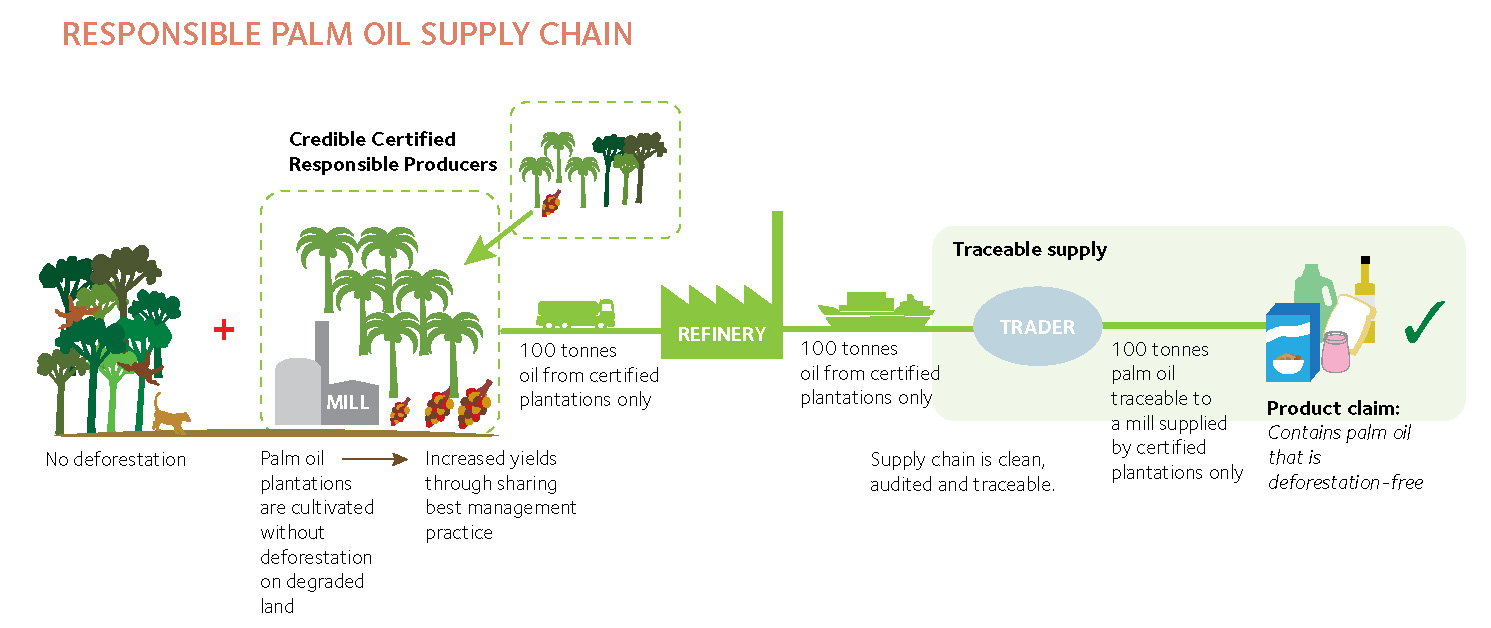
Greenpeace's idealized vision for sustainable palm oil production
Greenpeace says the RSPO should also move toward stronger standards, including banning conversion of peatlands and deforestation. The group calls on the RSPO to close some of the loopholes that allow companies to produce and trade un-certified palm oil while still operating under the banner of RSPO membership.

Greenpeace's report comes at a challenging time for the palm oil industry, relative to recent boom. Slowing demand for palm oil has severely cut profit margins in the sector this year. Meanwhile planned expansion in tropical Africa, mainland Asia, and Latin America could usher in an era of oversupply in the near-term, further undercutting prices.

It's unclear what impact these trends would have on demand for certified palm oil. Past gluts have led producers to walk away from marginal plantations and abandon plans for new development, potentially reducing pressure on forest lands. Whether this will increase interest in producing and sourcing premium RSPO-certified palm oil remains to be seen.

Nonetheless, in the short- to medium-term, palm oil production will likely continue to be a lucrative option relative to other forms of agriculture in the tropics, putting it in direct competition with forest preservation.


Source: http://news.mongabay.com/2013/0903-rspo-vs-greenpeace-palm-oil-deforestation.html

Indonesian Updates: Indonesia finally establishes REDD+ agency to tackle deforestation (7 Sep 2013)

Indonesia finally establishes REDD+ agency to tackle deforestation

September 07, 2013


Indonesia has finally established an agency to implement the country's Reducing Emissions from Deforestation and Degradation (REDD+) program.

The REDD+ agency, established by a decree from President Susilo Bambang Yudhoyono on Friday, is a ministry-level body that will coordinate a national REDD+ strategy between various ministries that influence and control land use policy across the sprawling archipelago. The agency will also oversee monitoring, reporting, and verifying emissions reductions as required under a billion dollar agreement signed with Norwayin 2010. Norway is compensating Indonesia on a performance-basis for reducing greenhouse gas emissions from deforestation.

The pact with Norway stipulated the creation of the agency, but the process has lagged behind schedule due to disagreements between various bureaucracies. Nonetheless, REDD+ has been slowly moving forward in pilot provinces, including Central Kalimantan in Indonesian Borneo. The first REDD+ project —Rimba Raya— was approved in May.

Indonesia is also in the third year ofa moratorium on granting new logging and plantation concessionsin some 14 million hectares of previously unprotected rainforests and peatlands. The moratorium was also part of the Norway deal.

REDD+ has been strongly supported by President Yudhoyono under his plan to reduce emissions 26 percent relative a projected 2020 baseline. That target could rise to 41 percent with international aid. Indonesian is one of a handful of large developing countries that has set such goals.

More than 80 percent of Indonesia's greenhouse gas emissions result from land use, mostly peatlands degradation and rainforest destruction. Therefore curtailing logging and conversion of natural forests for plantations have emerged as top priorities for the country. More than half of forest loss in Indonesia is attributed to timber, pulp and paper, and palm oil production.

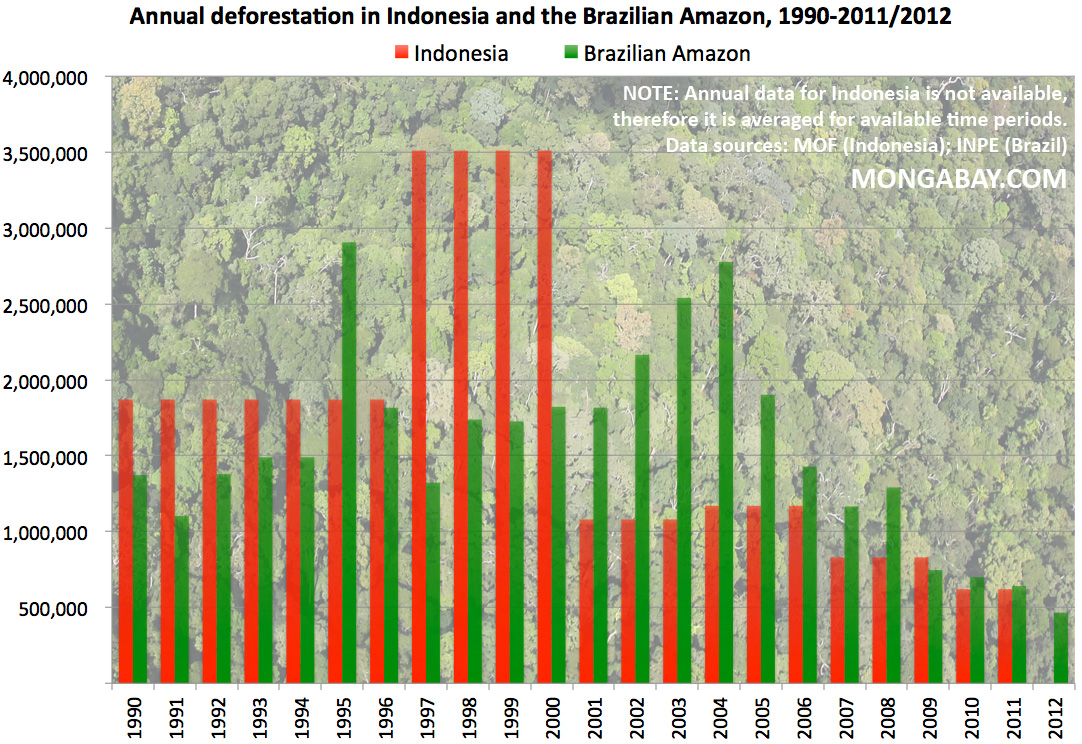
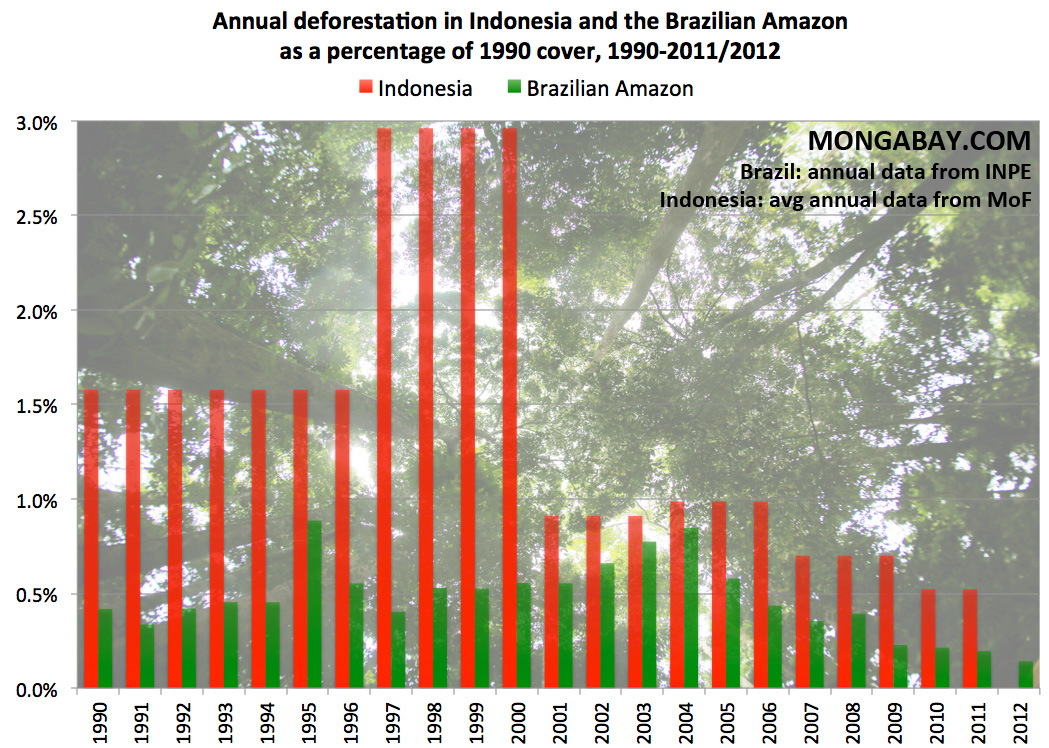
Chart: deforestation in the Brazilian Amazon and Indonesia, 1990-2011
Chart: deforestation in the Brazilian Amazon and Indonesia, 1990-2011Chart comparing annual deforestation between Brazil and Indonesia, 1990-2011
Chart comparing annual deforestation between Brazil and Indonesia, 1990-2011Indonesia has one of the highest deforestation rates in the world. Click images to enlarge.

The Indonesian government is expected to announce the REDD+ agency's head in coming weeks, according to Mongabay-Indonesia. The REDD+ Task Force, which the REDD+ agency replaces, was run by Kuntoro Mangkusubroto, a close advisor to the president.

The REDD+ agency will have 60 staff based in Jakarta.

Source: http://news.mongabay.com/2013/0907-indonesia-redd-agency.html

Sunday, July 28, 2013

Forests: Near real-time deforestation monitoring system to go global (25 Jul 2013)

mongabay.com logo

Near real-time deforestation monitoring system to go global

Rhett A. Butler, mongabay.com
July 25, 2013


A near real-time deforestation monitoring system will soon cover all the world's tropical forests, report the researchers behind the initiative.

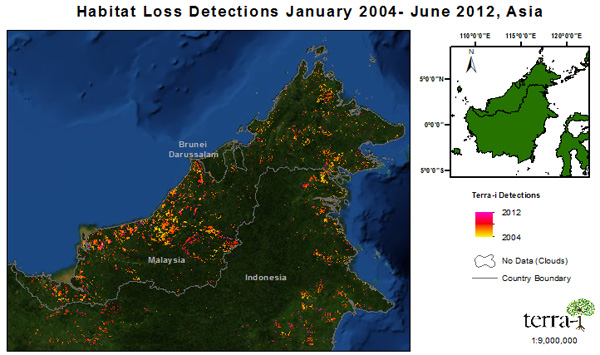
Terra-i — a collaborative project between Colombia's International Center for Tropical Agriculture (CIAT), the Nature Conservancy (TNC), the School of Business and Engineering (HEIG-VD) in Switzerland, and King’s College London — has been testing its system in tropical Asia, extending its reach beyond its stronghold in Central and South America. Terra-i uses data from NASA's satellite-based MODIS sensors to assess changes in forest cover at a 250-meter resolution every 16 days. The system is similar to the near real-time deforestation tracking system used in Brazil by the government and Imazon, a local NGO.

"We can now provide near real time data on land cover change in Latin America and we expect to be producing pan-tropical results over the next few months," Louis Reymondin, a researcher at CIAT, told mongabay.com. "Since this is the first continental scale system on operation and the first to work outside of the Brazilian Amazon, this allows a similar level of reporting and understanding of land cover change for other countries as Brazil has had in place for some time."

The system detects deforestation based on changes in "greenness" in natural vegetation. It normalizes seasonal vegetation response to rainfall to reduce false positives. The data is then mapped and made available for download viawww.terra-i.org. For Latin America, data is available at the national level and by protected area, ecosystem, and state or municipality.


Deforestation in Borneo 2004-2012, according to Terra-i


Reymondin says Terra-i has applications beyond serving as a deforestation alert system.

"Terra-i has a range of applications, such as: monitoring the effectiveness of conservation; assessing the impact on the environment of the construction of new infrastructure like roads; assessing the contribution of deforestation to climate change and understanding the likely impacts of deforestation on downstream and downhill populations."

Terra-i isn't the only near real-time deforestation alert system under development. The World Resources Institute (WRI) is putting the final touches on Global Forest Watch, a tool that will also track deforestation on a bi-weekly basis, while offering layers like plantation concession maps as well as providing a mechanism for users to share photos and reports from the field.

Source: http://news.mongabay.com/2013/0725-terra-i-deforestation-tracking-system.html