Wednesday, January 29, 2014

World News: Making best out of waste (25 Jan 2014)

Making best out of waste

AHMEDABAD: As part of Republic Day celebrations, students pursuing design course fromUnitedworld Institute of Design have initiated an awareness programme on solid waste management. The initiative-'Heal The World'aims to educate school going kids regarding the need to save environment by reducing, recycling and reusing waste.

The programme will engage students of age from 10 years to 18 years and make them create sculptures, utility product, decorative products and other products out of waste like empty plastic bottles, wires, newspapers, polythene bags and glass.

"It is believed that any positive change in habit and culture is developed only at tender age which once inculcated remains forever. We can save our environment by changing our outlook and become the change agent," one of the students from the institute said.

Students from Ahmedabad, Mumbai, Delhi and Kolkata will be competing with each other with their creations with the best 10 models being selected from each zone to compete in the final and best three models will be conferred with award in Ahmedabad on February 9, 2014 at Unitedworld campus.

Ritesh Hada, managing director, Unitedworld, said, "Such awareness programmes should be integrated in the academic curriculum itself not only for school going children, but also in colleges and for professionals at their workplace, where a lot of waste is created."

More than 3,000 students are expected to participate in this programme. More than 30 schools from Ahmedabad have registered for participation.

source from: http://timesofindia.indiatimes.com/home/environment/developmental-issues/Making-best-out-of-waste/articleshow/29380106.cms

Book: Fairness and Justice in Environmental Decision Making Water under the bridge (Jan 2014)

Fairness and Justice in Environmental Decision Making

Water under the bridge

By Catherine Gross

Routledge – 2014 – 180 pages
By crossing disciplinary boundaries, this book uniquely connects theories of justice with people's lived experience within social conflicts over resource sharing. It shows why some conflicts, such as local opposition to wind farms and water disputes, have become intractable social problems in many countries of the world. It shows the power of injustice in generating opposition to decisions. The book answers the question: why are the results of many government initiatives and policies not accepted by those affected?
Focusing on two social conflicts over water sharing in Australia to show why fairness and justice are important in decision-making, the book shows how these conflicts are typical of water sharing and other natural resource conflicts experienced in many countries around the world, particularly in the context of climate change. It tells the stories of these conflicts from the perspectives of those involved. These practically-based findings are then related back to ideas and constructs of justice from disciplines such as social psychology, political philosophy and jurisprudence.
With a strong practical focus, this book offers readers an opportunity to develop a deep understanding of fairness and justice in environmental decision-making. It opens up a wealth of fairness and justice ideas for decision-makers, practitioners, and researchers in natural resource management, environmental governance, community consultation, and sustainable development, as well as people in government and corporations who interface and consult with communities where natural resources are being used.
review:
"A clear and compelling case for fairness as a foundation for resource sharing. Catherine Gross' book is essential for those wanting to understand the role of fairness and justice in preventing social conflict". Paul R. Ehrlich, Bing Professor of Population Studies, Stanford University, USA
"Building on real-world examples of environmental conflict over wind power and water access, the author clarifies what fairness and justice mean to those affected. She then argues the need for a theory of justice to guide environmental decision-making and to optimise fairness, as understood and seen. A timely book, as environmental tensions mount."Professor Tony McMichael, Australian National University, Australia
Content:
1. A global concern: seeking fairness in resource sharing 2. Theories of Justice and the search for fairness 3. Developing a justice-based research approach 4. Voices and stories: two water conflicts in Australia 5. Finding injustice - seeking justice 6. A sense of justice - processes and outcomes 7. Muddying the waters: worldviews, institutions and change 8. Justice as a means and an end in environmental decision-making

Tuesday, January 28, 2014

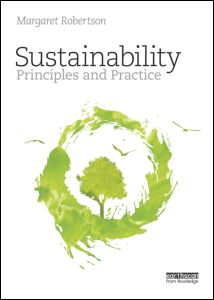
Book: Sustainability Principles and Practice (20 Jan 2014)

Sustainability Principles and Practice

By Margaret Robertson

Routledge – 2014 – 392 pages
Description:
Sustainability Principles and Practice gives an accessible and comprehensive overview of the interdisciplinary field of sustainability. The focus is on furnishing solutions and equipping the student with both conceptual understanding and technical skills for the workplace. Each chapter explores one aspect of the field, first introducing relevant theory and presenting issues, then supplying tools for working toward solutions. Elements of sustainability are examined piece by piece, and wide coverage ranges over ecosystems, social equity, environmental justice, food, energy, product life cycles, cities, and more. Techniques for management and measurement as well as case studies from around the world are provided.
Chapters include further reading, discussion questions, and problems to foster quantitative thinking. The book is supported by a companion website with key website links, detailed reading lists, glossary, and additional case studies, together with numerous projects, research problems, and group activities, all of which focus on real-world problem solving of sustainability issues.
The textbook is designed to be used by undergraduate college and university students in sustainability degree programs and other programs in which sustainability is taught.
Content:
Part 1: Context 1. What Is Sustainability? 2. A Brief History of Sustainability 3. The Biosphere 4. The Human Sphere 5. Putting Sustainability into Practice Part 2: Issues and Solutions 6. Climate 7. Water 8. Ecosystems and Habitat 9. Pollution 10. Energy 11. Food 12. Green Buildings and Sites 13. Livable Cities 14. Products 15. Waste, and Recycling Part 3: Becoming an Agent for Change 16. Working in an Organization 17. Education: Preparing a New Generation to Live Well in a Changing World 18. Working as Agents for Change
Author Bio:
Margaret Robertson, a member of
 the American Society of Landscape Architects (ASLA), is coordinator of the Sustainability Coordinator degree program at Lane Community College in Eugene, Oregon, USA, and a Sustainability Fellow in the Higher Education Associations Sustainability Consortium.

China News: Vehicle with pangolins seized in Guangxi (25 Jan 2014)

Vehicle with pangolins seized in Guangxi

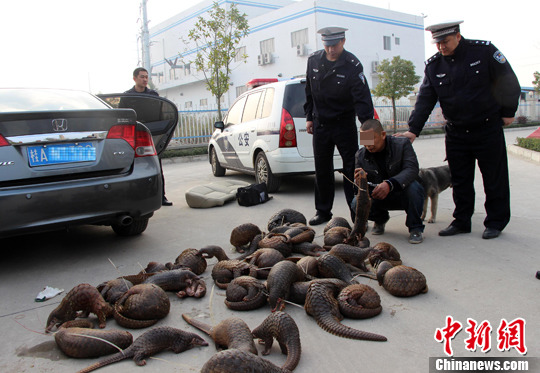
A total of 39 live pangolins were found hidden inside a sedan by police in Fangchenggang of southern China's Guangxi Province on Jan. 24. [Photo/CNS]
A total of 39 live pangolins were found hidden inside a sedan by police in Fangchenggang of southern China's Guangxi Province on Jan. 24, Chinanews.com reported.
Local police noticed a black car suddenly hit the brakes as it was about to pass through a highway toll station in Fangchenggang around 3:00 a.m. last Friday. There were only two men seated inside the car, but the vehicle appeared much heavier, police said.
Police forced a halt to the car after following it for some five kilometers. Officers first discovered a false license plate inside, yet a strong fishy smell aroused further suspicion.
Finally, a lot of pangolins, still alive, were retrieved from a box hidden in the back seat.
One man was placed in custody, while the other managed to escape.
The case has been handed over to the Fangchenggang forest public security bureau and is currently still under investigation.
The pangolin, found naturally in tropical regions throughout Africa and Asia, is under national second-class protection.

Hong Kong News: Landfill plan to be resubmitted (24 Jan 2014)

Landfill plan to be resubmitted

January 24, 2014
Secretary for the Environment KS Wong says the need for landfill extension is urgent, and the Government will re-submit its extension proposal to the Legislative Council in the first quarter of this year.

Speaking to reporters today, Mr Wong said the Government has done a lot to communicate with stakeholders on the issue, and has improved the operation of landfills, to gain public support.

Meanwhile, Mr Wong said the waste charging public engagement ended today, and the Council for Sustainable Development will submit a report to the Government.

Surveys show the majority of people support waste charging, although there are concerns on whether the scheme can be implemented in an effective way.

The Government will study feedback to review the scheme and work with the community to build support for the plan.

Mr Wong also said claims that Under Secretary for the Environment Christine Loh has resigned have no foundation.

Book: The Ethics of Japan's Global Environmental Policy The conflict between principles and practice (Jan 2014)

The Ethics of Japan's Global Environmental Policy

The conflict between principles and practice

By Midori Kagawa-Fox

Routledge – 2012
This book examines the Japanese government policies that impact on the environment in order to determine whether they incorporate a sufficient ethical substance. Through the three case studies on whaling, nuclear energy, and forestry, the author explores how Western philosophers combined their theories to develop a ‘Western environmental ethics code’ and reveals the existence of a unique ‘Japanese environmental ethics code’ built on Japan’s cultural traditions, religious practices, and empirical experiences.
Kagawa-Fox’s discussions show that in spite of the positive contributions that Japan has made towards the global environment, the government has failed to show a corresponding moral obligation to the world ecology in its environmental policy. The book argues that this is a result of the integrity of the policies having been compromised by vested interests and that Japanese business and politics ensure that the policies are primarily focused on maintaining sustainable economic growth. Whilst Japan's global environmental initiatives are the key to its economic survival in the 21st century, and these initiatives may achieve their aims, they do however fail the Japanese code of environmental ethics.
This book is essential reading for anyone interested in Environmental Studies, Environmental Policy and Ethics, Japanese Politics and Japanese Culture and Society.