Showing posts with label global warming. Show all posts

Wednesday, March 19, 2014

India News: Forecast updates strengthen El Nino fears (12 March 2014)

Forecast updates strengthen El Nino fears

Forecast updates strengthen El Nino fears
In a number of El Nino years, Indian monsoon has been normal.


NEW DELHI: Latest updates from two global weather prediction agencies have added to the spectre of a developing El Nino, raising fears of a possible weak monsoon this year.

Indian Met officials are treating the reports with caution, saying that though chances of an El Nino developing around mid-2014 are growing, predictions made at this stage suffer from low accuracy.

El Nino — 'the boy' in Spanish — is an unusual warming of sea surface waters in eastern and central equatorial Pacific associated with changes in wind patterns that impact weather in many parts of the world. It generally has an adverse effect on the Indian monsoon.

In its update on Thursday, the Australian Bureau of Meteorology said factors that lead to an El Nino were now increasingly visible. "The tropical Pacific Ocean subsurface has warmed substantially over the past few weeks, which was likely to result in a warming of the sea surface in the coming months," it said.


"A recent burst of westerly winds over the far western Pacific is the strongest seen since at least 2009 - the last time an El Nino developed," the bureau added.

The agency said most climate models it had surveyed were showing temperatures approaching or exceeding El Nino thresholds in the coming summer.

US agency NOAA's Climate Prediction Center, which updated its forecast on Wednesday, said temperature anomalies associated with El Nino had strongly increased since the end of January.

NOAA said there was a 50% chance of El Nino developing during the summer or autumn this year.

"There's a good chance of El Nino forming this year. But whether — or how much— it would impact the Indian monsoon would depend on its intensity and the timing of its onset," said D Sivananda Pai, India Meteorological Department's lead monsoon forecaster, adding that the picture would be clearer after April.

Pai's predecessor M Rajeevan, currently advisor to the earth sciences ministry, agrees. "Monsoon predictions made during this time of the year suffer from a 'spring barrier'. Accuracy increases after spring. We need to watch the developments closely," he said.

The causal links between El Nino and the Indian monsoon aren't totally understood. While a majority of bad monsoon years — when rain deficit is 10% or more — coincide with El Nino events, the reverse link isn't that strong. In a number of El Nino years, Indian monsoon has been normal.

One factor that seems to negate the effect of El Nino is a positive sea temperature difference between western and eastern Indian Ocean — a phenomenon called Indian Ocean Dipole. However, IOD this year is expected to be neutral.


source from: http://timesofindia.indiatimes.com/home/environment/global-warming/Forecast-updates-strengthen-El-Nino-fears/articleshow/31863331.cms

Friday, March 14, 2014

World News: Earth to get hotter despite global warming slowdown (13 March 2014)


Earth to get hotter despite global warming slowdown

WASHINGTON: Earth's climate would continue to warm during this century on track with previous estimates, despite the recent slowdown in the rate of global warming, a new Nasa study has warned.

The research hinges on a new and more detailed calculation of the sensitivity of Earth's climate to the factors that cause it to change, such as greenhouse gas emissions.

Drew Shindell, a climatologist at Nasa's Goddard Institute for Space Studies in New York, found Earth is likely to experience roughly 20 per cent more warming than estimates that were largely based on surface temperature observations during the past 150 years.

Global temperatures have increased at a rate of 0.12 degrees celsius per decade since 1951, researchers said.

But since 1998, the rate of warming has been only 0.05 degrees celsius per decade - even as atmospheric carbon dioxide continues to rise at a rate similar to previous decades, they said.

Recent research suggested Earth may be less sensitive to greenhouse gas increases than previously thought.

The Fifth Assessment Report of the Intergovernmental Panel on Climate Change (IPCC), issued in 2013, also reduced the lower range of Earth's potential for global warming, said researchers.

To put a number to climate change, researchers calculate what is called Earth's "transient climate response."

This calculation determines how much global temperatures will change as atmospheric carbon dioxide continues to increase — at about one per cent per year — until the total amount of atmospheric carbon dioxide has doubled.

The estimates for transient climate response range from near 1.4 degrees celsius offered by recent research, to the IPCC's estimate of 1.0 degrees celsius.

Shindell's study estimates a transient climate response of 1.7 degrees celsius, and determined it is unlikely values will be below 1.3 degrees celsius.

In order to understand the role played by carbon dioxide emissions in global warming, it is necessary to account for the effects of atmospheric aerosols, researchers said.

While multiple studies have shown the Northern Hemisphere plays a stronger role than the Southern Hemisphere in transient climate change, this had not been included in calculations of the effect of atmospheric aerosols on climate sensitivity.

When corrected, the range of likely warming based on surface temperature observations is in line with earlier estimates, despite the recent slowdown, researchers said.

The research was published in the journal Nature Climate Change.


soure from: http://timesofindia.indiatimes.com/home/environment/global-warming/Earth-to-get-hotter-despite-global-warming-slowdown/articleshow/31940484.cms

Thursday, February 13, 2014

World News: Trade winds spur hiatus in global warming: Study (10 Feb 2014)

Trade winds spur hiatus in global warming: Study

SYDNEY: An unprecedented spike in Pacific trade winds has seen global warming slow significantly in the past 12 years but the effect is only temporary and temperatures will surge, a study found on Monday.
The Australian-led report, published in the latest edition of Nature Climate Change, said a dramatic acceleration in equatorial trade winds blowing from the Americas to the West Pacific had boosted circulation of the ocean.
"If the trade winds blow particularly strong that warm water that's piled up there starts to converge in the ocean interior," said lead author Matthew England.
"In a way it's locking away energy we've obtained from greenhouse gas into the subsurface ocean and that's what causes the hiatus (in global warming)."
The study examined a pause in global warming since 2001 along with a previous such stall between 1940-75 and identified a close link to negative phases of the Interdecadal Pacific Oscillation (IPO) -- a wind pattern associated with a cool tropical Pacific and strengthened winds.
England said the winds finding helped to explain why global warming didn't occur in a continual upward trajectory -- a criticism of climate change sceptics -- but "a series of abrupt steps in between periods of more or less steady temperatures".
England said the current plateau in global warming at a time when "greenhouse gases in the atmosphere have shot up to record levels" had puzzled scientists.
"This pause in surface warming doesn't mean that global warming has stopped at all, we seeArctic sea ice melting to record low levels, the land ice sheets across the world are melting rapidly, ocean temperatures continue to warm," he said.
"So it's not a contradiction of global warming but it has confused scientists, just because we do expect the surface temperatures around the world to progressively warm decade by decade."
England's team, which also included researchers from the United States, looked to the seas for answers and found "there was more than enough heat going into the ocean to account" for the plateau they were seeing.
"The reason the oceans are taking up extra heat, and this is particularly occurring in the Pacific Ocean is that the trade winds have strengthened considerably over the last two decades," he said.
He described their intensification as "unprecedented in the measurement record and way beyond the strength of the trends ever captured by climate models".
But England said the surging trade winds were only temporary and their associated cooling effects would likely reverse sharply once the IPO shifted back to a positive phase "within as little as a decade".
"If the trade winds slow down or stop, what happens is that heat absorption by the ocean reverses and we actually get heat coming back up to the atmosphere," he said.
"The bad news is that out of this hiatus we're expecting quite rapid warming to occur."
Were the elevated winds to persist, England's study found the current hiatus would extend to 2020. If they abated in the next few years it was likely to be "short-lived, with rapid warming set to resume soon after the wind trends reverse".
Steve Rintoul from Australia's government science agency CSIRO -- a partner in the study -- said the oceans held the key to understanding climate change.
"More than 93 percent of the warming of the planet since 1970 is found in the ocean," he said.
"If we want to understand and track the evolution of climate change, we therefore need to look in the oceans."

Wednesday, February 12, 2014

Indian News: After deadly cold, now brace up for global warming (10 Feb 2014)

After deadly cold, now brace up for global warming

SYDNEY: There may be an abrupt rise in global average temperatures in about a decade, scientists have warned.

New research finds that strong trade winds have driven more of the heat from global warming into the oceans.

But when those winds slow, that heat would rapidly return to the atmosphere causing an abrupt rise in global average temperatures.

Heat stored in the western Pacific Ocean appears to be largely responsible for the hiatus in surface warming observed over the past 13 years.

The dramatic acceleration in winds has invigorated the circulation of the Pacific Ocean, causing more heat to be taken out of the atmosphere and transferred into the subsurface ocean, while bringing cooler waters to the surface.

"Scientists have long suspected that extra ocean heat uptake has slowed the rise of global average temperatures, but the mechanism behind the hiatus remained unclear," said Matthew England, chief investigator at the ARC Centre of Excellence for Climate System Science.

"But the heat uptake is by no means permanent: when the trade wind strength returns to normal - as it inevitably will - our research suggests heat will quickly accumulate in the atmosphere," he added.

So global temperatures look set to rise rapidly out of the hiatus, returning to the levels projected within as little as a decade, he cautioned.

We are just seeing another pause in warming before the next inevitable rise in global temperatures, said the research published in the journal Nature Climate Change.

source from :http://timesofindia.indiatimes.com/home/environment/pollution/National-Green-Tribunal-questions-permits-given-to-polluting-industries/articleshow/30180718.cms

Wednesday, January 22, 2014

World News: Day's weather influence people form global warming opinions (20 Jan 2014)


WASHIGNTON: It may sound strange but even global warming opinions among the common men on the street waver as the weather changes from hot to cold and vice versa. 


During unusually hot weather, people tend to accept global warming threats but they generally swing against it during cold events, says a fascinating study. 

Conducted in the wake of polar vortex that hitNorth America last week, a new study claims that the acceptance of climate change depends on the weather on the day when people are asked about it. 

"While a number of studies have looked at the relationship between daily temperature and global warming judgments or opinions, very few have explored the psychology that underlies the effect," said lead author Lisa Zaval from Columbia University

The researchers looked at five recent studies on the effects of warm weather on climate change opinions and found evidence for something called 'attribute substitution'. 

That's where a person forms his/her opinion using more readily available information - like today's temperature - rather looking at more diagnostic but less accessible information, like global climate change patterns, said the study published in the journal Nature Climate Change. 

There is every reason to expect that it works the same way with cold snaps, it added. 

"Our data suggest that perceiving today's local temperature to be colder than usual can lead to reduced concern about global warming," Zaval explained. 

"It seems likely that 'attribute substitution' plays a role for unusually cold temperatures as well as unusually warm temperatures," Zaval added. 

The researchers also found that present extreme temperatures can reinforce our memories of past similar events. 

An especially hot day today can cause us to overestimate the frequency of similar past events, which can further increase our belief in global warming. 

"We're going to see more extreme heat events in the future and people would learn through their experience," said geographer Peter Howe from Utah State University. 

"Weather experts must add more in-depth climate information into their daily weather reports so that they disseminate long-term climate patterns to the people for a better understanding of global warming," Howe added.

source from: http://timesofindia.indiatimes.com/home/environment/global-warming/Days-weather-influence-people-form-global-warming-opinions/articleshow/28745569.cms

Friday, September 27, 2013

IPCC: Human influence on climate clear (27 Sep 2013)

IPCC: Human influence on climate clear
China.org.cn, September 27, 2013

Human influence on the climate system is clear. This is evident in most regions of the globe, a new assessment by the Intergovernmental Panel on Climate Change (IPCC) concludes.
It is extremely likely that human influence has been the dominant cause of the observed warming since the mid-20th century.
It is extremely likely that human influence has been the dominant cause of the observed warming since the mid-20th century. The evidence for this has grown, thanks to more and better observations, an improved understanding of the climate system response and improved climate models.
Warming in the climate system is unequivocal and since 1950 many changes have been observed throughout the climate system that are unprecedented over decades to millennia. Each of the last three decades has been successively warmer at the Earth’s surface than any preceding decade since 1850, reports the Summary for Policymakers of the IPCC Working Group I assessment report, Climate Change 2013: the Physical Science Basis, approved on Friday by member governments of the IPCC in Stockholm, Sweden.
"Observations of changes in the climate system are based on multiple lines of independent evidence. Our assessment of the science finds that the atmosphere and ocean have warmed, the amount of snow and ice has diminished, the global mean sea level has risen and the concentrations of greenhouse gases have increased," said Qin Dahe, Co-Chair of IPCC Working Group I.
Thomas Stocker, the other Co-Chair of Working Group I said: "Continued emissions of greenhouse gases will cause further warming and changes in all components of the climate system. Limiting climate change will require substantial and sustained reductions of greenhouse gas emissions."
"Global surface temperature change for the end of the 21st century is projected to be likely to exceed 1.5°C relative to 1850 to 1900 in all but the lowest scenario considered, and likely to exceed 2°C for the two high scenarios," said Co-Chair Thomas Stocker. "Heat waves are very likely to occur more frequently and last longer. As the Earth warms, we expect to see currently wet regions receiving more rainfall, and dry regions receiving less, although there will be exceptions," he added.
Projections of climate change are based on a new set of four scenarios of future greenhouse gas concentrations and aerosols, spanning a wide range of possible futures. The Working Group I report assessed global and regional-scale climate change for the early, mid-, and later 21st century.
"As the ocean warms, and glaciers and ice sheets reduce, global mean sea level will continue to rise, but at a faster rate than we have experienced over the past 40 years," said Co-Chair Qin Dahe. The report finds with high confidence that ocean warming dominates the increase in energy stored in the climate system, accounting for more than 90% of the energy accumulated between 1971 and 2010.
Co-Chair Thomas Stocker concluded: "As a result of our past, present and expected future emissions of CO2, we are committed to climate change, and effects will persist for many centuries even if emissions of CO2 stop."
Rajendra Pachauri, Chair of the IPCC, said: "This Working Group I Summary for Policymakers provides important insights into the scientific basis of climate change. It provides a firm foundation for considerations of the impacts of climate change on human and natural systems and ways to meet the challenge of climate change." These are among the aspects assessed in the contributions of Working Group II and Working Group III to be released in March and April 2014. The IPCC Fifth Assessment Report cycle concludes with the publication of its Synthesis Report in October 2014.
"I would like to thank the Co-Chairs of Working Group I and the hundreds of scientists and experts who served as authors and review editors for producing a comprehensive and scientifically robust summary. I also express my thanks to the more than one thousand expert reviewers worldwide for contributing their expertise in preparation of this assessment," said IPCC Chair Pachauri.

Wednesday, September 25, 2013

New Books: Four Degrees of Global Warming Australia in a Hot World Edited by Peter Christoff (23 Sep 2013)

Four Degrees of Global Warming

Australia in a Hot World

Edited by Peter Christoff

Routledge – 2014 – 270 pages

Descriptions:
At Copenhagen in December 2009, the international community agreed to limit global warming to below two degrees Celsius to avoid the worst impacts of human-induced climate change. However climate scientists agree that current national emissions targets collectively will still not achieve this goal. Instead, the ‘ambition gap’ between climate science and climate policy is likely to lead to average global warming of around four degrees Celsius by or before 2100. If a ‘Four Degree World’ is the de facto goal of policy, we urgently need to understand what this world might look like.
Four Degrees of Global Warming: Australia in a Hot World outlines the expected consequences of this world for Australia and its region. Its contributors include many of Australia’s most eminent and internationally recognized climate scientists, climate policy makers and policy analysts. They provide an accessible, detailed, dramatic, and disturbing examination of the likely impacts of a Four Degree World on Australia’s social, economic and ecological systems.
The book offers policy makers, politicians, students, and anyone interested climate change, access to the most recent research on potential Australian impacts of global warming, and possible responses.

Contents:
1. Introduction Peter Christoff
Part 1: Climate Science and Four Degrees
2. Australia's Climate at Four Degrees Penny Whetton, David Karoly, Ian Watterson, Leanne Webb, Frank Drost, Dewi Kirono and Kathleen McInnes
3. Extreme Events Karl Braganza, Kevin Hennessy, Lisa Alexander and Blair Trewin 
Part 2: Ecological Impacts
4. Terrestrial Species and Ecosystems Lesley Hughes
5. Marine Species and Ecosystems Ove Hoegh Guldberg
6. Agricultural Systems Mark Howden and Serena Henry
7. Compounding Problems Will Steffen and David Griggs 
Part 3: Social and Economic Impacts
8. Compounding Social and Economic Impacts Ross Garnaut
9. Human Health Tony McMichael
10. Cities Jan McDonald11. Regional Security Peter Christoff and Robyn Eckersley 
Part 4: Adaptation
12. Regional Adaptation Challenges Andrew Hewett 13. Adaptation - Can We? Jon Barnett and Jean Palutikof14. Conclusion Peter Christoff

Thursday, September 12, 2013

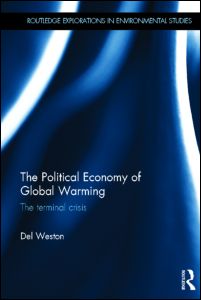
New Books: The Political Economy of Global Warming The Terminal Crisis By Del Weston (27 Aug 2013)

The Political Economy of Global Warming

The Terminal Crisis

By Del Weston

Routledge – 2014 – 230 pages
Descriptions:
Humanity is facing an unprecedented global catastrophe as a result of global warming. This book examines the reasons why international agencies, together with national governments, are seemingly unable to provide real and binding solutions to the problems. The reasons presented relate to the existing dominant global economic structure of capitalism as well as the fact that global warming is too often seen as an isolated problem rather than one of a suite of exceptional, converging and accelerating crises arising from the global capitalist political economy.
This book adopts a political economy framework to address these issues. It accepts the science of global warming but challenges the predominant politics and economics of global warming. To illustrate the key issues involved, the book draws on South Africa – building on Samir Amin’s thesis that the country represents a microcosm of the global political economy. By taking a political economy approach, the book provides a clear explanation of the deep and pervasive problem of the denial which fails to acknowledge global warming as a systemic rather than a market problem. The book should be of interest to students and scholars researching climate change, environmental politics, environmental and ecological economics, development studies and political economics.
Contents:
  1. Why the inaction on global warming? 
  2. The state of the planet 
  3. Global warming – evidence, causes and projections 
  4. Kyoto and emissions trading schemes 
  5. The global political economy and global warming 
  6. Inequality, ecological debt and global warming 
  7. The metabolic rift, development, de-peasantisation 
  8. Africa, global warming and the future of the continent 
  9. South Africa – a microcosm of the global political economy 
  10. Alternatives 
  11. Conclusion: Capitalism or the Planet?

Thursday, June 20, 2013

Indian Updates: Global warming may cause extreme droughts in India, World Bank warns (19 Jun 2013)

The Times of India

Global warming may cause extreme droughts in India, World Bank warns
PTI | Jun 19, 2013, 06.00 PM IST

WASHINGTON: Global warming could lead to more extreme droughts in large parts of India, resulting in widespread food shortages and hardship in the country, in the next few decades, a new World Bank report warned today.

The impact of a possible global temperature rise of 2 degrees Celsius in the next few decades threatens to trap millions of people in poverty, according to the report.

The soaring temperatures will also drive regular food shortages in Sub-Saharan Africa.

Shifting rain patterns in South Asia due to warming could leave some parts under water and others without enough water for power generation, irrigation, or drinking, the report said.

"Events like the devastating Pakistan floods of 2010, which affected more than 20 million people, could become common place. More extreme droughts in large parts of India could lead to widespread food shortages and hardship," the report said.

Another impact of climate change could be degradation and loss of reefs in South East Asia possibly resulting in reduced fish stocks and coastal communities, while cities could be more vulnerable to increasingly violent storms, it said.

The new report builds on a World Bank report released late last year, which concluded the world would warm by 4 degrees Celsius above pre-industrial levels by the end of this century if we did not take concerted action now.

This new report looks at the likely impacts of present day, 2 degrees Celsius and 4 degrees Celsius warming on agricultural production, water resources, coastal ecosystems and cities across Sub-Saharan Africa, South Asia and South East Asia.

Source: 
http://timesofindia.indiatimes.com/home/environment/global-warming/Global-warming-may-cause-extreme-droughts-in-India-World-Bank-warns/articleshow/20665577.cms

Sunday, June 16, 2013

Publication: Global warming may up flood risk in India, Southeast Asia by Yukiko Hirabayashi at the University of Tokyo's Institute of Engineering Innovation (10 Jun 2013)

The Times of India

Global warming may up flood risk in India, Southeast Asia
PTI | Jun 10, 2013, 09.51 PM IST

TOKYO: Unchecked global warming may increase the risk of flooding at the end of this century in 42 per cent of the Earth's land surface, including parts of India, Southeast Asia and Africa, a new study has warned.

According to a research team led by Yukiko Hirabayashi at the University of Tokyo's Institute of Engineering Innovation, the number of people exposed to the risk of flooding would increase from the current estimate of 5.6 million to 80 million by 2100 if temperatures rise by 3.5 C degrees during the period.

"An ensemble of projections under a new high-concentration scenario demonstrates a large increase in flood frequency in Southeast Asia, Peninsular India, eastern Africa and the northern half of the Andes, with small uncertainty in the direction of change," the study said.

However, flood frequency is projected to decline in certain areascovering 18 per cent of the land surface, it said.

The research team made the projections based on the output of 11 existing climate models and its own programme designed to forecast river inundation, The Japan Times quoted Kyodo News agency as reporting.

If global warming progresses without effective countermeasures, many of the world's 29 major rivers would see massive floods, which currently occur once a century, at an increased frequency of every 10 to 50 years, the researchers said.

The study was published in the journal Nature Climate Change.

Source: 
http://timesofindia.indiatimes.com/home/environment/global-warming/Global-warming-may-up-flood-risk-in-India-Southeast-Asia/articleshow/20526776.cms

Monday, June 10, 2013

New Books: Health and Climate Change Modelling the impacts of global warming and ozone depletion By Pim Martens (1 Jun 2013)


Health and Climate Change

Modelling the impacts of global warming and ozone depletion

By Pim Martens

Published 1st June 2013 by Routledge – 204 pages

Descriptions:
'Understanding how complex ecological and climatic change can influence human health is the new challenge before us. The book confronts these multidimensional risk assessments head-on and will catalyse the important interdisciplinary and integrated approach that is the new paradigm now required for environmental and public health research.' Dr JONATHAN PATZ Johns Hopkins School of Hygiene and Public Health 'This book provides a sturdy foundation for thinking about how best to tackle a varied spectrum of population health hazards posed by different aspects and combinations of global change processes? it alsogoes that extra mile by estimating the attributable population burdens of disease or mortality that are likely to result from these aspects of global change. It is heartening to see the results of this mathematical modeling being presented in policy-relevant terms.' From the Foreword by TONY McMICHAEL Health and Climate Change is the first major study of the potentially devastating health impacts of the global atmospheric changes which are under way. Using the best available data, the author presents models of the most plausible future courses of vector-borne diseases such as malaria, dengue fever and schistosomiasis; skin cancer caused by nozone depletion; and cardiovascular and respiratory disorders caused by higher temperatures. Current epidemiological research methods are not well adapted to analysing complex systems influenced by human intervention, or more simple processes calculated to take place within the distant future. Health and Climate Change proposes a new paradigm of integrated eco-epidemiological models for these areas of study. It will be essential reading for those concerned with public health and epidemiology, environmental studies, climate change and development studies. Originally published in 1998

Contents:
List of Acronyms and Abbreviations List of Figures List of Tables List of Boxes Foreword by Tony McMichael Preface 
1. Introduction The Issue Scope and Objectives Outline
2. An Eco-Epidemiological Modelling Approach Introduction Limitations of Conventional Epidemiology Eco-Epidemiological Modelling Discussion
3. Climate Change and Vector-Borne Diseases Introduction The Vectors and Their Diseases Epidemic Potential Climate Effects Malaria Prevalence Climate Scenarios Changes in Potential Risk Areas Changes in Malaria Prevalence Local Estimates: Model Validation Model Limitations and Uncertainties Discussion and Conclusions
4. Modelling Malaria as a Complex Adaptive System Introduction The Genetic Algorithm Modelling Adaptation by Genetic Algorithms Modelling Experiments Discussion and Conclusions
5. Climate Change, Thermal Stress and Morality Changes Introduction Health Impact Assessment Thermal Stress in a Number of Cities Cardiovascular Mortality and Sensitivity to Adaptation Discussion and Conclusions
6. The Impact of Ozone Depletion on Skin Cancer Incidence Introduction Modelling the Cause-Effect Chain Ozone Depletion and Skin Cancer Risk in the Netherlands and Australia Uncertainties Discussion and Conclusions
7. Discussion and Conclusions Introduction Major Findings Future Research lines Epilogue References Index

Wednesday, June 5, 2013

International Conference on Climate Change and Coral Reef Conservation will be hosted The Ministry of the Environment of Japan and Okinawa Prefecture on 29-30 Jun 2013

International Conference on Climate Change and Coral Reef Conservation

International Conference on Climate Change and Coral Reef Conservation

Saturday, June 29th and Sunday, June 30th 2013, Place Okinawa Institute of Science and Technology, Free admission with simultaneous English translation\

The Ministry of the Environment of Japan and Okinawa Prefecture will host an International Conference on Climate Change and Coral Reef Conservation at Okinawa Institute of Science and Technology Graduate University (OIST) from the 29th to the 30th of June this year. This conference aims to showcase and discuss advanced measures and researches on climate change and coral reef conservation in small islands, and to propose the features of a sustainable island in harmony with nature to the international audience.