Showing posts with label natural disasters. Show all posts

Saturday, August 10, 2013

Chinese Updates: Natural disasters kill 461 in July (8 Aug 2013)

Natural disasters kill 461 in July

Xinhua, August 8, 2013

Natural disasters across China claimed 461 lives and left 228 people missing in July, according to official statistics unveiled on Wednesday.
The Ministry of Civil Affairs and the National Commission for Disaster Reduction said in a report that more than 81.58 million people were affected by disasters and 3.33 million people were forced to relocate.
About 293,000 houses collapsed and 1.48 million houses were damaged to varying degrees, and nearly 7.81 million hectares of farmland were affected, with 1.21 million hectares left unable to yield any crops, according to the report.
The disasters caused direct economic losses of 121.53 billion yuan (about 19.85 billion U.S. dollars).
The figure, however, does not include losses caused by the 6.6-magnitude earthquake that hit northwest China's Gansu Province on July 22, the report said, adding that the exact figure is still under assessment.
Natural disasters in July were mainly floods, earthquakes, droughts and geological hazards, according to the report.

Sunday, July 21, 2013

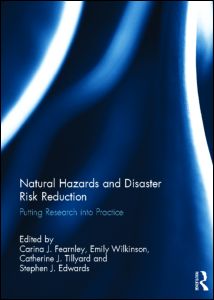
New Books: Natural Hazards and Disaster Risk Reduction Putting Research into Practice Edited by Carina Fearnley, Emily Wilkinson, Catherine J. Tillyard,Stephen J. Edwards (19 Jul 2013)

Natural Hazards and Disaster Risk Reduction

Putting Research into Practice

Edited by Carina FearnleyEmily WilkinsonCatherine J. Tillyard,Stephen J. Edwards

Published 19th July 2013 by Routledge – 112 pages

Descriptions:
Building upon presentations given during the conference on ‘Disaster Risk Reduction for Natural Hazards: Putting Research into Practice’, held at University College London in November 2009, the articles collected in this book examine how natural hazards research is accessed and used by practitioners and decision-makers, and conversely, how policy and practice inform research.
As with the conference, this book successfully brings together views from humanitarian and development agencies, academia, business, government and funding bodies. It is rare to engage such a wide range of sectors in a discussion relating to the issues of disaster risk reduction from a natural hazards perspective, and the book captures this interaction and the resultant exchange of ideas, thus providing an insight into how stakeholders respectively undertake or engage with natural hazards research. Collectively, the articles highlight the need for greater dialogue, understanding and collaboration between all these sectors if research is to be made relevant and generate significant impact on risk reduction policy and practice. There is an urgent requirement to better understand the respective needs, ways of working, project timescales and funding mechanisms for disaster risk reduction, as well as the challenges posed by institutional and organizational structures and functions. These issues must be overcome to ensure that ultimately, and most significantly, discussions turn into positive practical actions so that research on natural hazards is relevant and applicable. The book represents a step in that journey.
This book was published as a special issue of Environmental Hazards.
Contents:
  1. Preface 
  2. Culture and disaster risk reduction: Lessons and opportunities 
  3. Disaster-induced migration: Assessing the impact of extreme weather events on livelihoods
  4. Building livelihoods to reduce risk among the most marginalized in urban areas: Strategic approaches from Dhaka 
  5. Evaluating critical links in early warning systems for natural hazards 
  6. ‘Community’ perceptions of a disaster risk reduction intervention at Santa Ana (Ilamatepec) Volcano, El Salvador 
  7. Why ‘small is beautiful’ in municipal disaster risk reduction: Evidence from the Yucatán peninsula, Mexico 
  8. Conference summary on disaster risk reduction for natural hazards: Putting research into practice

Sunday, June 30, 2013

New Books: The Role of Ecosystems in Disaster Risk Reduction edited by Fabrice G. Renaud, Karen Sudmeier-Rieux and Marisol Estrella (Jun 2013)

The Role of Ecosystems in Disaster Risk Reduction

Edited by Fabrice G. RenaudKaren Sudmeier-Rieux and Marisol Estrella

1221 – Renaud – Role of Ecosystem _FINAL front cover_web
PUBLICATION DATA:
ISBN-13: 978-92-808-1221-3
LANGUAGE:
English
PAGES:
440
PRICE:
US$40.00
PUBLISHER:
United Nations University Press
PUBLISHED:
June 2013

The increasing worldwide trend in disasters, which will be aggravated by global environmental
change (including climate change), urges us to implement new approaches to
hazard mitigation, as well as exposure and vulnerability reduction. We are, however, faced
with hard choices about hazard mitigation: should we continue to build dikes and walls
to protect ourselves against floods and coastal hazards – though we have seen the limits
of these – or should we consider alternative, ecosystem-based solutions? Ecosystem
management is a well-tested solution to sustainable development that is being revisited
because of its inherent “win–win” and “no-regrets” appeal to address rising disaster and
climate change issues. It is one of the few approaches that can impact all elements of the
disaster risk equation – mitigating hazards, reducing exposure, reducing vulnerabilities
and increasing the resilience of exposed communities. Yet, the uptake of ecosystem-based
approaches for disaster risk reduction (DRR) is slow despite some very good examples of
success stories. Reasons for this are multiple: ecosystem management is rarely considered
as part of the portfolio of DRR solutions because the environmental and disaster
management communities typically work independently from each other; its contribution
to DRR is highly undervalued compared to engineered solutions and thus not attributed
appropriate budget allocations; finally, there are poor science–policy interactions on
ecosystem-based DRR, which have led to unclear and sometimes contradictory scientific
information on the role of ecosystems in DRR.
The aim of this book is to provide an overview of knowledge and practice in the multidisciplinary
field of ecosystem management and DRR to encourage and further develop
dialogues between scientists, practitioners, policymakers and development planners.

About the Editors:

Fabrice G. Renaud is Head of Section at the United Nations University Institute for
Environment and Human Security, Germany. Karen Sudmeier-Rieux is a Researcher at the
Center for Research of the Terrestrial Environment, University of Lausanne, Switzerland.
Marisol Estrella is the Programme Coordinator of the Disaster Risk Reduction Unit,
Post-Conflict and Disaster Management Branch, United Nations Environment Programme,
Switzerland.

Table of Contents:

Part I: Why do ecosystems matter in disaster risk reduction?
The relevance of ecosystems for disaster risk reduction, Fabrice G. Renaud, Karen Sudmeier-Rieux and Marisol Estrella
Ecosystem-based disaster risk reduction (Eco-DRR): An overview, Marisol Estrella and Nina Saalismaa
Part II: Ecosystems and coastal disaster risk reduction
Investigating the performance of coastal ecosystems for hazard mitigation, Sam S.L. Hettiarachchi, Saman P. Samarawickrama, Harindra J.S. Fernando, A. Harsha R. Ratnasooriya, N.A. Kithsiri Nandasena and Srimal Bandara
Bioshields: Mangrove ecosystems as resilient natural coastal defences, Carmen Lacambra, Daniel A. Friess, Tom Spencer and Iris Möller
Integrating the role of ecosystems in disaster risk and vulnerability assessments: Lessons from the Risk and Vulnerability Assessment Methodology Development Project (RiVAMP) in Negril, Jamaica,
Pascal Peduzzi, Adonis Velegrakis, Marisol Estrella and Bruno Chatenoux
Increasing the resilience of human and natural communities to coastal hazards: Supporting decisions in New York and Connecticut, Michael W. Beck, Ben Gilmer, Zach Ferdaña, George T.
Raber, Christine C. Shepard, Imen Meliane, Jeffrey D. Stone, Adam W. Whelchel, Mark Hoover and Sarah Newkirk
A coastal adaptation strategy for the City of Cape Town: An ecosystem-based management approach towards risk reduction, Darryl Colenbrander, Penny Price, Gregg Oelofse and Sakhile Tsotsobe
Lessons from local initiatives on ecosystem-based climate change work in Tonga, Stavros Mavrogenis and Ilan Kelman
Part III: Water resources management for disaster risk reduction
Good flood, bad flood: Maintaining dynamic river basins for community resilience, Pieter van Eijk, Chris Baker, Romana Gaspirc and Ritesh Kumar
Utilizing integrated water resources management approaches to support disaster risk reduction, James Dalton, Radhika Murti and Alvin Chandra
The matter is not if, but when and where: The role of capacity development in disaster risk reduction aiming for a sustainable water supply and sanitation, Madeleine Fogde, Luis Macario and Kirsten Carey
Part IV: Sustainable land management for disaster risk reduction
12 The role of vegetation cover change in landslide hazard and risk, Maria Papathoma-Koehle and Thomas Glade
Protection forests: A key factor in integrated risk management in the Alps,André Wehrli and Luuk Dorren
Forest cover and landslide trends: A case study from Dolakha District in central-eastern Nepal, 1992–2009, Stéphanie Jaquet, Karen Sudmeier-Rieux, Marc-Henri Derron and Michel Jaboyedoff
Part V: Policy, planning and future perspectives
Reducing vulnerability: The role of protected areas in mitigating natural disasters, Nigel Dudley, Kathy MacKinnon and Sue Stolton
Urban disaster risk reduction and ecosystem services, Lorenzo Guadagno, Yaella Depietri and Urbano Fra Paleo
Applying environmental impact assessments and strategic environmental assessments in disaster management, Anil Kumar Gupta and Sreeja S. Nair
Opportunities, challenges and future perspectives for ecosystem-based disaster risk reduction, Marisol Estrella, Fabrice G. Renaud and Karen Sudmeier-Rieux
For more information: 

Saturday, June 29, 2013

New Books: Risk Edited by Ragnar Lofstedt, Frederic Bouder (25 Jun 2013)

Risk

Edited by Ragnar LofstedtFrederic Bouder

Published 25th June 2013 by Routledge – 1,808 pages

Descriptions:
Can we better predict or mitigate the consequences of natural disasters, such as earthquakes and hurricanes? Can we reduce the number of oil spills? And what should be done to clean up the mess when something does goes wrong? Why are people concerned about nuclear plants, but so reckless when they go skiing, or when they drive their motor cars? And how can we ensure that experts and ordinary citizens exchange meaningful information about hazards?
Over the past fifty years or so, eminent scholars from the decision sciences, geography, sociology, anthropology, and many other fields, have offered useful pointers towards finding an answer to these and other crucial questions. Their prolific and converging efforts have established Risk Analysis as a vivid new discipline, a discipline which this new Routledge collection enables users to discover—or to understand better.
The collection conveys essential lessons about how risks can be better assessed. Sophisticated models about the probability and magnitude of harms have been developed and tested in a variety of fields, for example, by engineers trying to build safer plants, or by toxicologists trying to understand the pathways of pollutants. The materials gathered here also help us to understand how powerful perception drivers shape our views of different risks and, as a consequence, how risk communication may be best conducted. Risk also brings together and makes sense of a body of knowledge that has allowed the development of specific methods to join together these two crucial elements into a coherent management ‘whole’.
Contents:
Volume 1: Risk Assessment
Volume II: Risk Perception
Volume III: Risk Communication
Volume IV: Risk Management

Monday, June 10, 2013

Events: Distinguished Speaker Seminar: Ian Davis - Reflections on Reducing Disaster Risks in the Asia and Pacific Region 1972-2013 organized by ADB Institute on 25 Jun 2013

Distinguished Speaker Seminar: Ian Davis - Reflections on Reducing Disaster Risks in the Asia and Pacific Region 1972-2013

ADBI, Tokyo, Japan : 25 June 2013

Purpose

ADBI's Distinguished Speaker Seminar series brings eminent persons to ADBI to encourage debate among policymakers, researchers, academics, think tanks, and other audiences interested in economic development challenges in Asia, the Pacific and Europe.

Background

Developing countries in the Asia and Pacific region are particularly exposed to risks from natural disasters. Of the ten major natural disasters with the highest death tolls across the world since 1980, seven occurred in developing countries in Asia. The loss in life and property from these disasters has been huge. The average annual direct economic loss due to disasters in the Asia and Pacific region in the period 2002–2011 is estimated at $65 billion, and the trend is rising.
In view of the severe economic and human impact of disasters, it is important to formulate and implement country-based and region-wide strategies to address and reduce such risks and their consequences.

Participants

Policymakers, academics and the general public.

Language

English


For more information: http://www.adbi.org/event/5732.davis.distinguished.speaker/

Sunday, May 19, 2013

Publications: Lessons Learnt From The Triple Disaster In East Japan (Jun 2012)


IGES Policy Report No.2012-01
Lessons Learnt From The Triple Disaster In East Japan
Editor: Watarai, Aya|2012/06|
Publisher: IGES(Hayama)

Language: English|
Publication Type: Policy Reports|
ISBN/ISSN: 978-4-88788-112-9|
Copyright: IGES. |
Contributor: Kojima, Satoshi and Asuka, Jusen|
IGES Staff: Nakabayashi, Mie


This policy paper comprises a report on the outcomes of the Earthquake Research Initiative conducted by IGES following the Great East Japan Earthquake. It focuses on three themes: Post-Fukushima Energy Supply Options in Japan; Observation of Multi-stakeholder Collaboration in Northeast Japan Earthquake; and Effective Energy Saving Measures: Experience from Post-Fukushima. The report offers recommendations for creating low-carbon and sustainable societies that are resilient to the effects of climate change and natural disasters, and that could serve to guide other nations in Asia, where frequent natural disasters occur.

Keywords:

Geographic area:

Download:


For more information: http://enviroscope.iges.or.jp/modules/envirolib/view.php?docid=3986

Publications: Global Estimates 2012: People displaced by disasters by M.Yonetani (May 2013)


Eldis Logo - Return to home page

Global Estimates 2012: People displaced by disasters by M.Yonetani


View full report


Over five years from 2008 to 2012, around 144 million people were forced from their homes in 125 countries. In 2012, an estimated 32.4 million people in 82 countries were newly displaced by disasters associated with natural hazards triggered by climate- and weather-related events (98 per cent of all displacement in 2012; 83 per cent over five years), with flood disasters in India and Nigeria accounting for 41 per cent of global displacement in 2012. In India, monsoon floods displaced 6.9 million and in Nigeria 6.1 million people were newly displaced. The Global Estimates report determines that while over the past five years 81 per cent of global displacement has occurred in Asia, in 2012 Africa had a record high for the region of 8.2 million people newly displaced, over four times more than in any of the previous four years. The report concludes that the systematic collection, analysis and sharing of data is critical to inform policy and measures where they are most needed.


For more information: 

Thursday, May 9, 2013

Philippine Updates: DENR BEGINS GROUNDWORK FOR MASSIVE REFORESTATION IN CDO (8 May 2013)


DENR BEGINS GROUNDWORK FOR MASSIVE REFORESTATION IN CDO

Wednesday, 08 May 2013 17:47 |

The Department of Environment and Natural Resources (DENR) is moving forward with the implementation of a new law seeking to reforest some 3,000 hectares throughout Cagayan de Oro City, in a bid to prevent a repeat of the devastation inflicted by typhoon “Sendong” in 2011.
DENR Secretary Ramon J.P. Paje said a six-member validation team has been formed to identify the areas to be covered by the massive reforestation program in the Misamis Oriental capital, as mandated under Republic Act (RA) No. 10452.
Paje said the validation team, composed of forestry and urban planning officers, is tasked to prioritize barangays surrounding the Cagayan de Oro River which, in 2011, failed to hold the huge amount of rainfall brought by tropical storm Sendong that eventually poured into low lying areas of the city and triggered deadly flashfloods.
Sendong left more than 1,200 people dead and destroyed P1.3 billion in agriculture and properties in Cagayan de Oro and nearby Iligan City.
Last month, President Benigno Aquino III signed RA 10452 that mandates the DENR to plant trees in 3,000 hectares of public land in Cagayan de Oro to protect its people and its environment from floods and landslides.
The reforestation program seeks to avoid a repeat of the disaster left by Sendong in Cagayan de Oro in December 2011. Another severe flooding hit the city in January 2009.
Paje reiterated that the law complements the Aquino administration’s forest policies – the National Greening Program (NGP) and the total log ban– aimed at fighting the adverse effects of climate change.
“The enactment of RA 10452 came at a most opportune time, just as the national government is making an unprecedented push to reforest the country through the NGP and the nationwide logging ban in natural and residual forests,” Paje pointed out.
NGP is the government’s flagship reforestation program that seeks to plant some 1.5 billion trees covering about 1.5 million hectares in six years ending in 2016.
Agustilo Obsioma, DENR Region 10 technical director for forestry, said the areas to be prioritized under RA 10452 are barangays along Cagayan de Oro River that were badly hit by Sendong.
The program, he said, will also include former concession areas covered by timber license agreement earlier issued by the government.
Obsioma said the ground mapping and validation of these areas, using the global positioning system (GPS) technology, would take at least two weeks.
According to the DENR, Cagayan de Oro’s forestland area covers 20,702 hectares or about 48 percent of the city’s total land area of 42,246 hectares.
The DENR Region 10 reported that at least 11 low-lying villages along Cagayan de Oro River were seriously hit by the 2011 flashfloods: Carmen, Consolacion, Balulang, Macasandig, Nazareth, Sitio Taguanao, and Barangays 6, 7, 13, 15, and 17.# 

For more information: 

Wednesday, May 1, 2013

New Book: Towards Disaster Risk Reduction A Policy-Focused Approach to Natural Hazards and Disasters Edited by Jason K. Levy, Chennat Gopalakrishnan (30 Apr 2013)


Towards Disaster Risk Reduction

A Policy-Focused Approach to Natural Hazards and Disasters

Edited by Jason K. LevyChennat Gopalakrishnan

Published 22nd April 2013 by Routledge – 104 pages
Description:
This book constitutes a landmark attempt to address, comprehensively and in-depth, a policy-focused approach to the many timely and important issues associated with building a culture of disaster prevention and disaster risk reduction. This book not only provides key insights into the field of natural hazard and disaster studies but also assesses the causes, perspectives, and consequences of natural disasters, as well as providing a global survey of post-recovery policies. The contributions found herein discuss disaster risk reduction strategies and policies for managing the unexpected and cascading impacts of natural disasters. A particular focus is placed on transboundary catastrophes that cross policy domains, geographic, political, and sectoral boundaries. Since the disaster management and natural resources policy research field draws on a diverse range of paradigms and influences, the book includes case histories, empirical studies, conceptual-theoretical investigations, policy perspectives, institutional analysis, and risk analyses. The role of human culture, disaster psychology and environmental monitoring are examined in depth. Deficiencies and inequalities in local, national, and global disaster response are also discussed. Original strategies for reducing disaster risk are put forward and the prospects for a major change in the direction of global policy on disasters.
This book was published as a special issue of the Journal of Natural Resources Policy Research.

Contents:
1. Introduction: A Policy-Focused Approach to Natural Hazards and Disasters—Towards Disaster Risk Reduction (DRR)
2. The L’Aquila Earthquake of 6 April 2009 and Italian Government Policy on Disaster Response
3. Using Natural Capital to Reduce Disaster Risk
4.The Dynamics of Informal Responses to Covariate Shocks
5. Negotiation Support for Environmental Disaster Management: Drama Theory II and the Survival of Louisiana’s Indigenous Gulf Coast Tribes
6. A Gap Hazard Analysis: Initiating Policy Development with Mountainous Communities

For more information: http://www.routledge.com/books/details/9780415826785/

Monday, April 29, 2013

Publication: Climate resilience and disaster risk management: stories of change from CDKN by M. Dupar (Apr 2013)


Eldis Logo - Return to home page

Climate resilience and disaster risk management: stories of change from CDKN by M. Dupar


View full report


This brief presents results from projects supported by the Climate and Development Knowledge Network (CDKN) to assess vulnerability and mainstream climate resilience into development planning. Case studies from India, Ghana and Colombia illustrate the importance of involving diverse social groups in defining and monitoring vulnerability and delivering adaptation solutions. The paper highlights the use of innovative techniques such as role-playing games to raise people’s awareness of the tough challenges posed by decision-making in a changing climate. Examples include: an initiative to protect residents of Ahmedabad, western India from heatwaves through common sense measures; a programme of witness tours and capacity building for local assembly members in Ghana, to raise awareness of climate-related risks to coastal development; and an ambitious process of vulnerability assessment in Cartagena, Colombia.

For more information: 

Thursday, April 11, 2013

New Book: Observatory essay book published by Hong Kong Observatory (9 Apr 2013)


Observatory essay book published


Photo
Meteorological manuscript:  The Hong Kong Observatory has published a collection of essays entitled Under the Same Sky to commemorate the department's 130th anniversary.

April 09, 2013

The Hong Kong Observatory has published a collection of essays entitled Under the Same Sky to commemorate the department's 130th anniversary.
 
The book comprises 50 Chinese and English articles written by six directors and serving and retired staff of the department, scholars, and other people.
 
Through the authors' real-life stories, and more than 150 pictures, the evolution of the observatory and society over the decades is vividly recorded.
 
Natural disasters that Hong Kong has experienced are recollected in the book, to increase public awareness of disaster prevention and mitigation, in preparation for a possible increase in frequency of extreme weather brought about by climate change.
 
The book, at $74 a copy, is on sale at the observatory’s Resource Centre, the Information Services Department’s Publications Sales Unit, and the Map Publications Centre, Kowloon. It is also available from the Online Government Bookstore.

For more information: 

Sunday, March 24, 2013

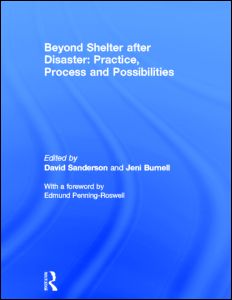
New Book: Beyond Shelter after Disaster: Practice, Process and Possibilities Edited by David Sanderson, Jeni Burnell (18 Mar 2013)


Beyond Shelter after Disaster: Practice, Process and Possibilities

Edited by David SandersonJeni Burnell

Published 18th March 2013 by Routledge – 166 pages

Description: 
Providing shelter after a disaster is recognised as one of the most complex areas of humanitarian relief and recovery. Some aid agencies have stopped providing shelter altogether after bad experiences, while those that do quickly become engaged in challenges that go far beyond the provision of structures alone. Yet with the number and severity of disasters set to increase, due to climate change and rapid urban growth, the need for approaches that work has never been greater.
This book explores the issues in three parts. The first, Practice, looks at lessons from past efforts. Part two, Process, proposes practical and effective people-centred approaches. Part three considers currently neglected issues such as disability, human rights and urban-oriented approaches. Through practical case studies and academic research, Beyond Shelter after Disaster critiques past methods and explores future options for improving practice in one of the most complex areas of post disaster relief and recovery.
This book was originally published as a special issue in Environmental Hazards: Human and Policy Dimensions.

Contents:
1. Introduction. Beyond shelter after disaster: practice, process and possibilities 
Part one: practice 2. What have we learned from 40 years’ experience of Disaster Shelter?
3. Harnessing time: Reflections on constraints to development
4. Post-disaster reconstruction: A current analysis of Gujarat’s response after the 2001 earthquake 
Part two: process
5. Resilient dwellings or resilient people? Towards people-centred reconstruction
6. Community-led resettlement: from a flood- affected slum to a new society in Pune, India
7. Lost in translation? The challenges of an equitable post-disaster reconstruction process: lessons from Chile 
Part three: possibilities 8. Is there a human right to shelter after disaster?
9. Can humanitarian responses in urban areas reinforce underlying causes of vulnerability? Tweaking a livelihoods analysis of inequality and infrastructure in splintering cities
10. From research to practice (and vice versa) for post-disaster settlement and shelter
11. Disability and public shelter in emergencies