Showing posts with label tree management. Show all posts

Sunday, September 15, 2013

ICF National Conference 2014: Trees, People and the Built Environment from 2-4 Apr 2014

TPBEII landscape Birmingham

ICF National Conference 2014

ICF CONF IDENT LAND v3
Location : University of Birmingham, Elgar Concert Hall, Bramall Music Building, Birmingham

Call for Papers now open (July 2013)

Conference Papers are welcomed that address any topic involving trees and the built environment, in both the social and natural sciences. Dowload the Call for Papers flyer for information on how to submit your abstract. (Deadline: 21 Oct 2013)

Trees, People and the Built Environment is back!

Following on from the highly successful event in 2011, the international urban trees research conference Trees, People and the Built Environment returns to Birmingham in 2014.
Again hosted by the ICF as its National Conference 2014, Trees, People and the Built Environment II continues its influential pan-industry partnership initiative between over 20 organisations representing professionals within the greenspace and built environment sectors. A Conference Steering Group, drawn from this partnership, will guide the programme content and format. 


Conference Aims

Urban trees and woodlands are essential elements of our green infrastructure and play a vital role in promoting liveable and sustainable towns and cities. The urban forest can have numerous environmental, economic and social benefits, contributing enormously to the health and welfare of everyone who lives and works in urban areas.
 For reference, you can download the Trees, People and the Built Environment Proceedings 2011.

Attend

Booking for Trees, People and the Built Environment II will open in the Autumn. To ensure that you receive notification of when bookings can me made join the TPBE LinkedIn Group (see below) or sign up for ICF's monthly free e-news.

Keep Up To Date

Join the TPBE LinkedIn Group and discussion forum to keep up to date with conference news, discuss urban tree issues and share information with this global network of 850+ tree professionals with an interest in the urban sector.


Conference Partners

The Arboricultural Association, Ancient Tree Forum, Bartlett Tree Research Laboratories, Forest Research, Forestry Commission, Institute of Chartered Foresters, Institution of Civil Engineers, International Society of Arboriculture (UK & I Chapter), Landscape Institute, London Tree Officers Association, Municipal Tree Officers Association, Myerscough College, National Association of Tree Officers, Natural England, Royal Institute of British Architects, Royal Institution of Chartered Surveyors, Trees and Design Action Group, University of Birmingham, University of Manchester, Utility Arboriculture Group.
Consultative supporters: English Heritage, Green Infrastructure Partnership, Royal Town Planning Institute

Contact Us

For more information on TPBEII please contact Allison Lock, ICF Communication and Events Manager by email or call +44 (0) 131 240 1425

ICF National Conference 2013

The ICF 2013 Conference: Woodlands and the Green Economy took place in April - visit the 2013 conference web page for more information.

For more information: http://www.charteredforesters.org/icf-events/icf-national-conference/

Sunday, September 8, 2013

Malaysian Updates: FRIM develops DNA markers for karas species identification (2 Sep 2013)

FRIM Official PortalFRIM develops DNA markers for karas species identification

FRIM Genetic Laboratory will be ready to offer Aquilaria species identification and verification services once it has completed the development of the DNA markers.
FRIM Genetic Laboratory will be ready to offer Aquilaria species identification and verification services once it has completed the development of the DNA markers.
2 September 2013 (Monday) – Forest Research Institute Malaysia (FRIM) has successfully developed DNA markers for five Aquilariaspecies (karas), while still working on three (3) others, in an effort to help ensure the accurate identification and verification of the species.
FRIM has been approached by plantation owners to assist in this since 2011 to ensure compliance with requirements under the International Trade in Endangered Species Act 2008 (Act 686), gazetted on 14 February 2008 and enforced from 1 July 2010.
Under the Act, karas planters are required to register and submit relevant information on the species to be planted including its verification certificate. The problem with the species identification is that it is difficult to distinguish the species at sapling stage given they share similar features.
Aquilaria malaccensis, one of the species found in Terengganu.
Therefore, in support of the implementation of this Act and to assist the plantation sector, FRIM has taken the initiative to conduct the research project using DNA Marker Technology in 2012. The project, funded by the Ministry of Science, Technology and Innovation (MOSTI), is undertaken with support of the Forestry Department Peninsular Malaysia and Sarawak Forest Department.
The study covers all five major local species, namely A. malaccensis(agarwood, karas or depu), A. microcarpa (garu), A. hirta (candan), A. rostrata and A. beccariana (gaharu tanduk), and three exotic species—A. crassnaA. subintegra and A. sinensis.
“Once the study is completed end of this year, FRIM will be able to start offering Aquilaria species identification and verification services to karas planters by 2014,” said FRIM Director General Dato’ Dr Abd Latif Mohmod.
He said the high commercial value of its resin known as agarwood (gaharu), used in the perfume industry as well as for medical purposes and religious ceremonies, has resulted in the increasing interest in establishing karas plantations for agarwood in the country.
The value of agarwood can fetch up to RM25,000/kg depending of the grade and quality, and with the introduction of inoculation technology, agarwood production has increased.
Due to uncontrolled harvesting, Aquilaria species have been listed in the schedule species under Appendices I, II and III to the Convention on International Trade in Endangered Species (CITES).
For any query on the research project, please contact Dr Norwati Muhammad or Dr Siti Salwana Hashim via email: norwati@frim.gov.my / salwana@frim.gov.my.

Wednesday, August 7, 2013

HK's Updates: 8 valuable trees added to register (6 Aug 2013)

8 valuable trees added to register

August 06, 2013
樹屋Eight trees have been added to the Old & Valuable Trees Register to boost their protection.
 
The Development Bureau's Tree Management Office announced the move today, saying 20 trees have been added to the register in the past year.
 
The Government launched the register in 2004. Trees on it are included due to their large size, rarity, old age, outstanding form or cultural, historical or memorable significance.
 
Data on the register is updated on a regular basis.
 
Click here for details on and pictures of the trees.

For more information: 

Thursday, August 1, 2013

Malaysian Updates: Palm oil drives Malaysian rainforest tree to extinction (30 Jul 2013)

Palm oil drives Malaysian rainforest tree to extinction

Rhett A. Butler, mongabay.com
July 30, 2013


Oil palm plantations have extinguished the last habitat of a rainforest tree in Malaysia, reports the New Straits Times.

Last week the Forest Research Institute Malaysia (FRIM), a state agency, announced that the last stands of keruing paya (Dipterocarpus coriaceus) in Peninsular Malaysia were wiped out when Bikam Forest Reserve in Perak was cleared for oil palm plantations. The plantations were established after Bikam was de-gazetted, or re-zoned from a logging concession for conversion to oil palm. More than 450 hectares of forest were cleared.

Maketab Mohamed, president of the Malaysian Nature Society, told the New Straits Times that experts had warned about the risk of de-gazetting the permanent forest estate for oil palm.

"It is indeed a shocking find but this phenomenon did not happen overnight," he was quoted as saying. "The extinction was caused by the act of the state which de-gazetted forest reserves for oil palm plantations over a long period of time."


Data released by NASA in June showed a spike in deforestation in Perak between January and March 2013


Mohamed noted that the species, which like other dipterocarps has commercial timber value, is found only in the southern Perak region in Peninsular Malaysia.

"The Bikam forest reserve was identified as the last largest natural habitat for the trees," he said. "But even that habitat is now gone; becoming a victim of exploitation of the forest for oil palm cultivation."

WhileDipterocarpus coriaceushas been eliminated from Bikam, there is still hope for the species: FRIM has a cache of seedlings that could be replanted if suitable habitat is identified — and protected. The species also occurs in Malaysian Borneo, Sumatra and Kalimantan.

Vast areas of natural forest in Malaysia have been cleared for oil palm plantations over the past 30 years, putting a number of plant and animal species at risk. Some scientists have called the crop the "single most immediate threat to the greatest number of species" for the impact expansion has had on habitat of endangered wildlife in Southeast Asia.


Bikam Forest Reserve in 2008


Bikam Forest Reserve in 2011. Courtesy of Google Earth


Source: http://news.mongabay.com/2013/0730-keruing-paya-extinction-palm-oil.html

Wednesday, April 3, 2013

Taiwanese Updates: 栽植適當樹種提升工業區空氣品質-環保署發表研究成果 (2 Apr 2013)


植適當樹種提升工業區空氣品質-環保署發表研究成果
提供單位:行政院環境保護署空保處
發布日期:2013.04.02

新聞圖片環保署表示,為篩選傳統工業區常見空氣污染物的適合樹種,該署特與學術研究機構合作,在石化及鋼鐵集中的工業區周界及主要幹道進行實地樹種現況普查,以健康指數篩選優勢樹種,並與實驗室之樹種淨化空氣污染物的實驗數據比對驗證,篩選出適合石化及鋼鐵工業區淨化空氣污染物的樹種。結果顯示,適合石化工業區的樹種有台灣櫸、黃連木、水黃皮、小葉欖仁、檸檬桉、小葉南洋杉、茄冬、檉柳、白水木及榕樹等;適合鋼鐵工業區的樹種有尾葉桉、檉柳、海棗、白水木、小葉南洋杉、榕樹等(附件1)。未來於工業區進行綠化植栽以及環境影響評估新開發行為時,該署建議業者於隔離綠帶以及綠化植栽可選擇這些適合的樹種,該署也會將相關資訊登錄於環保署網站,供民眾參考。 

石化及鋼鐵工業是傳統的高污染高耗能產業,在製程中易產生空氣污染物,石化工業主要污染物為揮發性有機物氣體,鋼鐵工業主要污染依製程分成三大類:一般煉鋼廠以硫氧化物、氮氧化物、氟化氫、懸浮微粒為主,電弧爐廠與集塵灰廠主要為懸浮微粒及戴奧辛。環保署說,環保單位及產業界雖然致力於排放標準加嚴及污染物減量,但在排放於大氣中的空氣污染物,如能藉由植物最自然又節能的淨化特性,將可進一步達到淨化空氣與美化環境的目的。 

環保署表示,針對現地樹木健康狀況,係依植株地上部有無病徵、落葉、黃化、褐化、萎凋及葉片褐化百分比,健康指數分0至5等級,等級愈高表示愈健康(附件2)。經由現場調查發現上述2類廠區之樹木健康指數為2至4等級,顯見仍有進行樹木補植或更換樹種的空間。其次,將現場篩選出的優勢樹種,與實驗室利用枝葉圍封箱、熏氣箱(附件3)量測數據交叉驗證,結果顯示,若以空氣污染物種類來考量適合種植的樹種,二氧化硫濃度較高之場所,建議選用小葉南洋杉、木麻黃、台灣櫸、海棗及檉柳等;淨化氮氧化物的建議樹種為檉柳、台灣櫸、黃連木、木麻黃及檸檬桉等;淨化乙烯建議選用台灣櫸、黃連木、茄冬及小葉欖仁;淨化甲苯可選用水黃皮、海棗、木麻黃、黃連木及茄冬;淨化臭氧可選用黃連木、白水木、檉柳、欖仁及榕樹等;而淨化氟化氫則可選用小葉欖仁、榕樹、檉柳及台灣櫸等(附件4)。 

環保署表示,上述建議樹種係依植物淨化空氣污染物能力為主,未來執行植樹相關單位,可以綜合考量栽植地環境現況,並結合生態及生物多樣性等因素,以使植樹達到最大效益。植樹是一項無悔的政策,該署未來將持續進行相關調查研究,建立更完整之資料庫,並加強推動不同污染源,需慎選適合的樹種,減碳與淨化空氣的效果將會更好,讓我們共同為環境盡一分心力。

For more information and download the relative documents: 

Saturday, March 16, 2013

Call for comments/suggestions: Inviting comments/ suggestions on the Report of the Committee constituted to study the regulatory regime regarding felling and transit regulations for tree species grown on private land-reg (Deadline: 15 Apr 2013)


F. No.8-14/2004-FP
Government of India
Ministry of Environment & Forests
Forest Policy Division

Paryavaran Bhawan,
CGO complex,
Lodhi Road,
New Delhi-110003
Dated: 8th March, 2013


To:
1. All concerned
2. MoEF website
3. ENVIS cell of MoEF


CIRCULAR

Sub: Inviting comments/ suggestions on the Report of the Committee constituted to study the regulatory regime regarding felling and transit regulations for tree species grown on private land-reg.

This is informed to all concerned Ministries/ Departments/ interested persons & institutions/ State Forest Departments/ Agro-foresters & Farmers/ local communities and NGOs etc., that the Ministry of Environment & Forests constituted a Committee in July, 2011 to study the regulatory regime on felling and transit regulations for tree species grown on non forest/private lands, to evaluate the experience of different States/UTs and to recommend the regulatory regime in the recently initiated Green India Mission, one of the eight Mission under National Action Plan for Climate Change.

2. The Committee has brought out the Report on the study on felling and transit regulations for tree species grown on non forest/private lands, which is available on the website of the Ministry of Environment & Forests (moef.nic.in). The suggestions/ comments, if any, on the Report are invited for consideration of the Committee to make the report more effective and useful for greater private initiatives in afforestation/ tree plantation.

3. The comments/ suggestions may please be sent to the undersigned through written communication/ fax/ email so as to reach this office latest by 15th April, 2013


Sd/=
(Subhash Chandra)
Dy. Inspector General of Forests (Forest Policy)
Telefax; 011-24363974
Email; subhaash.chandra@gmail.com


For original document: 
http://envfor.nic.in/assets/Report-of-the-Committee-on-Regulatory-Regime-for-Trees-Grown-on-Private-Land-Nov-2012.pdf

Sunday, January 6, 2013

HK updates: Tree care ensures a greener Hong Kong (6 Jan 2013)


PhotoTree care ensures a greener Hong Kong

January 06, 2013
There are many trees dotted around Hong Kong, offering a great variety of flora in both rural and urban areas. The Tree Management Office was established in 2010 to assess trees and train staff in different government departments to deal with tree problems.
 
The office hopes that with community surveillance and the work of different departments, Hong Kong can take good care of its trees and develop a greener environment.
 
The office provides about 140 courses for government departments. It has trained about 17,000 people so far.

Tree Management Officer Keith Fan teaches government staff how to conduct tree inspections.
 
On the day of this interview, he was teaching a class of 30 in Kowloon Park, to inspect the condition of a tree on a slope.
 
“If this kind of fungus is found on the surface of the tree, the root of this tree will probably be damaged by infection,” he told his students.
 
"The first step to inspecting a tree is to observe it by eye. If problematic trees are found, more advanced equipment is required for further testing, such as tomography scanners, to gather more data about the heath condition of the trees.”
 
Staff are trained to conduct tree risk assessments, and to learn mitigation measures.
 
Different departments conducted more than 28,000 tree inspections last year, and prescribed mitigation measures for more than 19,000 trees.
 
Tree Management Office Head Lawrence Chau said there are many ways to deal with problematic trees. Some simply need pruning, support or removal, while others must be treated for pests and disease.
 
Striking a balance 
Deciding whether to repair or remove a problematic tree is not an easy decision.
 
“We are trying our best to strike a balance when managing trees. We have to take public safety into account, and consider the feelings of the community for trees. Although the overall policy focuses on public safety, we also communicate with local communities, especially on trees which are highly worthy of protection,” Mr Chau said.
 
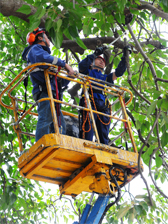
A 14-metre candlenut tree on Perkins Road has long branches which have posed problems for vehicles passing by it. Leisure & Cultural Services Department officers examined the situation and decided to cut part of the tree. Tree surgeons had to work quickly and accurately to minimise the operation's impact on traffic.
 
Community care 
Due to the vast number of trees in Hong Kong, the Tree Management Office suggests that one way to improve tree monitoring is to gather support from the public. People can report problematic trees by calling 1823.
 
People can also download the Tell Me@1823 application for smartphones, and simply submit photographs and a description to report a problematic tree. A geospatial function allows the app to capture the tree's location, enabling related departments to conduct follow-up work as quickly as possible.
 
Tree Care Report forms are available online for people to report tree problems to the Tree Management Office.
 
The office has also prepared a pictorial guide to explain how to identify health and structural problems in trees.


Link to Department Bureau Tree Management Office: http://www.trees.gov.hk/en/home/index.html