Showing posts with label NGOs. Show all posts

Thursday, April 17, 2014

Philippines News: Green groups in QC hit council bid to lift incinerator ban (14 April 2014)

Green groups in QC hit council bid to lift incinerator ban

By 


MANILA, Philippines—Quezon City-based environmentalists are up in arms over a local council resolution asking Congress to lift the ban on incinerators to pave the way for the setup of waste-to-energy (WTE) facilities in the city.
Green advocacy leaders and Quezon City residents Von Hernandez, Sonia Mendoza, Joey Papa and Shally Vitan—who represent different groups—denounced the councilors’ move as a “death blow” to waste prevention and recycling initiatives, pointing out that incineration is a “lazy man’s dangerous technology.”

They warned that lifting the ban by amending two laws—the Clean Air Act of 1999 and the Ecological Solid Waste Management Act of 2000—would lead to further ecological degradation.

Hernandez, EcoWaste Coalition president and Greenpeace Southeast Asia executive director, said the resolution was “a regressive and despicable move on the part of the city council. Not only does it betray the Quezon City government’s utter inability to implement real solutions already prescribed in law, it also shows that these politicians would not hesitate to burn and waste taxpayers’ money on polluting facilities.”

“What is being presented as a ‘quick fix’ is actually a scheme to increase the already stratospheric costs of waste management and disposal in Quezon City,” Hernandez said, pointing out that the public should ask who stands to benefit from the setup of a WTE facility.

Papa, president of Bangon Kalikasan Movement, stressed that incineration as a means to dispose of solid waste would only compete with recycling which is environmentally and economically beneficial.
“Instead of being fixated with this lazy man’s dangerous technology, our city officials should focus on optimizing recycling and providing incentives for households to separate their discards at source, to recycle and to compost,” he said.

These “burn proponents,” Papa said, would “negate the best practices of a good number of Quezon City residents,” like those in barangays that had succeeded in reducing their waste output through segregation and recycling.
Vitan said a quick-fix measure such as the WTE facility would only compound the city’s waste-management problem and add health hazards to the mix.

“What Quezon City needs to do is to aggressively reduce the garbage it produces by securing the cooperation of residents,” said Vitan, Asia-Pacific coordinator for Global Alliance for Incinerator Alternatives. “It may be long and slow but it is sustainable.”

Mother Earth Foundation president Sonia Mendoza reminded the city councilors of the danger of incinerators which, she said, emit cancer-causing dioxins.

“Incinerator peddlers would always say there’s ‘nothing to worry about, it’s zero emission.’ But even the most technologically advanced waste burners with expensive, high-tech emission-control devices still emit various contaminants, often failing emission standards.”

The council recently asked the House of Representatives, through former Quezon City mayor and now Speaker Feliciano Belmonte Jr., to amend the two laws and lift the ban.

The councilors maintained that a WTE facility would be necessary in view of the city’s growing population and economic development which had increased solid waste generation and posed trash disposal problems.
Last year, the city government held exploratory talks with the group of businessman Manny V. Pangilinan for a possible joint venture, wherein the city would be supplying the trash while the MVP group would construct and run a WTE facility.


Read more: http://newsinfo.inquirer.net/593896/green-groups-in-qc-hit-council-bid-to-lift-incinerator-ban#ixzz2yjrLj6Iy

Monday, January 27, 2014

Publication: Shining a Light on Fossil Fuel Subsidies at the WTO: How NGOs can contribute to WTO notification and surveillance (Jan 2014)

IISD Publications Centre

Shining a Light on Fossil Fuel Subsidies at the WTO: How NGOs can contribute to WTO notification and surveillance

» Liesbeth Casier, Robin Fraser, Mark HalleRobert Wolfe, IISD, 2014.Paper, 29 pages, copyright: IISD
Fossil fuel subsidies undermine efforts to mitigate climate change and damage the trading system. However, multilateral discussion is hampered by inconsistent definitions and incomplete data. Members do not notify such subsidies as much as they should under the Agreement on Subsidies and Countervailing measures (ASCM), which limits the usefulness of the SCM Committee. The reports of the Trade Policy review mechanism on individual countries and on the trading system draw on a wider range of sources, creating an opportunity for non-governmental organizations (NGOs) to provide the missing data from publicly available sources. We suggest a new template that could be used for such third-party notifications. The objective is to shine a light on all fossil fuel subsidies that cause market distortions, especially trade distortions. The result should be better, more comparable data for the Secretariat, governments, and researchers, providing the basis for better-informed discussion of the incidence of fossil fuel subsidies and rationale for their use.

PDF
  • Hard copy not available.

Tuesday, January 14, 2014

Hong Kong News: Holiday alert: Waste not, want not! (2 Jan 2014)

Holiday alert: Waste not, want not

The festive season is fast approaching, with the promise of feasts. Before you sit down to another groaning table, keep an eye out for Foodwise ambassador Big Waster - and heed his advice: "Order only portions you can finish, buy only what you need. Please be conscious, stop the waste.”

He is joining fellow messengers from green group Greeners Action on excursions to crowded streets and shopping malls, rapping out his message while seeking satisfied diners with no leftovers on their plate.

As part of the Greeners Action food waste reduction program, the entourage is visiting high-traffic restaurant locations to reward customers who finish all the food they ordered.
Photo
Happy ending:  Greeners Action volunteers visit high-traffic restaurant locations to reward customers who finish all the food they ordered.
Photo
Conservation consideration:  Fifteen restaurants are participating in a food-waste reduction program underway in Wong Tai Sin for six months.
Photo
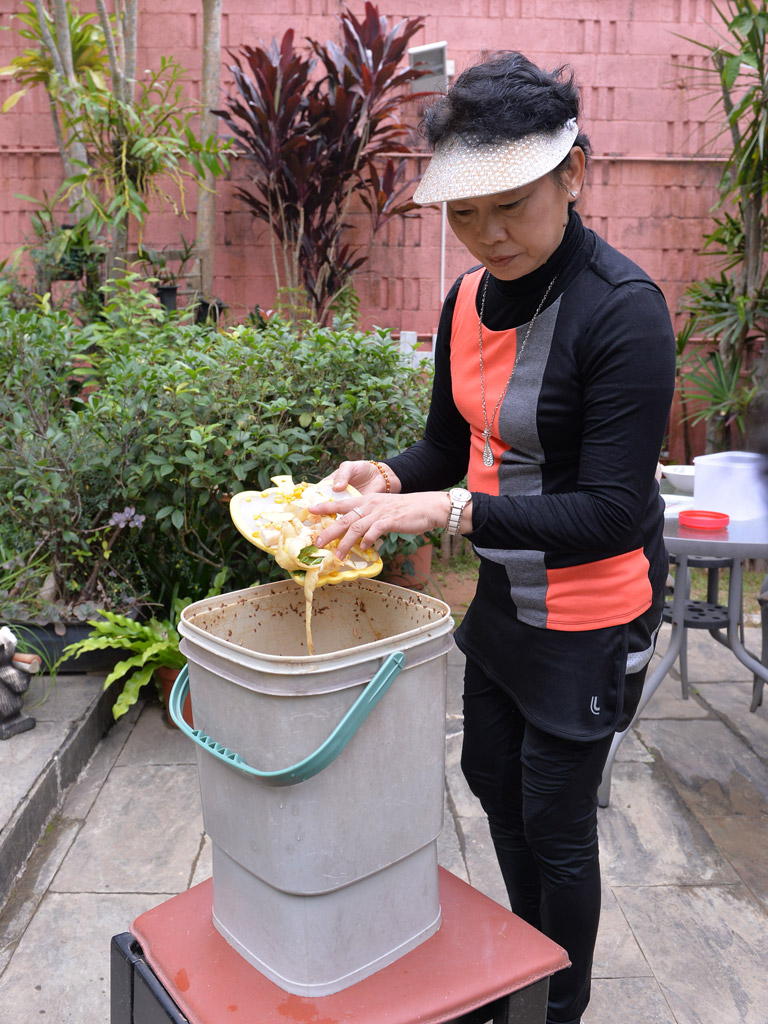
Green thumb:  Priscilla Wong bought her own food-waste recycling bin to turn household food waste into fertiliser for her vegetable garden, and indoor and outdoor plants.
Photo
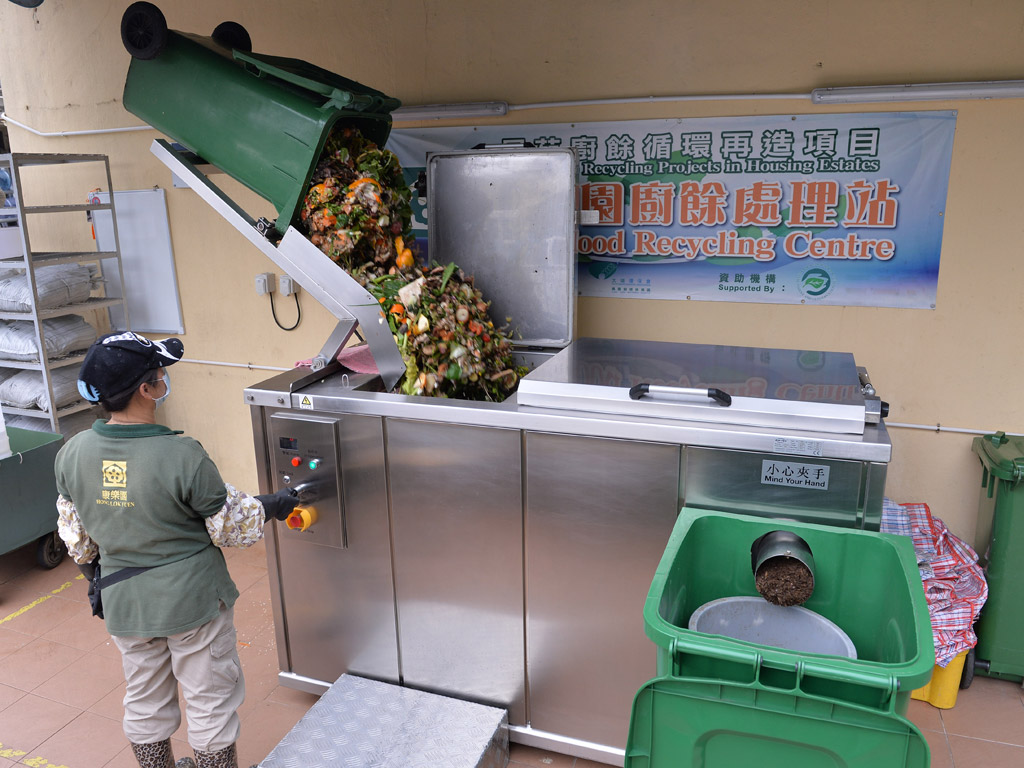
Landfill diversion:  The Environment & Conservation Fund offers subsidises to housing estates to set up food-waste treatment equipment and encourage households to reduce food waste
 
Ms Lam and her family were surprised when Greeners Action volunteers handed her a $50 supermarket voucher after they finished all their dishes.
“We are not big eaters, so we ordered three set meals for the four of us. This lets us share different dishes and not waste food,” Ms Lam said.
The campaign to curb food waste has already been held in Kwun Tong, Tsuen Wan and Tuen Mun. It has now begun in Wong Tai Sin and will last there for six months. Fifteen restaurants are participating, including fast food outlets, and Japanese, Chinese and buffet restaurants.

Lasting change
“We want to encourage people to change their habits,” Greeners Action executive director Angus Ho said.

“There are parties everywhere during Christmas and New Year. We want to remind people that our eyes are usually bigger than our stomach. We should order only what we need, not what we want, to reduce food waste.”

The participating restaurants have designated bins to collect food waste. The waste will then be transferred to the Kowloon Bay Pilot Composting Plant to be processed into fertiliser. Greeners Action expects about 100 tonnes of food waste will be diverted from landfills during the campaign period.

“I had no idea how to deal with the leftovers before we joined this program,” said Jimmy Chan, a manager of a participating Chinese restaurant.

“It makes sense to help reduce food waste. It’s easy, too, a habit. I will remind my colleagues to put the leftovers into the collection bins. They will get used to it.”

Home-based waste management
Food waste can also be collected on the home front. The Environment & Conservation Fund launched a food-waste recycling project scheme in housing estates  in July, 2011. Participating estates received subsidies to set up food-waste treatment equipment and to encourage households to reduce food waste.

Priscilla Wong lives in a participating estate in Tai Po, and joined the scheme when it launched. She separates her food waste from other rubbish every day, and puts it into a box the housing estate provided for its recycling.

Mrs Wong, an avid gardener, even bought her own food-waste recycling bin which sits in her back yard. She puts non-animal food waste into it, to turn it into fertiliser for her vegetable garden, and indoor and outdoor plants.

“This food waste was regarded as rubbish, but now it can be turned into something useful. I can also help reduce the burden on the landfills. It’s a meaningful measure,” Mrs Wong said.

Click here to learn more about the Food Wise Hong Kong Campaign, to see how you can contribute to reducing food-waste.

Wednesday, November 13, 2013

Publication: What Should Think Tanks Do? A Strategic Guide to Policy Impact (12 Nov 2013)

What People are Saying

"The chasm between good ideas and making policy has confounded Washington for too long. Andrew's concise and informed work builds a bridge to connect these two realms and maps the five steps to successfully walk across it. Whether an academic or a legislator, think tank or government staffer, if you care about turning good ideas into good policy, Andrew's book will guide you down the right path."—Barry Jackson, former senior advisor to President George W. Bush
"With its focus on outcome-oriented strategies, [What Should Think Tanks Do?] is essential for the directors and funders of think tanks, who want their institutions to make a real difference in informing and influencing public policy."—Paul Brest, Stanford University, former president, William and Flora Hewlett Foundation, and co-author, Money Well Spent: A Strategic Plan for Smart Philanthropy
"This interesting and thoughtful treatise offers practical advice that will help think tank directors better manage how their organizations engage in research, and how they communicate their findings to multiple target audiences. It should prove enormously helpful both to think tanks and to scholars who study these complex and increasingly visible organizations."—Don Abelson, The University of Western Ontario
"The policy world is filled with voices clamoring to be heard, but few organizations are consistently successful at getting the ear of policymakers and shaping the ideas that become part of public debate. This book shows how organizations that care about influencing policy can take a strategic approach to impact and deliver results."—Jane Harman, Director, President, and CEO of the Woodrow Wilson Center, former Member of Congress
"Selee has produced a highly practical guide to help think thinks improve their strategic planning, performance, and impact. In a highly competitive and information rich world, think tanks and other knowledge-based organizations must make strategic choices regarding staffing, technology, and engagement. What Should Think Tanks Do? provides the tools for effectively managing these complex challenges and choices."—James G. McGann, Director, Think Tanks and Civil Societies Program, University of Pennsylvania

Chapter List

Introduction: Ideas That Matter 
1. What Do You Want to Achieve?
2. What Do You Do That Makes a Unique Contribution?
3. Who Are Your Key Audiences and How Do You Reach Them? 
4. What Resources Do You Need and How Can You Develop Them? 
5. How Do You Evaluate Impact and Learn from Your Experience? 
Notes
Interviews
Selected Readings 

Wednesday, August 21, 2013

Publications: Phase VII IT Industry Investigative Report - Who is Polluting the Taihu Basin? published by IPE (1 Aug 2013)


Phase VII IT Industry Investigative Report - Who is Polluting the Taihu Basin?
Publisher: IPE    Date of Issue: 2013-08-01
Beijing, China – August 1st, 2013 – A number of environmental NGOs including, Lv Se Jiang Nan, The Institute of Public and Environmental Affairs, Friends of Nature, Envirofriends and Nature University jointly released a report titled “Who is Polluting the Taihu Basin?” The report looks at serious pollution problems in the tributaries and waterways of the Taihu Basin caused by companies discharging polluted wastewater, companies such as Foxconn, and HTC’s supplier Unimicron.
Phase VII IT Industry Investigative Report - Who is Polluting the Taihu Basin? - Press Release

Phase VII IT Industry Investigative Report - Who is Polluting the Taihu Basin? - Report

Phase VII IT Industry Investigative Report - Who is Polluting the Taihu Basin? - PPT (Chinese Only)

Phase VII IT Industry Investigative Report - Who is Polluting the Taihu Basin? - Video

Phase VII IT Industry Investigative Report - Who is Polluting the Taihu Basin? - Transcript fom the Press Conference (Chinese only)

Thursday, August 1, 2013

Malaysian Updates: Malaysian NGOs form alliance to address palm oil concerns (31 Jul 2013)

Malaysian NGOs form alliance to address palm oil concerns

Rhett A. Butler, mongabay.com
July 31, 2013


Seven Malaysia-based NGO's have banded together to form an alliance to provide a Malaysian civil society perspective on social and environmental issues related to palm oil production. The initiative aims in part to counter Malaysian industry claims that concerns over palm oil are purely driven by Western NGO's.

The alliance, called the Malaysian Palm Oil NGO Coalition (MPONGOC), currently includes the Borneo Rhino Alliance (BORA), Bornean Sun Bear Conservation Centre (BSBCC), Indigenous Peoples Network of Malaysia (JOAS), Land Empowerment Animals People, (LEAP), Malaysian Nature Society (MNS) Sabah branch, Partners of Community Organisations (PACOS) Trust and WWF Malaysia, according to a statement issued by the group.

"MPONGOC aims to influence land use policy and decision making, and is also working towards advocating consumer responsibility," said the group. "Strengthening implementation of best environmental management practices including enforcement of pollution regulations, building capacity for smallholder verification and best practices, supporting community-based organizations largely made up of indigenous people to engage with the industry on their own terms, and mainstreaming awareness on human wildlife conflict are other objectives."


Conversion of rainforest for oil palm plantations in Malaysian Borneo


The move is significant because much of the dialog around social and environmental issues related to palm oil production is shaped by international NGO's, most of which are based in Western Europe or the United States. Therefore it has been relatively easy for the palm oil industry to brush off criticism by claiming that it simply represents a new form of colonialism, whereby Western nations use NGO's as a proxy to protect domestic soy, corn, and rapeseed producers. The Malaysian palm oil industry has spent millions of dollars on marketing and public relations since 2007 attempting to advance that message.

Now that messaging will be undercut by local NGO's expressing their own viewpoints on issues like deforestation, pollution, and land-grabbing. Some of those views may not necessarily match up with those of international NGO's. To start, MPONGOC says it will "engage in constructive and on-going dialogue with the industry via the Malaysian Palm Oil Association (MPOA), Malaysian Palm Oil Board (MPOB) and the Malaysian Palm Oil Council (MPOC)", industry groups that have had limited direct engagement with Western NGOs.


Clearing of natural forest for oil palm plantations in Malaysian Borneo


MPONGOC says it will also engage with international NGO's, which could help bridge the gap in understanding between Western activist groups — some of which call for measures, like banning palm oil imports, that play directly into industry messaging — and Malaysian palm oil producers.

“We intend to engage with all parties, bring our collective voice, leadership, skills and experience to the table to deepen and expand dialogue between civil society, industry and government in the vital conversation of sustainability for all," said LEAP Executive Director Cynthia Ong in a statement.

"We see MPONGOC as being able to offer solutions by involving all stakeholders," added PACOS Trust Executive Director Anne Lasimbang, noting that some of the most vulnerable people — indigenous communities — have been largely ignored in the debate over palm oil.

WWF-Malaysia Executive Director Dionysius Sharma said that the initiative could help provide a path toward more sustainable palm oil production.

“We hope that through MPONGOC, the industry, regulators, financiers, buyers and other stakeholders could work collectively to develop and promote the adoption of environmentally appropriate, socially beneficial and economically viable practices in the oil palm industry," he said.


Orangutans have become a symbol for concerns about uncontrolled expansion of oil palm plantations into native forests.


Palm oil is the highest-yielding source of vegetable oil grown on a commercial basis. But the industry's expansion in recent decades has been a major driver of deforestation across Malaysia and Indonesia. Biologists have thus called the crop the "single most immediate threat to the greatest number of species".

Source: http://news.mongabay.com/2013/0731-MPONGOC-palm-oil.html

Sunday, July 21, 2013

Events: “Challenges and Solutions to Plastic Recycling in Hong Kong” organized by FoE (HK) on 25 Jul 2013

Friends of the Earth (HK) 香港地球之友 - Hong Kong, Hong Kong

活動名稱:塑膠回收討論會
開始日期:2013/07/25開始時間:18:30
結束日期:2013/07/25結束時間:20:00
地點:Friends of the Earth (HK) Office


近日,有關廢物棄罝之問題在社會引起激烈討論,有見及此,地球之友將
於2013年7月25日下午6時30分於本會會址就有關塑膠回收及廢物議題進行討論。

當日討論議程如下:
6:30 pm    背景簡介
6:45 pm    塑膠回收所面對的挑戰 (講者:楠豐國際有限公司林贇睿小姐)
7:30 pm    討論/問答環節
8:00 pm    討論會結束
(**討論會將以英語進行)


地址:香港北角屈臣道2號海景大廈A座13樓1301-02室

有與趣參加的朋友請電郵至foehk@foe.org.hk留位;名額有限,先到先得。


是次活動主要是提供一個平台予地球之友的會員、員工及其他有興趣人仕進行討論,並了解更多有關廢物管理相關的議題;活動講者所提供的資料並不代表香港地球之友的立場。請自備水杯或水瓶以享用我們提供的熱茶或熱水。


香港地球之友

*有關討論會及講者的詳細資料,請參閱電郵下半部份 (只有英文)


Come and hear Ms Stephanie Lam share her personal thoughts on the topic of “Challenges and Solutions to Plastic Recycling in Hong Kong”. 

One of the most controversial topics in Hong Kong today is WASTE DISPOSAL.  Spending $HK35m on a study by people that have not found a solution in the past 20 years is not a solution.  Throwing money at a problem does not achieve anything other than creating another report, which will join the dusty archives of previous reports.  This problem cannot be resolved by people with limited experience in this industry.  Do you know how other major countries deal with the problem of waste disposal and in particular the scrap plastic waste disposal?  A major part of the solution is recycling, via technology, marketing, logistics, management and common sense.  Can it be done?,  100% Yes!  Can we come up with a solution for HK? 

Stephanie Lam, BBA, HKU (Accounting & Finance) is the Managing Director of the global broking trading house for plastic recyclables, UNM International Ltd.  To ensure success Stephanie inspects all suppliers and customer operations personally, prior to entering into business transactions and has inspected more than 100 of these operations around the world.  It often includes walking among piles of smelly plastic scrap, but knowing that the product can be recycled and made into a renewable product and not discarded into landfill or incinerated to add more carbon into the atmosphere, Stephanie finds it rewarding and fulfilling.  She has thus dedicated her business career to achieve waste reduction..

Sunday, July 7, 2013

Events: Water Seminar II: Less is More organized by Civic Exchange on 30 Jul 2013

Water Seminar II: Less is More


Civic Exchange is organising “Water Seminar II: Less is More” on 30 July 2013. Ms. Su Liu (Head of Greater China & Water Policy Research, Civic Exchange) will present her new research findings examining water issues under one country two systems. Renowned speakers will then lead us to discussions on Hong Kong’s water price, water self-sufficiency and urban ecological security, as well as Civil society’s role in Hong Kong’s water issues.


Details:
Date: 30 July 2013 (Tuesday)
Time: 2:00 – 6:00pm
Venue: The Boys’ & Girls’ Clubs Association of Hong Kong
Address: Room 502, Lecture Hall, 3 Lockhart Road, Wanchai, Hong Kong
Language: English
Registration: This event is free of charge but registration is needed.

For more information: http://www.civic-exchange.org/wp/130730waterseminar/#more-18263

Friday, February 1, 2013

Indian Updates: India, US join hands to tackle illegal wildlife trade (29 Jan 2013)


India, US join hands to tackle illegal wildlife trade


NEW DELHI: India and the US have decided to join hands to tackle illegal wildlife trade, which involves billions of dollars annually.

US and Indian government officials, representatives of NGOs, wildlife lawyers and enforcement officials today discussed some of their challenges and successes in combating wildlife trafficking in the roundtable organised by the US Embassy and WWF/TRAFFIC India — two global organisations engaged in wildlife related issues — here.

"The United States and India have worked together on wildlife conservation for over 25 years. We will continue to work together to combat poaching, manage our wildlife resources, improve enforcement capacity, and reduce consumer demand for illegal wildlife products," said a joint statement issued after the meeting.

Co-chairing a panel discussion on Illegal Trade in Wildlife with WWF-India CEO and secretary general Ravi Singh, US under secretary of state for economic growth, energy, and environment, Robert D Hormats, emphasised the need for high-level political will, public outreach, and greater international coordination and cooperation to combat wildlife trafficking.

He was also of the opinion that regional enforcement networks such as the South Asia Wildlife Enforcement Network (SAWEN) should be strengthened to deal with the problem.

Singh noted the intimate link between the decline of India's wildlife species, and alarming trends in illegal wildlife trafficking.

"It is imperative that issues of illegal wildlife trade should be taken up in a strategic manner, linking national agencies and senior government executives. Here, the US government can be an important partner on global wildlife intelligence, networking and sharing of best practices in enforcement," he said.

According to the WWF-India, illegal wildlife trade is estimated at USD 10-20 billion annually, and is among the largest sources of illegal trade.

Source:
http://timesofindia.indiatimes.com/home/environment/flora-fauna/India-US-join-hands-to-tackle-illegal-wildlife-trade/articleshow/18242281.cms

Wednesday, December 5, 2012

Updates: Greenpeace, Guide to Greener Electronics (Nov 2012)

Guide to Greener Electronics


#1 wipro 

WIPRO 7.1/10

Wipro, an Indian electronics company that has previously participated in Indian editions of the Guide, makes its debut in the international version of Greenpeace’s Guide to Greener Electronics with 7.1 points – placing it in 1st position. 
Download Wipro report card
#2 hp 

HP 5.7/10

HP is still above most companies on the ranking, but has lost its top spot from the most recent edition of the Greenpeace Guide to Greener Electronics, and now sits in 2nd position, with 5.7 points, behind newcomer Wipro. 
Download HP report card
#3 nokia 

NOKIA 5.4/10

Nokia moves up to 3rd position in this edition of the Greenpeace Guide to Greener Electronics. After three years at 1st position, Nokia fell to 3rd in last year’s edition. 
Download Nokia report card
#4 ACER 

ACER 5.1/10

Acer moves up the ranking to 4th position, with a score of 5.1. Acer is showing a larger leadership role in its conversations with suppliers on a range of issues. This has resulted in increase scoring across the three criteria. 
Download Acer report card
#5 DELL 

DELL 4.6/10

Dell drops to 5th position, with 4.6 points. While Dell scores high overall, the company scores poorly on all Products criteria. 
Download Dell report card
#6 APPLE 

APPLE 4.5/10

Apple drops to 6th position, with a score of 4.6. Though one of the high scorers in this edition, Apple misses out on points for lack of transparency. 
Download Apple report card
#7 SAMSUNG 

SAMSUNG 4.2/10

Samsung moves up to 7th position, with 4.2 points in this year’s Greenpeace Guide to Greener Electronics. Samsung is close to achieving a revised goal of eliminating some of the most hazardous substances from its products.
Download Samsung report card
#8 SONY 

SONY 4.1/10

Sony moves up to 8th position, with 4.1 points. Sony was a top scorer in last year’s Guide; it has lost significant points for not continuing its energy policy advocacy work for tougher greenhouse gas (GHG) reduction targets. 
Download Sony report card
#9 LENOVO 

LENOVO 3.9/10

Lenovo drops to 9th place in this edition of the Guide. Lenovo made progress since the last Guide, but did not reach its extended goal of eliminating these chemicals from all its products by the end of 2011. 
Download Lenovo report card
#10 PHILIPS 

PHILIPS 3.8/10

Philips moves down to 10th position in the Greenpeace Guide to Greener Electronics, with 3.8 points. 
Download Philips report card


For more ranks and information: http://www.greenpeace.org/international/en/campaigns/climate-change/cool-it/Campaign-analysis/Guide-to-Greener-Electronics/

Wednesday, July 18, 2012

Risks and Opportunities of NGOs in China and Taiwan, 24 July 2012, Hong Kong


Risks and Opportunities of NGOs in China and Taiwan

Introduction

Symposium on Next Step to a Better Future
Date:
24 Jul 2012
Time:
10:30 - 12:45
Venue: Social Sciences Chamber, 11/F, The Jockey Club Tower, The University of Hong Kong
Speaker:
Dr Helen Liu
Assistant Professor
Department of Politics and Public Administration, The University of Hong Kong
Professor Xiong Yuegen
Professor
Department of Sociology, Peking University
Moderator:
Professor Cecilia Chan
Associate Dean of Faculty of Social Sciences and Director of the ExCEL3 Project
The University of Hong Kong
About the Symposium:
The relaxation of government control on the civil society has resulted in rapid development of non-governmental organizations (NGOs) both in Taiwan and China. This Symposium will provide a discussion forum on the contemporary risks and opportunities ahead of the NGOs in these communities.
Details and registration: : click here

Wednesday, November 16, 2011

Symposium on Capacity Building for the NGO Sector


Date: Monday November 21, 2011
Time: 2:30 - 6:00pm

Venue: Council Chamber, 8/F, Meng Wah Complex, The University of Hong Kong, Pokfulam Road, Hong Kong

Speakers:
Professor Kirsten A Grønbjerg
Efroymson Chair in Philanthropy, Center on Philanthropy
School of Public & Environmental Affairs, Indiana University
Social Impact Assessment - Organizational and Community Dimensions

Professor Leslie Lenkowsky
Clinical Professor of Public Affairs and Philanthropic Studies
School of Public & Environmental Affairs, Indiana University
The Business of Charity

Professor H Brinton Milward
Providence Service Corporation Chair in Public Management
School of Government & Public Policy, The University of Arizona
Governance and Capacity Building in the Nonprofit Sector

Professor Dennis R Young
Bernard B and Eugenia A Ramsey Chair of Private Enterprise
Andrew Young School of Policy Studies, Georgia State University
Educating Social Entrepreneurs and Encouraging Social Innovation

Moderators:
Professor Lam Wai FungDepartment of Politics and Public Administration, HKU
Dr Eliza LeeCentre for Civil Society and Governance, HKU

Programme: click here

Registration: click here

Enquiries: floluk@hku.hk