Showing posts with label global. Show all posts

Monday, October 21, 2013

Event: On the Path to 2050 Exciting Possibilities to Address a High Challenging Future in the Global Provision of Water to Planet Earth (25 Oct 2013)


On the Path to 2050: Exciting Possibilities to Address a High Challenging Future in the Global Provision of Water to Planet Earth
Mr. Paul Reiter
Former Executive Director of International Water Association
Principal in ReiterIWS 
Date:25 October 2013, Friday
Time:11:00 am – 12:00 noon
Venue:Room 2504 (Lift 25/26)
The Hong Kong University of Science and Technology, Clearwater Bay, Kowloon

Abstract
Until recently, the world continued to use water as though it was unlimited resource. In the last decade, there has been a real awakening to the looming scarcity of freshwater in all continents. For example, according to the ADB, Asia will be facing a 40% scarcity of water by 2030. Solving this problem of scarcity has to begin by using water more efficiently, but that will be alone will not fill the gap. Reuse of grey water, sea water flushing systems, desalination will all contribute to more urban water. Changing the scale of networks and treatment in urban neighborhoods will greatly enhance the water and energy efficiency related to water use, networks and treatment. Finally, large scale exchanges between urban areas and outlying agricultural areas offer win-win options for the use of new water in agriculture.


Sunday, August 25, 2013

Events: Global Energy Essay Contest 2013 organized by global energy initiative (deadline: 28 Oct 2013)

The University of Hong Kong

Sustainability@HKU


Global Energy Essay Contest 2013


Global Energy Essay Contest 2013

Introduction

"A Vision for The Decade (2014-2024) of Sustainable Energy for All"
Date:
28 Oct 2013
The Global Energy Essay Contest provides an exciting opportunity for college and university students around the world to engage in critical  thinking and present their ideas and solutions to tackle the key energy issues that humanity faces today.
Eligibility
The essay contest is open to all students from across the world that   are currently enrolled in university working towards a degree program   (e.g. B.A., B.S., M.A., M.S, M.B.A, M.Ed., Ph.D., etc) to take part in  the contest.
Essay Topic
The United Nations General Assembly unanimously declared  201402024 as the Decade of Sustainable Energy for All, underscoring the importance of energy issues for sustainable development and for the elaboration of the post-2015 development agenda.
Taking inspiration from this, we would like students to share their thoughts on the declaration through this year?s essay topic:
"A Vision for The Decade (2014-2024) of Sustainable Energy for All"
Prizes
The First and Second place winners will receive an invitation to the Global Energy Conference at the United Nations from December 11-12, 2013. The First place winner will also have a speaking opportunity during the award presentation ceremony. Airfare and accommodation to New York will be covered. The top ten finalists will receive  certificates from Global Energy Initiative.
The deadline for submission is October 28, 2013. Prize winners will be announced on November 8, 2013.

Visit our website http://globalenergyinitiative.org/ for more details.

For more information:

Sunday, August 18, 2013

New Books: A Global Environmental Right By Stephen J. Turner (16 Aug 2013)

A Global Environmental Right

By Stephen J. Turner

Routledge – 2014 – 208 pages
Descriptions:
The development of an international substantive environmental right on a global level has long been a contested issue. To a limited extent environmental rights have developed in a fragmented way through different legal regimes. This book examines the potential for the development of a global environmental right that would create legal duties for all types of decision-makers and provide the bedrock for a new system of international environmental governance.
Taking a problem solving approach, the book seeks to demonstrate how straightforward and logical changes to the existing global legal architecture would address some of the fundamental root causes of environmental degradation. It puts forward a draft global environmental right that would integrate duties for both state and non-state actors within reformed systems of environmental governance and a rational framework for business and industry to adhere to in order that those systems could be made operational. It also examines the failures of the existing international climate change regime and explains how the draft global environmental right could remedy existing deficits.
This innovative and interdisciplinary book will be of great interest to policy-makers, students and researchers in international environmental law, climate change, environmental politics and global environmental governance as well as those studying the WTO, international trade law, human rights law, constitutional law and corporate law.
Contents:
  1. Introduction 
  2. The state of degradation of the planet’s environment, the impact upon human rights and the current status of the development of environmental rights 
  3. The Global Legal Architecture and its effect on International Environmental Governance 
  4. A Global Environmental Right - Draft with Commentary 
  5. The Application of a Global Environmental Right to Climate Change 
  6. Conclusion

Thursday, August 1, 2013

Events: IN BEIJING: Global Choke Point: Water-Energy-Food Confrontations in the World’s Two Largest Economies organized by the Wilson Center on 7 Aug 2013

Events

IN BEIJING: Global Choke Point: Water-Energy-Food Confrontations in the World’s Two Largest Economies

August 07, 2013 // 2:00pm — 4:30pm


NOTE: This meeting will be held in Beijing
LOCATION: Room 127, Leo KoGuan Building, Peking University School of Government - Beijing, China
Three colliding trends — declining freshwater reserves, uncertain grain supplies, and booming energy demand — are disrupting economies, governments, and environments around the world. Unlike food or energy, we cannot grow or easily produce more water. That is especially true in the era of climate change, when deeper droughts and terrible floods tighten the food and energy choke points are already caused by waste, pollution, and mismanagement of water.
These complex challenges demand integrated analyses and innovative solutions. For three years research teams from the Woodrow Wilson Center and Circle of Blue have been reporting from the United States, China, Australia, India, and the other frontlines of the world’s water-food-energy crisis. In our Choke Point: China reports we were the first to find that China's northern desert provinces, which supply 70 percent of the nation's coal and 20 percent of its grain, would run out of water by the end of this decade if conventional farm and energy production practices did not change. Our Choke Point: U.S. work is examining some of the risks of energy development in the United States, like shale gas boom, which uses significant amounts of water and are developing in both important grain-growing states and some of the nation's driest regions.
Building on our Choke Point research in the United States and China, the Wilson Center’s China Environment Forum partnered with the Beijing-based Greenovation Hub to organize a diverse group of U.S. and Chinese experts into a China Water-Energy Team (China WET). The team is holding roundtable discussions in Beijing the week of August 5, 2013 with the goal of gathering information and data to identify research, legal, policy, and NGO priorities for China to begin dealing with water-energy confrontations and to explore opportunities for further U.S.-China cooperation on these issues.
At this workshop at Beijing University our Chinese and U.S. China WET members will be joined by Dr. Paolo Farah to delve into the water-energy challenges facing China and the United States, looking at risks and opportunities to build resilience to deal with these growing natural resource confrontations.
 
Event Documents: 
BACK TO TOP
 
Event Sessions: 
  • Short keynote: Global Choke Point
  • Keith Schneider, Circle of Blue

Panel 1: Water-Energy Confrontations in the United States
  • Vince Tidwell, Sandia National Laboratory
  • Pam Bush, Delaware River Basin Commission 
  • Q&A

Panel 2: Solving China’s Water-Energy Nexus Challenges
  • Jia Shaofeng, Institute for Geographic Sciences and Natural Resources Research—
  • Sun Qingwei, Greenpeace China
  • Yang Fuqiang, Natural Resources Defense Council
  • Q &A

Panel 3: Climate Change, Energy Security and Water Wrap Up Panel

Sunday, July 28, 2013

Forests: Near real-time deforestation monitoring system to go global (25 Jul 2013)

mongabay.com logo

Near real-time deforestation monitoring system to go global

Rhett A. Butler, mongabay.com
July 25, 2013


A near real-time deforestation monitoring system will soon cover all the world's tropical forests, report the researchers behind the initiative.

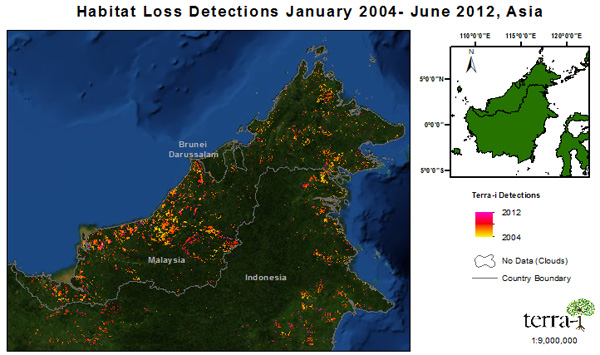
Terra-i — a collaborative project between Colombia's International Center for Tropical Agriculture (CIAT), the Nature Conservancy (TNC), the School of Business and Engineering (HEIG-VD) in Switzerland, and King’s College London — has been testing its system in tropical Asia, extending its reach beyond its stronghold in Central and South America. Terra-i uses data from NASA's satellite-based MODIS sensors to assess changes in forest cover at a 250-meter resolution every 16 days. The system is similar to the near real-time deforestation tracking system used in Brazil by the government and Imazon, a local NGO.

"We can now provide near real time data on land cover change in Latin America and we expect to be producing pan-tropical results over the next few months," Louis Reymondin, a researcher at CIAT, told mongabay.com. "Since this is the first continental scale system on operation and the first to work outside of the Brazilian Amazon, this allows a similar level of reporting and understanding of land cover change for other countries as Brazil has had in place for some time."

The system detects deforestation based on changes in "greenness" in natural vegetation. It normalizes seasonal vegetation response to rainfall to reduce false positives. The data is then mapped and made available for download viawww.terra-i.org. For Latin America, data is available at the national level and by protected area, ecosystem, and state or municipality.


Deforestation in Borneo 2004-2012, according to Terra-i


Reymondin says Terra-i has applications beyond serving as a deforestation alert system.

"Terra-i has a range of applications, such as: monitoring the effectiveness of conservation; assessing the impact on the environment of the construction of new infrastructure like roads; assessing the contribution of deforestation to climate change and understanding the likely impacts of deforestation on downstream and downhill populations."

Terra-i isn't the only near real-time deforestation alert system under development. The World Resources Institute (WRI) is putting the final touches on Global Forest Watch, a tool that will also track deforestation on a bi-weekly basis, while offering layers like plantation concession maps as well as providing a mechanism for users to share photos and reports from the field.

Source: http://news.mongabay.com/2013/0725-terra-i-deforestation-tracking-system.html

Saturday, July 6, 2013

Updates: Over 700 species added to the threatened categories on the IUCN Red List (photos) Jeremy Hance (3 Jul 2013)

Over 700 species added to the threatened categories on the IUCN Red List (photos)

Jeremy Hance

July 02, 2013


In another sign of the global biodiversity crisis, the IUCN Red List has added 715 species to its threatened categories of Vulnerable, Endangered, and Critically Endangered in this year's update. Some of these species were evaluated by the IUCN Red List for the first time while others saw their conditions deteriorate, such as the the white-lipped peccary (Tayassu pecari) which is now listed as Vulnerable due to overhunting, deforestation, and possibly disease. As of this year, the Red List has evaluated 70,923 of the world's species—including almost all mammals, birds, and amphibians—of which 20,934 are deemed threatened.

"The overall picture is alarming. We must use this knowledge to its fullest—making our conservation efforts well targeted and efficient—if we are serious about stopping the extinction crisis that continues to threaten all life on Earth," says Jane Smart, Global Director of the IUCN Biodiversity Conservation Group.

This year's list includes an update of the world's conifers, the first total re-evaluation of this plant family since 1998. According to the update, 34 percent of the world's conifers are now threatened with extinction, up from 30 percent. For example, both California’s Monterey pine (Pinus radiata) and the Atlas cedar (Cedrus atlantica) fell from Least Concern to Endangered; in all 33 conifer species saw their status fall. On the other hand, Lawson's cypress (Chamaecyparis lawsoniana) moved from Endangered to Near Threatened due to active conservation efforts.

"Conservation works and the results for the Lawson’s cypress are reassuring," noted Aljos Farjon, Chair of the IUCN SSC Conifer Specialist Group. "However, this is clearly not enough. More research into the status and distribution of many species is urgently needed. We suspect that there are many new species waiting to be described but it is likely that they will never be found due to the rate of deforestation and habitat conversion for oil palm plantations."

Oil palm plantations have driven deforestation across vast sections of Malaysia and Indonesia. The industry is now eyeing expansion in the forests of Africa and South America.

This year's update also included the first evaluation of the world's freshwater shrimp and marine cone snails. Scientists found that 28 percent of the world's freshwater shrimp species are imperiled, while 8 percent of the cone snails.

"The freshwater shrimp data further confirm what we know from analyses of other animal groups: freshwater species are among the most threatened with extinction due to the dams, channels, pollution, and introduced exotic species in those ecosystems," says Mary Klein, president and CEO of NatureServe.

Another family group that depends heavily on freshwater—amphibians—is arguably the most endangered vertebrate class on Earth. Currently the IUCN Red List considers 41 percent of the world's amphibians as threatened with extinction. Meanwhile, a quarter of the world's mammals face extinction and 13 percent of the world's birds, however too few of the world's reptiles and fish have been evaluated to make an accurate estimate.

Although the IUCN Red List has evaluated over 70,000 species since it's inception, that's only a drop in the bucket of the world's total described biodiversity: currently 1.7 million species have been described with around 20,000 new species named every year.In fact, some taxonomic groups remain almost completely unevaluated: only one mushroom has been evaluated to date out of an estimated 31,000 species. While some 4,000 insects have been evaluated, over a million have been described.

Three years ago prominent scientists, including E.O. Wilson, called for a new initiative to assess an additional 100,000 or so species in an effort to create what they dubbed "barometer of biodiversity." They estimated it would cost around $60 million dollars, but to date the initiative has not moved forward.

Lack of funds has hampered efforts across the board. It's estimated that between $7-10 billion is spent annually on biodiversity conservation worldwide, mostly going to managing protected areas.

"For comparison, annual spending on subsidies to agriculture in the US, European Union and Japan is about US $220 billion per year," reads a 2010 article in the IUCN World Conservation.

Scientists have been warning for decades that human beings are likely pushing the world into a mass extinction event with untold consequences for all, a warning that has only grown louder in light of worsening climate change, ocean acidification, and a human population that last year hit 7 billion. While the conservation plights of charismatic, big species get most of the media limelight, it's likely that hundreds of thousands of other species are at risk of vanishing, some of them perhaps not even described by science and most receiving no targeted attention from conservationists.

The white-lipped peccary (Tayassu pecari) is now listed as Vulnerable. Photo by: Geoff Gallice.
The white-lipped peccary (Tayassu pecari) is now listed as Vulnerable. Photo by:Geoff Gallice.


The giant river prawn (Macrobrachium rosenbergii) is listed as Least Concern. Photo by: Chris Lukhaup.


The Yangtze finless porpoise (Neophocaena asiaeorientalis asiaeorientalis) has fallen to Critically Endangered. Photo by: Xiaoqiang Wang.

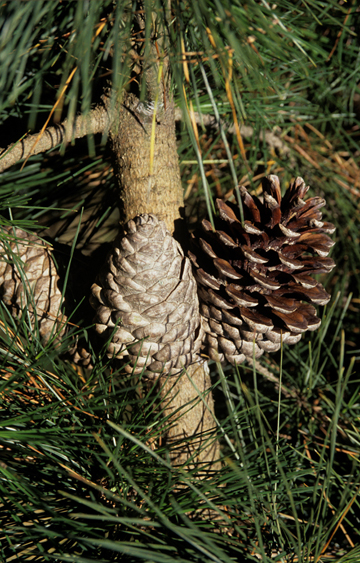
The Monterey Pine (Pinus radiata) is now listed as Endangered. Photo by: Aljos Farjon.

Source: 
http://news.mongabay.com/2013/0702-hance-iucn-update.html

Thursday, June 20, 2013

Indian Updates: Rise in global temperatures may impact monsoon, farm yields: Report (20 Jun 2013)

Rise in global temperatures may impact monsoon, farm yields: ReportRise in global temperatures may impact monsoon, farm yields: Report
TNN | Jun 20, 2013, 05.48 AM IST

NEW DELHI: An expected 2°C rise in the world's average temperatures in the next decades will make India's monsoon highly unpredictable and by 2040, the country will witness a sharp reduction in crop yields due to extreme heat, a report commissioned by the World Bank cautioned on Wednesday.

It said shifting rain patterns will leave some areas under water and others without enough water for power generation, irrigation or, in some cases, even drinking.

The report titled 'Turn Down the Heat: Climate Extremes, Regional Impacts and the Case for Resilience', examines the likely impacts of 2°C and 4°C warming on farm production, water resources, coastal ecosystems and cities across South Asia, sub-Saharan Africa, and Southeast Asia.

The new report warned that by the 2040s, reduced water availability due to changes in precipitation levels and falling groundwater tablesare likely to aggravate the situation in India, where groundwater resources are already at a critical level and about 15% of the country's groundwater tables are overexploited.

The report cited Kolkata and Mumbai along with Bangladesh as "potential impact hotspots" threatened by "extreme river floods, more intense tropical cyclones, rising sea levels and very high temperatures". With South Asia close to the equator, the sub-continent would see much higher rises in sea levels than higher latitudes, with the Maldives confronting the biggest increases of between 100-115 cm.

"Melting glaciers and loss of snow also pose a significant risk to stable and reliable water resources. Major rivers such as the Ganges, Indus and Brahmaputra depend significantly on snow and glacial melt water, which makes them susceptible to climate change-induced glacier melt and reductions in snowfall," the report said. It projected a rapid increase in the frequency of low snow years in the future, well before 2°C warming takes place and said this could increase the risk of flooding, threatening agriculture.

In India, more than 60% of the crop area is rain-fed, making it highly vulnerable to climate-induced changes in precipitation patterns. It is estimated that by the 2050s, with a temperature increase of 2°C-2.5°C compared to pre-industrial levels, water for agricultural production in the river basins of the Indus, Ganges and Brahmaputra will reduce further and may impact food adequacy for some 63 million people.

The report, prepared for the World Bank by the Potsdam Institute for Climate Impact Research and Climate Analytics and peer reviewed by 25 scientists worldwide, said the consequences for South Asia of a warming climate were even worse if global temperatures increased by an average of 4°C by 2090.

"In this scenario, seen as likely unless action is taken now to limit carbon emissions, South Asia would suffer more extreme droughts and floods, rising sea levels, melting glaciers, and declines in food production," the report said.

"In India, for example, an extreme wet monsoon that currently has a chance of occurring only once in 100 years is projected to occur every 10 years by the end of the century," it added.

The report also said many of the worst climate impacts could still be avoided by holding warming below 2°C, but the window for action was narrowing rapidly.

"Urgent action is needed to build resilience through climate-smart agriculture, flood defences, drought and heat resistant crops, improved groundwater management, better coastal infrastructure, and human health," the report said.

Source: 
http://timesofindia.indiatimes.com/home/environment/developmental-issues/Rise-in-global-temperatures-may-impact-monsoon-farm-yields-Report/articleshow/20674471.cms

Monday, April 29, 2013

Events: National Institute for Environmental Studies (NIES) Public Symposium 2013: A Borderless Global Environment – movement of atmosphere, life, water and natural resources organized by NIES on 14 Jun and 21 Jun 2013


National Institute for Environmental Studies (NIES) Public 
Symposium 2013: A Borderless Global Environment – movement of atmosphere, life, water and natural resources

April 19 (Friday), 2013
Public Relations Office, Planning Department, National Institute for
Environmental Studies
(Contact: 029-850-2453)
The National Institute for Environmental Studies (NIES) will hold their annual Public Symposium over two Fridays in June, with respective Tokyo and Kyoto chapters to coincide with Environment Month. The theme of this year’s Public Symposium is “A Borderless Global Environment – movement of atmosphere, life,water and natural resources”. We will introduce NIES research outcomes in the diverse fields of atmosphere, biology, water and natural resources as they relate to global environmental issues. Attendance is free.

1. Overview of the National Institute for Environmental Studies Public Symposium 2013

Main Theme: “A Borderless Global Environment – movement of atmosphere, life, water and natural resources”
Summary: Human society is defined by lines of demarcation such as national borders - however no such borders exist when it comes to the global environment. In addition, various movements in the natural world - such as the wind, the tides of the oceans, and the migration of birds across the skies, are now supplemented by activities associated with human society, such as the transit of aircraft and shipping, which define our modern world. The transport of a large range of substances accompanies this movement, and these substances in turn bring with them environmental issues which transcend national borders.
The National Institute for Environmental Studies (NIES) establishes the actual nature of the issues which accompant this transport of substances, and works towards finding their solutions, from a global viewpoint unconfined by manmade boundaries, while maintaining an awareness of temporal scales, in order to effectively foresee the future course of human society. At the NIES Public Symposium there will be five lectures relating to the global environment, and attendees will also have the opportunity to come face-to-face with NIES researchers engaged with such issues at the poster session (19 poster displays are planned).
The poster session will also report on the contributions of activities as part of “Research on Disaster Environment” undertaken at NIES in the immediate wake of the Great East Japan Earthquake. We at NIES are of the hope that our Public Symposium will be a chance to think together about the borderless global environment.

Dates, Times and Venues:

Tokyo Chapter: June 14 (Friday), 2013, 12:00-17:30, Mielparque Hall
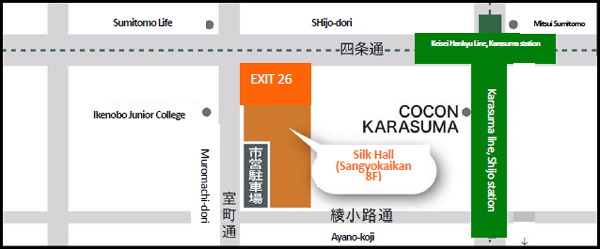
Kyoto Chapter: June 21 (Friday), 2013, 12:00-17:30, Silk Hall (Kyoto Sangyo Kaikan, 8F)

2. Program (Same for both Tokyo and Kyoto Chapters)

12:00-13:00Poster Session (19 poster displays)
13:00-Opening Address, NIES President SUMI, Akimasa
13:10-First Lecture: “Changes in global atmospheric carbon dioxide and methane and inference of causes as seen from the GHG observation satellite “IBUKI””, Tatsuya YOKOTA
13:50-Second Lecture: “Atmospheric substances around the globe: windborne causes of atmospheric pollution and climate change”, Seiji SUGATA
14:30-Third Lecture: “Ants around the globe – globalization and the issue of invasive alien species”, Koichi GOKA
15:10-15:25Break
15:25-Fourth Lecture: “Japan and the world connected by water – our lifestyles and the world’s water problems”, Naota HANASAKI
16:05-Fifth Lecture: “Environmental burdens accompanying the international supply chain and resource consumption”,Keisuke NANSAI
16:45Closing Remarks: Hideo HARASAWA, NIES Vice President
16:50-17:30Poster Session: * As per poster session from 12:00, but with additional participation of symposium speakers

Poster Session, Titles

  1. 1. Initiatives towards recovery and restoration from the Great East Japan Earthquake
  2. 2. Countermeasures for disaster and radioactively contaminated waste for Fukushima
  3. 3. Town planning for post-disaster regional recovery – environmental energy technologies and policy assessment tools
  4. 4. Japan Environment and Children’s Study – progress report for the nationwide survey on children’s health and the environment
  5. 5. Yellow sand from across the oceans and the health impacts of transboundary pollution
  6. 6. Study towards a toxicity evaluation method using cultured cells of suspended particulate matter
  7. 7. Particulate matter emissions from gasoline automobiles – compromises between improvement of fuel efficiency and atmospheric pollutants?
  8. 8. Short term changes in carbon dioxide concentrations in the upper atmosphere – CONTRAIL Project for atmospheric observation using commercial airlines
  9. 9. Observation of carbon dioxide concentrations in the atmosphere and ocean of the pacific
  10. 10. Impact of global warming on the Sea of Japan – extreme changes in maritime environments in the past 50 years
  11. 11. Migratory ecology of freshwater fish in the Mekong, the international waterway
  12. 12. Long-term trend monitoring of Persistent Organic Pollutants (POPs) in Japanese coastal areas – monitoring activities using bivalves
  13. 13. Monitoring study for gene recombinant rapeseed
  14. 14. Investigating the carcinogenic mechanism of inorganic arsenic
  15. 15. Improvement of household methanation devices for organic waste in the Asian region
  16. 16. Cobenefit waste water treatment technologies for environmental conservation and material cycles – appropriate treatment of molasses-based wastewater
  17. 17. Study for a new wastewater management method using bioresponse – using living organisms to test water
  18. 18. Roadmap for Asian Low Carbon Society – Ten actions toward Low Carbon Asia
  19. 19. Research on strategies for low carbon Asian cities – case study of the Iskandar Development Region, Malaysia

3. Dates, Times and Venues

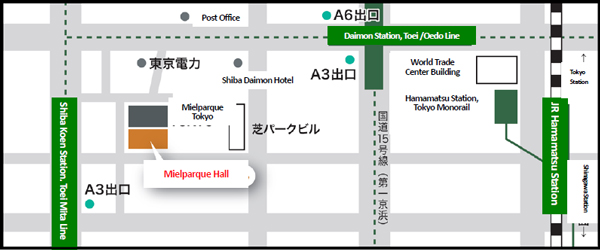
Tokyo Chapter: 12:00-17:30, June 14 (Friday), 2013, Mielparque Hall, 2-5-10, Shibakouen, Minato-ku, Tokyo 105-8582, Tel: 03-3433-7221
Access: 10 Minutes walk from JR Monorail Hamatsu Station / 2 minutes walk from Exit A3, Shibakoen Station, Toei Mita Line / 4 minutes walk from Exit A3 or A6, Daimon Station, Oedo Line
map1
Kyoto Chapter: 12:00-17:30, June 21 (Friday), 2013, Silk Hall, Kyoto Sangyo Kaikan 8F, Address: Moromachi-higashihairu, Shijou-dori, Karasumaru, Shimogyouku, Kyoto City, Tel: 075-211-8341
Access: 3 minutes walk from Exit 26, Toei subway, Karasumaru line, Shijou station / Hankyu Railways, Kyoto line, Karasumaru station
map2

4. Application Method

  1. (1) Official Symposium Site
    Register for either the Tokyo or Kyoto Chapters of the NIES Public Symposium at the following page: (http://www.nies.go.jp/sympo/2013/
    A confirmation mail will be automatically dispatched. Please print and bring this on the day for entrance to the NIES Public Symposium.
  2. (2) Mobile Symposium Site (http://www.nies.go.jp/sympo/2013/
    A confirmation mail will be automatically dispatched. Please print and bring this on the day for entrance to the NIES Public Symposium.
  3. (3) Postcard/Fax
    Please write your name/contact address/contact telephone number/Fax No./Email address, and whether you wish to participate in the Tokyo or Kyoto Chapters of the NIES Public Symposium on a postcard, or fax these details to the below address/Fax No.
* In order that we can accommodate numbers, we request that you complete the application process as soon as possible
** The symposium will be recorded for our records, and put on the NIES homepage at a future date. We ask for your understanding and cooperation

5. Contact

Administrative Office, National Institute for Environmental Studies (NIES) Public Symposium 2013 Stage Inc., Takamatsu 1-1-11, Toshima-ku, Tokyo (Attn: Sagawa, Inagaki, Kagami)
Tel.: 03-3958-5292 Fax: 03-5966-5773
E-mail: info_nies2013@stage.ac

Privacy Policy

  1. a) Any personal information submitted will be subject to the NIES security polcy and will not be used for any other purposes than those related to the Public Symposium
  2. b) Any such information is being submitted to the symposium hosts, the National Institute for Environmental Studies
  3. c) Applicants may be sent information on the next symposium. However the dispatch of such information can be cancelled immediately on request.

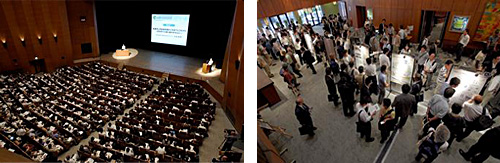
Below: Images from the NIES Public Symposium 2012

photo
For more information: http://www.nies.go.jp/whatsnew/2013/20130419/20130419-e.html

Thursday, March 21, 2013

Publication: 2012 Global food policy report prepared by IFPRI (20 Mar 2013)


2012 Global food policy report

Prepared by  International Food Policy Research Institute (IFPRI)


View full report


This flagship report by the International Food Policy Research Institute (IFPRI) examines the major food policy issues, developments and decisions of 2012. It reviews what happened in food policy and why, examines key challenges and opportunities, shares new evidence and knowledge, highlights emerging issues and suggests ways to improve food security for the poor. Issues considered in this volume include: trends in agricultural productivity and its implications for the global food supply; evolvement of the sustainable development agenda and how far behind is a green economy; integrating gender into agricultural and rural development; the possibility of the agricultural sector to offer meaningful jobs to young people in Africa; directions of the agricultural policies of the United States and the European Union, and how they differ; and different scenarios for how Brazil, China and India will influence global food security in the next 20 years or so.


For more information: 
http://www.eldis.org/go/display&type=Document&id=64819?utm_source=feedburner&utm_medium=feed&utm_campaign=Feed%3A+eldis-climate_change+%28Eldis+Climate+Change%29#.UUsOsxci4Vg

Events: EE Global 2013 - Energy Efficiency Global Forum from 20-21 May 2013


EE Global 2013 - Energy Efficiency Global Forum
Walter E. Washington Convention Center Washington, D.C., U.S.A. : 20 May 2013 - 21 May 2013


Background
EE Global 2013 is an invitation-only opportunity for energy efficiency’s influencers to convene from around the world for the robust debate, partnership-building, and idea-sharing needed to drive energy efficiency to scale. Join us in Washington, D.C. at the Walter E. Washington Convention Center on May 20 & 21 as we integrate effective policies and business practices to create actionable plans for the next generation of energy efficiency.


Objectives
Delegates will tackle pressing issues alongside senior energy officials, business executives, efficiency advocates and academic experts who will serve as thought leaders and conversation starters. From broad-vision plenary to intensive learning sessions, EE Global offers over 25 platforms for answering timely questions, including:
  • What is the role of energy efficiency as we adapt to a future of climate uncertainties?
  • How do you become the most energy-efficient economy in the world?
  • Is net-zero energy a “right” and achievable goal?
  • How do you unleash investment in EE technology development?

Target participants
Energy efficiency professionals from every sector of the industry, and every discipline. Previous forums have been evenly split among government, business and NGO participants.


Contacts
Alexandra Straub
astraub@ase.org
Tel: 202-530-2251

For more information:
http://eeglobalforum.org/about/welcome

Saturday, March 9, 2013

Events: Seventh Regional EST Forum in Asia and Global Consultation on Sustainable Transport in the post 2015 Development Agenda in Bali, Indonesia on 23-25 Apr

Clean Air Initiative

Seventh Regional EST Forum in Asia and Global Consultation on Sustainable Transport in the post 2015 Development Agenda


23-25 Apr 2013
The integrated event of Seventh Regional EST Forum in Asia and Global Consultation on Sustainable Transport in the post 2015 Development Agenda will be held on 23-25 April 2013 in Bali, Indonesia. The Regional EST Forum, under the theme of “Next Generation Transport System We Want for 21st Century~ Looking Beyond Rio+20”, will provide an ample opportunities not only to discuss and share the progress and achievements made by the countries towards achieving the goals under the Bangkok 2020 Declarations but also to address EST in the context of the Rio+20 Outcomes - The Future We Want.
The Seventh EST Forum is expected to address a number of areas such as
  • EST in the Context of Rio+20 Outcome - The Future We Want, and the post 2015 global development agenda being prepared by UN Secretary General Ban Ki-moon
  • Non-Motorized Transport (NMT), road safety and social equity
  • Promotion of Public Bicycle Schemes
  • Full Integration of Public Transport Modes
  • Intelligent Transport System: A Vision of 21st Century Cities
  • Regional connectivity (intra-region, rural-urban linkage, etc.) for sustainable development
  • Building resilient transport infrastructure and services through EST Measures
  • Financing Needs of Next Generation Sustainable Transport Systems for 21st Century
  • Institutional Arrangements in Realizing Next Generation Sustainable Transport Systems for 21st Century
  • Contribution of Railways towards realizing EST and sustainable development in the post Rio+20 development
  • The contribution towards realizing EST in Asia by the Rio+20 $ 175 billion voluntary commitment for more sustainable transport by eight multilateral development banks as well as other voluntary commitments on sustainable transport
  • Greenways initiative for converting road space into leaner parks and high quality pedestrian areas
  • Discussion on a Regional Agreement on Green freight in Asia, etc.
    Supporting Organizations and Partners:
    • United Nations Department of Economic and Social Affairs (UN DESA)
    • World Health Organization (WHO)
    • Asian Development Bank (ADB)
    • Clean Air Asia
    • Dutch Cycling Embassy
    • EMBARQ (The World Resources Institute’s Center for Sustainable Transport)
    • German International Cooperation (GIZ)
    • Institute for Transportation and Development Policy (ITDP)
    • The Korean Transport Institute (KOTI)
    • Nagoya Institute of Technology (NIT)
    • Nagoya University
    • Partnership on Sustainable, Low Carbon Transport (SLoCaT)
    • International Union of Railways (UIC)
    • International Association of Public Transport (UITP)
    • United Nations Economic and Social Commission for Asia and the Pacific (UN ESCAP)
    • United Nations Human Settlement Programme (UN HABITAT)

Thursday, February 21, 2013

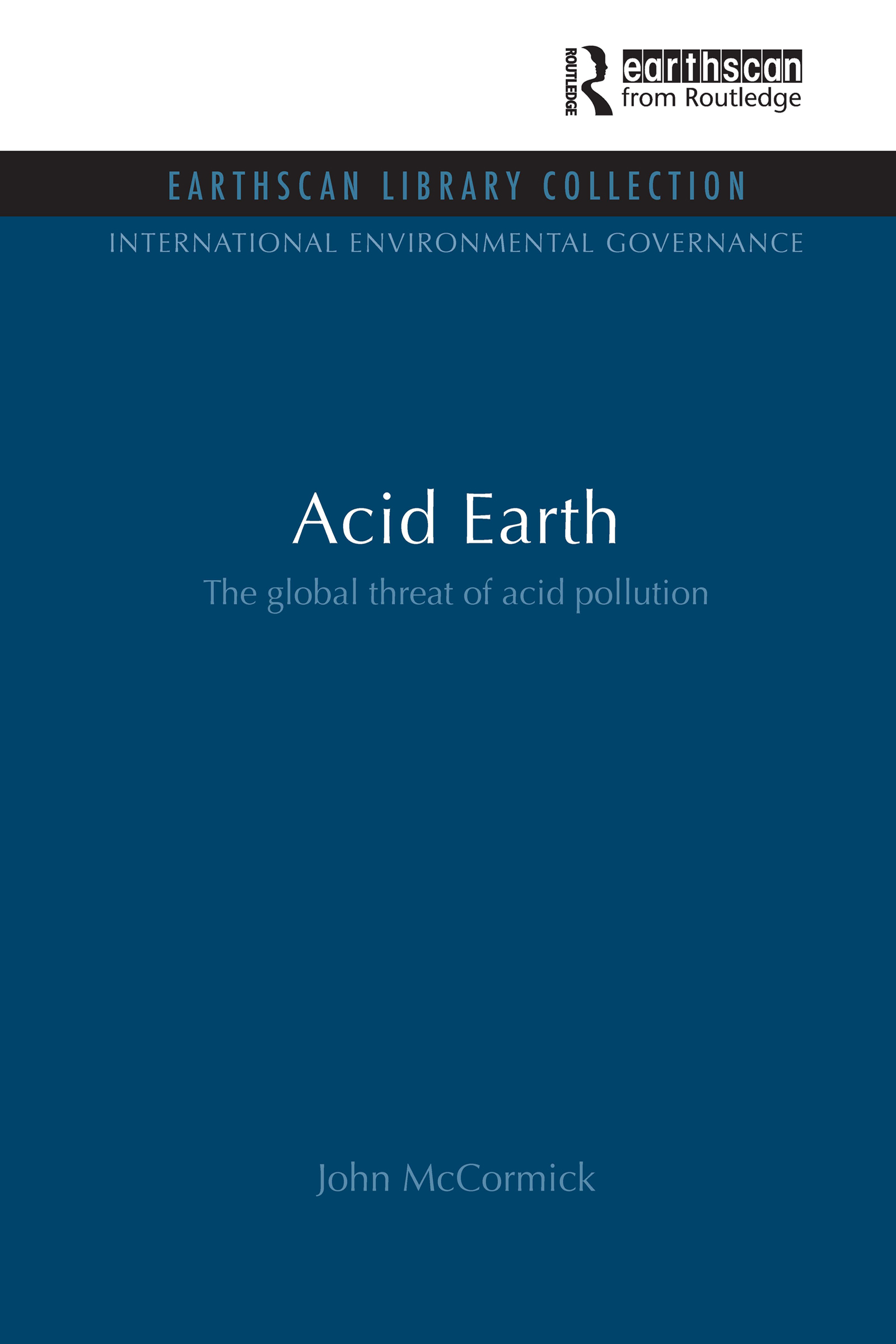
New Books: Acid Earth The Global Threat of Acid Pollution, 2nd Edition By John McCormick (14 Feb 2013)


Acid Earth

The Global Threat of Acid Pollution, 2nd Edition

By John McCormick

Published 14th February 2013 by Routledge – 242 pages
Description: 
Acid rain was one of the major environmental issues of the 1980s. But while industrialized countries have taken measures to reduce the emissions that lead to acidification, the problems have not gone away. Trees are still dying, lakes are still being made uninhabitable; buildings are still corroding; and human health is still suffering. The most worrying trend is the repetition in the industrializing countries of Asia and Latin America of the problems that have long afflicted Europe and North America. More than 10 years after it was first published, the highly acclaimed Acid Earth still provides the only global view of acidification, and remains the standard text on the subject. Chapters on the causes, effects and growing scientific understanding of acid pollution, and the possible solutions, are followed by detailed studies of the political struggles involved in responding to acid damage in western and eastern Europe, the US and the newly industrializing countries. Written in non-technical language for people interested in the problems of the environment, Acid Earth calls for a renewed sense of public and political will to bring the problems of acid pollution under control. The book also makes valuable reading for specialists and students. Originally published in 1992.
Contents:
List of Illustrations Acronyms and Abbreviations Acknowledgements Introduction 
Part I The Dimensions of Acidification
1. Acid Emissions
2. Acid Damage
3. Acid Controls
4. Acid Politics 
Part I1 National and Regional Experiences
5. Britain
6. The European Union
7. Russia and Eastern Europe 
8. North America
9. The Newly Industrializing Countries Conclusions Notes Index